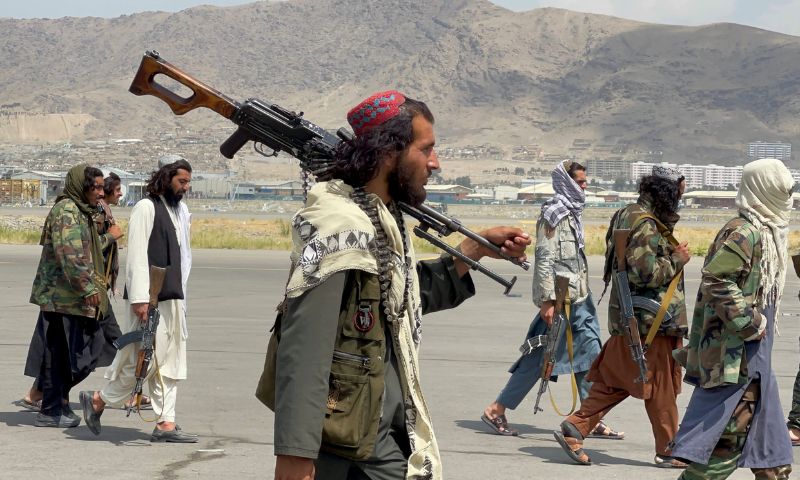



MOSCOW: Between 20,000 and 23,000 fighters affiliated with various international terrorist groups are currently operating in the Taliban-ruled Afghanistan, more than half of them foreign nationals, Russia’s Foreign Ministry has said.
The Russian Foreign Ministry, in a statement, said the fighters belong to various terrorist organisations and continue to pose “serious security and political challenges” for Afghanistan and the wider region.
Among the largest groups, the ministry said, are Islamic State Khorasan Province (ISKP), with around 3,000 fighters; Tehreek-e-Taliban Pakistan (TTP), with between 5,000 and 7,000 fighters; and al-Qaeda, whose strength is estimated at between 400 and 1,500 fighters.
Smaller factions operating in Afghanistan include the East Turkestan Islamic Movement (ETIM), the Islamic Movement of Uzbekistan — also known as the Turkestan Islamic Party — and Jamaat Ansarullah, according to the Russian ministry.
Russian officials said ISKP, also known as Daesh, remains the only terror group openly hostile to Afghanistan’s current Taliban regime.
However, they assessed that the terror group lacks the capability to seize or hold territory and instead focuses on attacks aimed at undermining public confidence and stability.
UN report flags terrorist presence
International concern over terrorist activity in Afghanistan has also been highlighted in reporting by The Diplomat magazine, citing findings from the United Nations Analytical Support and Sanctions Monitoring Team.
According to the UN report referenced by the magazine, the Taliban authorities continue to allow al-Qaeda and affiliated groups, including the TTP, to operate inside Afghanistan.
The monitoring team described al-Qaeda as a “service provider” to other terrorist organisations.
It said the terror group maintains religious schools in eastern and north-eastern provinces, where ideology is instilled in children and recruits receive training.
The report estimated that around 6,000 TTP fighters are based in Afghanistan.
It said the TTP carried out more than 600 attacks in Pakistan in 2025, mainly targeting military and government sites, causing dozens of deaths and injuries.
The UN team also assessed that ISKP remains resilient and poses a threat beyond Afghanistan’s borders.
Pakistan targets terrorist sanctuaries
Meanwhile, Pakistan’s Minister for Parliamentary Affairs, Dr Tariq Fazal Chaudhry, told the Senate on Monday that the Pakistan Air Force (PAF) had conducted a series of “precise, retaliatory” air strikes inside Afghanistan, targeting terrorist sanctuaries.
He said more than 100 terrorists were killed in an intelligence-based operation.
The strikes targeted terrorist hideouts and training facilities of the “Fitna al-Khawarij”, a term it uses for the banned Tehreek-e-Taliban Pakistan (TTP) terrorist group.
Minister Chaudhry said the operation was a direct response to the interim Afghan government’s failure to prevent Afghan territory from being used to launch terror attacks against Pakistan.
“The operation was a necessity, not a choice,” he told the upper house of parliament.
He said Pakistan had repeatedly shared “irrefutable, credible evidence” with Kabul regarding the presence of terrorist groups planning attacks from Afghan soil.
Security sources said the strikes targeted camps in eastern Afghanistan, particularly in Khost, Nangarhar, Paktika and Kunar provinces.
Pakistan’s Ministry of Information and Broadcasting said seven terrorist hideouts linked to the TTP and ISKP were struck in Nangarhar, Paktika and Khost provinces.
The Information Ministry described the operation as a “limited, proportionate and retributive response” to recent suicide bombings in Islamabad, Bajaur and Bannu during the holy month of Ramadan.
ALSO READ: Afghan Taliban Restrict Media Access to Areas Targeted by Pakistani Strikes
The ministry said the pre-dawn strikes precisely targeted terrorist infrastructure along the Pakistan-Afghanistan border with accuracy.
Pakistan rejected Afghan claims of civilian casualties and said the action was based on intelligence-led targeting of terrorist camps.
Local residents cited by regional media said Taliban forces restricted media and civilian access to areas hit by the Pakistani strikes.
The South Asia Times reported that Afghan authorities blocked local media and civilians from entering the targeted areas.
Pakistan has long accused the Afghan Taliban of allowing anti-Pakistan terrorist groups to operate from Afghan territory.