


Key points
- Police in IIOJK launched a granular survey targeting all local mosques.
- The Modi administration is demanding biometric Aadhaar numbers from mosque imams.
- Authorities are collecting IMEI hardware numbers to track religious leaders’ phones.
- Forms require detailed personal and social media data of religious functionaries.
- The survey maps mosques by sectarian affiliations like Deobandi or Barelvi.
- The move follows the 2019 revocation of Kashmir’s semi-autonomous status.
- International observers link the survey to a decade of Muslim marginalisation.
ISLAMABAD: A comprehensive police survey targeting mosques across the Muslim-majority Illegally Indian-Occupied Jammu and Kashmir (IIOJK) has ignited widespread anxiety among residents and religious leaders, who view the exercise as a blatant attempt by the Indian government to regulate and intimidate religious life in the region.
Granular data collection
According to a report by TRT World, local police units have been circulating multi-page structured questionnaires to mosque management committees throughout January 2026. While the forms begin with routine questions regarding denominations and funding, they quickly delve into highly sensitive personal data.
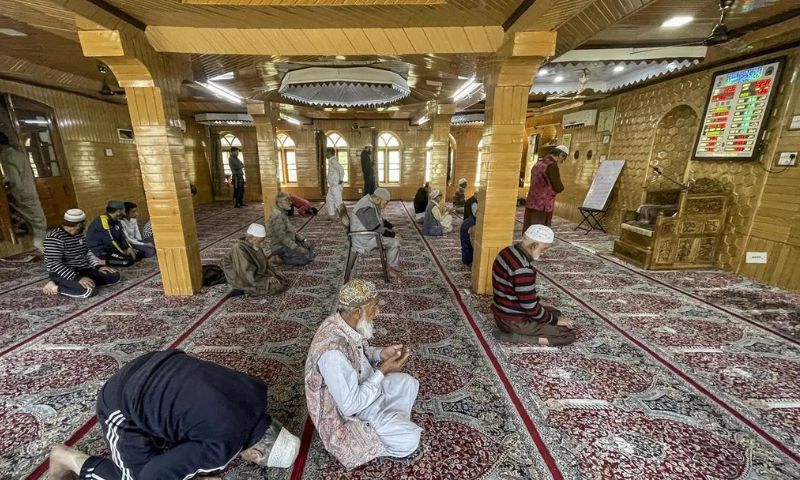
The administration is demanding the ‘Aadhaar’ — a 12-digit unique identification number issued by the Government of India to its residents — biometric identity numbers of prayer leader (imams) and muezzins — officials at a mosque responsible for delivering the Azaan (call to prayer) — along with the IMEI numbers of their mobile phones and detailed personal information about their families. Further inquiries include the mosque’s sectarian affiliation (such as Barelvi, Deobandi, or Ahle-Hadith, etc), bank account details, and the social media activity of religious functionaries.
A climate of fear
For many in Srinagar and beyond, the survey feels less like an administrative task and more like the state stepping into one of the last remaining sacred spaces. “Religion teaches us to speak truth, but when you know your phone number and Aadhaar are on record, silence feels safer,” one south Kashmir imam told TRT World.
The highhandedness of the approach is reflected in the unease of ordinary volunteers — teachers, engineers, and shopkeepers who serve on mosque committees — who now fear the data collection could affect their jobs or passports. Abdul Rashid, a 65-year-old worshipper, noted that such intrusive measures were never seen even during the most volatile years of the conflict.
Political and religious backlash
The Muttahida Majlis-e-Ulema (MMU) — an umbrella body of Islamic organisations — has condemned the survey as “unprecedented and invasive,” warning that it violates the right to privacy and religious freedom guaranteed by the Indian Constitution.
Political figures have also weighed in on the administration’s “iron-fisted” approach:
Aga Syed Ruhullah, Member of the Indian Parliament, stated that the survey risks turning religious practice into a regulated activity, noting that when preachers are profiled, “sermons will change… because of fear.”
A spokesperson for the Awami Ittehad Party (AIP) described the profiling as “nothing less than intimidation,” accusing the administration of criminalising normal religious life.
Context of control
This latest move is being viewed as part of a larger “reordering of power” in Kashmir since the 2019 revocation of the region’s autonomous status. Critics argue that by institutionalising surveillance within the pulpit, the Modi administration is moving beyond physical checkpoints to establish a permanent regime of “mental surveillance.”
As one cleric quietly summarised to TRT World: “They have not shut our mosques. They have entered our minds.”
The plight of minorities under Modi
The mosque survey in Kashmir is seen by international observers as the latest chapter in a broader, decade-long campaign of systematic marginalisation of religious minorities — particularly Muslims — under the Bharatiya Janata Party (BJP) government.
Human rights organisations and international commissions have documented several alarming trends that have made life increasingly precarious for India’s 200 million Muslims.
The Indian authorities have increasingly used extrajudicial demolitions of Muslim homes, businesses, and places of worship as a form of “collective punishment” following protests or communal tensions. Between 2020 and 2022 alone, thousands of properties, mostly belonging to Muslims, were demolished.
Simultaneously, the implementation of the Citizenship Amendment Act (CAA) and the proposed National Register of Citizens (NRC) are viewed as tools to disenfranchise and potentially expel Muslim residents.
Indian Prime Minister Modi and senior BJP officials used inflammatory rhetoric, including referring to Muslims as “infiltrators” during election campaigns. This environment has fueled a 97 per cent rise in hate speech and empowered “cow vigilantes”.
The Indian government has also facilitated the construction of Hindu temples on the sites of historic mosques, such as the Ram temple in Ayodhya, while introducing the Waqf Amendment Bill to erode Muslim community autonomy over their own religious endowments.
International Condemnation
For six consecutive years, the US Commission on International Religious Freedom (USCIRF) has recommended designating India as a “Country of Particular Concern” (CPC) due to “systematic, ongoing, and egregious violations” of religious freedom.