


GENEVA: The United Nations warned on Tuesday that tens of millions more people could face acute hunger if the ongoing Middle East conflict continues, pushing global food insecurity to unprecedented levels.
“If the Middle East conflict continues through June, an additional 45 million people could be pushed into acute hunger by price rises,” said Carl Skau, deputy executive director of the World Food Programme (WFP), at a press briefing in Geneva.
“This would take global hunger levels to an all-time record, and it’s a terrible, terrible prospect,” he added.
The warning comes as 319 million people worldwide are already facing acute food insecurity, the highest level on record.
Supply chains under strain
The conflict, triggered by US and Israeli strikes on Iran on February 28 and Tehran’s subsequent retaliation, has disrupted global supply chains and driven up costs for humanitarian operations.
Skau said shipping costs have risen by 18 percent since the war began, while longer routes and higher fuel prices have compounded operational challenges.
“Our supply chains may really be on the brink of the most severe disruption since COVID and the Ukraine war back in 2022,” he said.
He warned that rising costs mean the WFP can deliver less assistance. “We can buy less food or provide less cash to beneficiaries,” he said.
The consequences of the conflict in the Middle East are falling on people who do not have the margins to cope.
WFP's @CarlSkau explains how the price of fuel, fertilizers and supply chain disruptions could lead to a spike in global hunger. ⤵️ pic.twitter.com/fbiMjpCwxV
— World Food Programme (@WFP) March 17, 2026
The agency is already facing deep funding cuts as donor priorities shift towards defence spending, forcing reductions in aid programmes.
Fertiliser and fuel concerns
The disruption has also affected global fertiliser markets, with around a quarter of supplies passing through the Strait of Hormuz — a key maritime route now effectively at a standstill.
Skau said the timing was critical as sub-Saharan Africa enters its planting season, raising fears of further food shortages.
He added that rising food and fuel prices could leave millions unable to afford basic staples, particularly in import-dependent regions across Africa and Asia.
Gaza crisis deepens
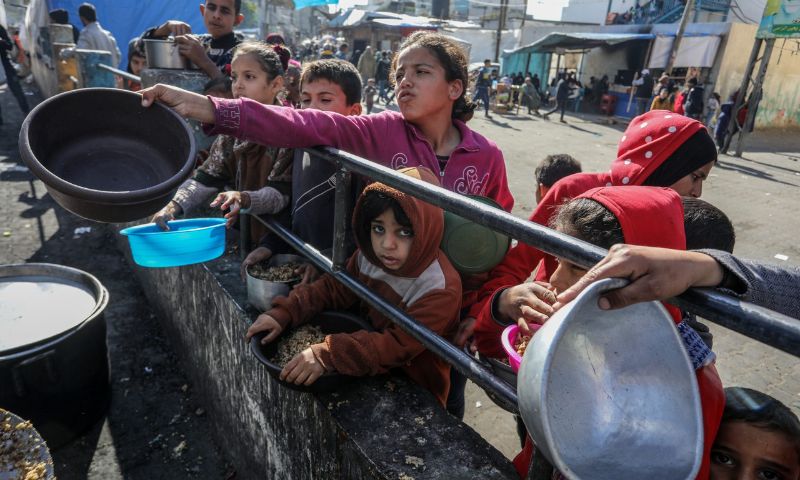
The humanitarian situation in Gaza continues to deteriorate amid the broader regional conflict.
Residents are scrambling to stockpile essential goods as supplies dwindle following border closures. Israel is expected to partially reopen the Rafah crossing with Egypt after a two-week shutdown that has worsened shortages.
According to the World Health Organization, only around 200 aid trucks are currently entering Gaza daily, far below the estimated requirement of 600.
The crossing was closed on the same day US and Israeli strikes on Iran began, with Israel citing security concerns.
Sudan and Afghanistan under pressure
Beyond Gaza, existing hunger crises are intensifying.
In Sudan, more than 21 million people — nearly half the population — face acute hunger. Famine has already been confirmed in some areas after months of conflict restricted aid access.
The UN has warned that funding shortfalls could halt assistance within months unless additional pledges are secured.
The WFP is also struggling in Afghanistan, where it can support only one in four acutely malnourished children, despite the country facing the world’s worst malnutrition crisis.
Lebanon displacement rises
In Lebanon, the conflict has triggered mass displacement and disrupted aid flows.
The UN’s humanitarian coordinator in the country, Imran Riza, said around 132,700 people are sheltering in 622 sites, while the total number displaced could exceed one million.
“Almost 20 per cent of the population has been displaced — and it’s going to continue,” he said.
Air traffic disruptions have halted aid deliveries from Gulf countries, which had previously provided significant support.
Riza added that around 70 per cent of displaced people are outside formal shelters, complicating relief efforts.
UN Secretary-General António Guterres urged an immediate end to the conflict, calling for adherence to international law and implementation of relevant Security Council resolutions.
“The war in the Middle East must stop,” he said in a statement issued by his office in New York.