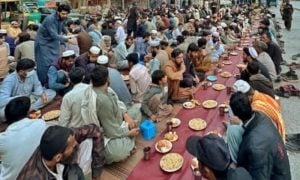
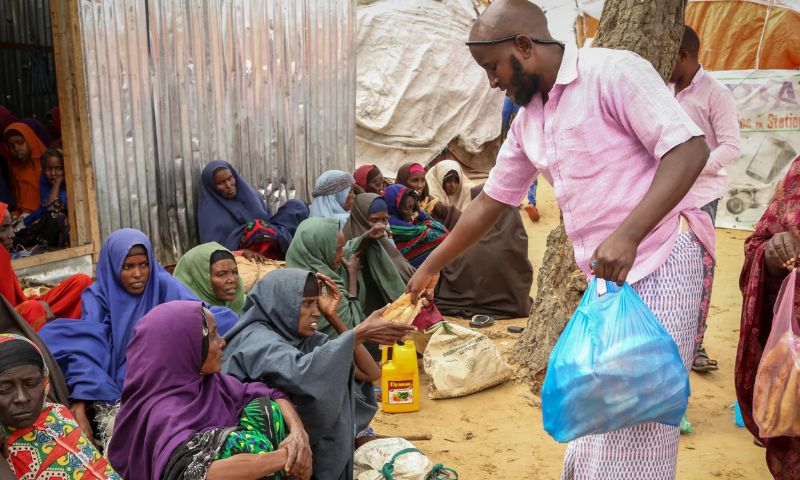



GENEVA: The United Nations on Friday warned that around 55 million people in west and central Africa are facing an acute food shortage this year, with people already starving in Borno state of Nigeria.
Violence across the region has sparked a hunger crisis, which is being worsened by cuts to humanitarian aid, the UN’s World Food Programme (WFP) has said.
The agency said it has been forced to reduce food assistance as funding runs low.
In West and Central Africa, “a staggering 55 million people will face acute food insecurity during the upcoming lean season from June to August 2026,” Jean-Martin Bauer, WFP’s director of food security and nutrition analysis, told reporters in Geneva.
🆘 A staggering 55 million people are at risk of crisis levels of hunger, or worse, across West and Central Africa this year.
A new analysis warns that reductions in humanitarian assistance are now pushing communities beyond their ability to cope. https://t.co/YrkGbLkzVF pic.twitter.com/apZ8SFv7Ld
— World Food Programme (@WFP) January 16, 2026
These individuals are classified in the crisis, emergency, and catastrophe phases of hunger — the three most severe levels in WFP’s five-tier food insecurity scale.
Bauer noted that the number of people in emergency conditions has doubled since 2020, reaching three million. In addition, 15,000 people in parts of Borno state, northeastern Nigeria, are now in the catastrophe phase — the first time this level has been recorded in a decade.
“This is a group that’s one step away from famine,” Bauer said, speaking from WFP’s headquarters in Rome. “That does mean that people are dying… people are starving.”
The latest analysis from the Cadre Harmonisé – the equivalent of the Integrated Food Security Phase Classification (IPC) for West and Central Africa – also projects that over three million people will face emergency levels of food insecurity (Phase 4) this year – more than double the 1.5 million in 2020. Four countries – Nigeria, Chad, Cameroon, and Niger- account for 77 percent of the food insecurity figures.
“Vital humanitarian aid is a transformative and stabilising force in volatile contexts,” said Sarah Longford, Deputy Regional Director for West and Central Africa.
“The reduced funding we saw in 2025 has deepened hunger and malnutrition across the region. As needs outpace funding, so too does the risk of young people falling into desperation. It’s critical that we support communities in crisis, so that rampant hunger doesn’t drive further unrest, displacement and conflict across the region,” she said.