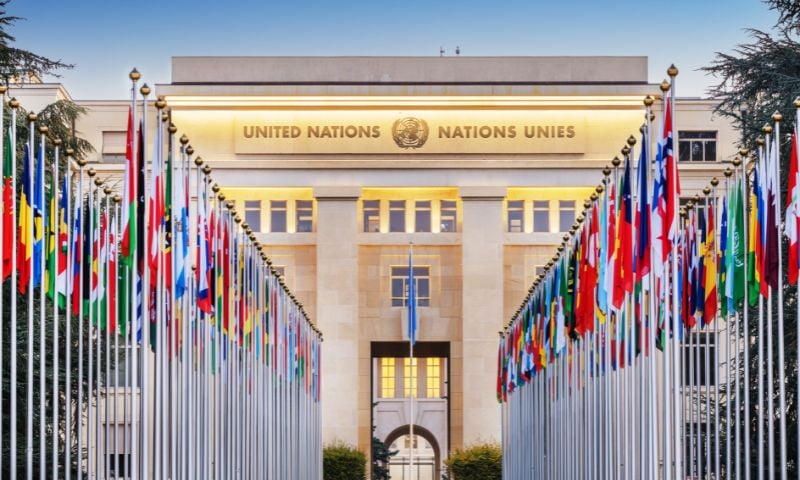
NEW YORK: Signatories to the landmark Nuclear Non-Proliferation Treaty (NPT) will convene at the United Nations on Monday, as prospects for consensus diminish and tensions between nuclear-armed states intensify.
At the previous review conference in 2022, United Nations Secretary-General António Guterres warned that humanity stood “one misunderstanding, one miscalculation away from nuclear annihilation.”
The global security environment has deteriorated further since then, reports AFP.
“I think there is a shared, if you will, sense of crisis by all states parties,” said Izumi Nakamitsu, United Nations High Representative for Disarmament Affairs.
“We don’t have any bilateral arms control agreements between the two largest nuclear weapon states,” she added, referring to the expiration in February of the New START treaty between the United States and Russia.
“We are also beginning to see a quantitative increase in nuclear capabilities in all nuclear-weapon states.”
Nakamitsu said mounting geopolitical tensions had effectively halted the post-Cold War trajectory of nuclear disarmament.
The NPT, signed by nearly all countries worldwide — with notable exceptions including India, Pakistan, and Israel — aims to prevent the spread of nuclear weapons, promote disarmament, and facilitate cooperation on civilian nuclear technology.
According to the Stockholm International Peace Research Institute (SIPRI), the world’s nine nuclear-armed states — the United States, Russia, China, France, the United Kingdom, India, Pakistan, Israel, and North Korea — possessed a combined 12,241 nuclear warheads as of January 2025.
The United States and Russia together account for nearly 90 per cent of the global arsenal and have both undertaken extensive modernisation programmes in recent years, SIPRI said.
China has also expanded its stockpile rapidly, prompting concern among the Group of Seven (G7) nations over growing nuclear capabilities in both Beijing and Moscow.
US President Donald Trump has signalled a willingness to resume nuclear testing, stating that “other countries are doing it too.”
In March, French President Emmanuel Macron announced a shift in nuclear deterrence policy, including an expansion of France’s arsenal, currently estimated at 290 warheads.
Risk of Breakdown
“It is obvious that trust is eroding, both inside and outside the NPT,” said Seth Sheldon of the International Campaign to Abolish Nuclear Weapons (ICAN), a Nobel Peace Prize-winning organisation.
Decisions at NPT review conferences require consensus, with the past two meetings failing to adopt final declarations.
In 2015, disagreement centred on a proposed nuclear-weapon-free zone in the Middle East, opposed by the United States, a close ally of Israel.
In 2022, divisions were driven largely by Russian objections to references to Ukraine’s Zaporizhzhia nuclear power plant, which is under Moscow’s control.
This year’s summit faces multiple potential fault lines, including the war in Ukraine, tensions surrounding Iran’s nuclear programme, proliferation concerns among non-nuclear states, and North Korea’s expanding arsenal.
Christopher King, secretary-general of the conference, warned that a third consecutive failure could have long-term consequences.
The treaty “might not implode overnight,” he said, but cautioned that “over time, [it could] unravel.”
Artificial intelligence is also expected to feature prominently in discussions, with some states advocating for firm guarantees that human control is maintained over nuclear weapons systems.