


Key Points
- UNSC to assess evolving threat from Islamic State terrorist network
- Africa is identified as the hardest-hit region with expanding affiliate control
- Approximately 3,000 fighters are estimated across Syria and Iraq
- ISIS-K is described as retaining a potent operational capability
- Afghanistan flagged over the risk of transnational attacks
ISLAMABAD: The United Nations Security Council is set to meet later today to assess the growing threat posed by the Islamic State terrorist group, a transnational terrorist organisation responsible for large-scale attacks across the Middle East, Africa, Asia, and beyond.
The group is commonly known by the acronym ISIS, often interpreted as the “Islamic State in Iraq and Syria.”
At the same time, the UN uses the term ISIL, or “Islamic State in Iraq and the Levant,” reflecting the original Arabic name.
The organisation itself now refers simply to the “Islamic State,” a term widely used by journalists in describing its global operations.
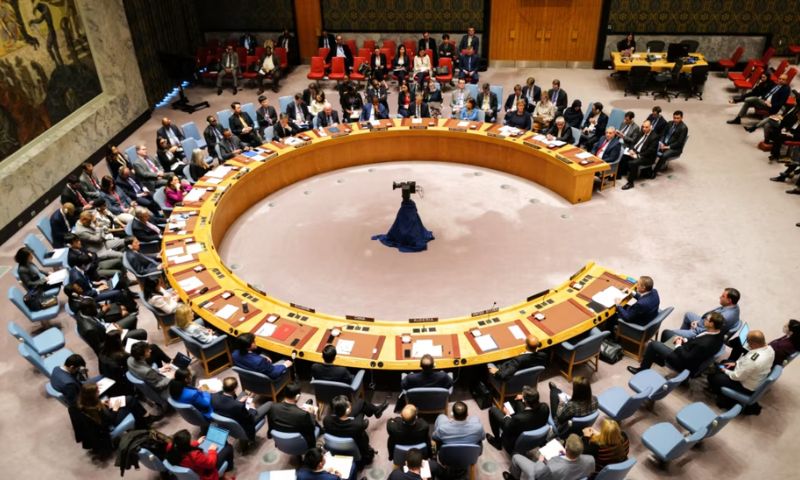
The meeting will include briefings on the Secretary-General’s 22nd biannual strategic report, which notes that the group has intensified activities across multiple regions since August 2025.
The report warns that the network exploits armed conflict, political instability, and weak governance, posing ongoing threats to international peace, security, human rights, and development.
Africa is highlighted as the most serious theatre, where Islamic State affiliates have expanded in West Africa and the Sahel, driving mass displacement, civilian casualties, and disruptions to humanitarian aid.
In the Middle East, the group remains active in Syria and Iraq, maintaining an estimated 3,000 fighters and seeking to inflame sectarian tensions.
Overcrowded detention camps in northeastern Syria holding captured fighters and their families are flagged as potential sites for further radicalisation.
Council members are expected to reiterate condemnation of the organisation and stress the need for coordinated international responses. Differences persist on how to balance security measures with human rights and international law.
Senior UN officials are also likely to warn that the group is increasingly using digital currencies, artificial intelligence tools, and uncrewed aircraft systems to finance and support its operations.
Afghanistan is singled out in the report, which warns that the group’s regional affiliate, Islamic State Khorasan Province (ISIS-K), remains a potent threat with regional and international ambitions.
According to the Secretary-General, ISIS-K operates in northern Afghanistan and near the Pakistan border, maintaining “potent operational capability.”
The affiliate carried out a January 19 attack in Kabul that killed six Afghans and one Chinese national, prompting condemnation from the Security Council.
The findings reveal continuing concern among council members about Afghanistan’s security trajectory.
They also underlined the potential for the country to serve as a base for transnational attacks, even as international attention remains divided among several conflict zones.
The meeting will be chaired by UK Parliamentary Under-Secretary of State Chris Elmore and will feature briefings from senior UN counter-terrorism officials.