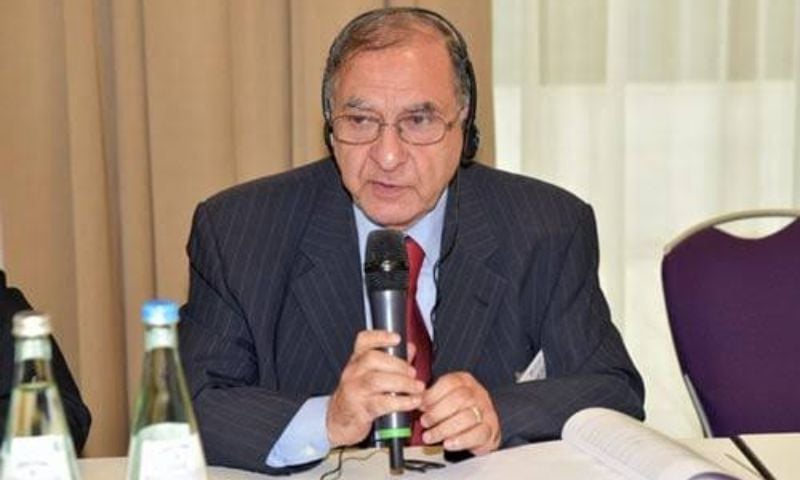
NITED NATIONS: The United Nations (UN) must move beyond speeches and demonstrate that its principles are applied equally to powerful and weaker states if it wants to restore public trust in the international system, Dr Ghulam Nabi Fai, chairman of the World Forum for Peace and Justice, has said.
In an article, Dr Fai said recent statements by senior UN officials on the need to uphold the UN Charter, international law and human rights raised questions about the organisation’s follow-up to its own findings and recommendations on Kashmir.
He referred to the 2018 report by the Office of the UN High Commissioner for Human Rights (OHCHR) on the human rights situation in Indian Illegally Occupied Jammu and Kashmir (IIOJK).
According to Dr Fai, the report documented violations including excessive use of force, arbitrary detention, restrictions on freedom of expression and assembly, torture and other abuses in IIOJK.
He said the report had also recommended that the Human Rights Council consider establishing a commission of inquiry to conduct a comprehensive, independent international investigation into human rights violations in IIOJK.
The report also called on India to respond to outstanding requests by UN special procedures, including the Working Group on Enforced or Involuntary Disappearances, and to facilitate their visits, he said.
“Where is the follow-up?” Dr Fai asked, arguing that the UN should explain what had happened to recommendations contained in its own human rights report.
His remarks came as the 81st session of the UN General Assembly opened under its new president, Bangladesh’s Ambassador Khalilur Rahman, whose stated theme is “Restoring trust, managing transformation: a United Nations that delivers for all”.
Dr Fai said the theme represented a significant challenge for the organisation, arguing that trust could not be restored merely through declarations but had to be earned through consistent action.
He also cited recent statements by UN Secretary-General António Guterres and UN High Commissioner for Human Rights Volker Türk on the importance of international law, human rights and the UN Charter.
Dr Fai said the organisation should apply the same standards when dealing with unresolved conflicts and human rights concerns, including IIOJK.
Referring to the General Assembly’s September 4 adoption of the “Correct the Map” resolution, he said the episode illustrated the broader difficulties facing multilateralism. The resolution, which concerns distortions in conventional world map projections, was adopted by 164 votes to one, with six abstentions.
India voted in favour but subsequently reiterated that its position on Jammu and Kashmir and Ladakh remained unchanged, Dr Fai noted.
He acknowledged that the resolution was concerned with cartographic representation rather than territorial sovereignty, but said the episode nevertheless raised questions about how member states interpret and apply UN decisions.
Dr Fai also recalled that India took the Kashmir dispute to the United Nations in 1948 and referred to statements attributed to India’s first prime minister, Jawaharlal Nehru, concerning a peaceful settlement and the role of the people of Kashmir.
He said the Jammu and Kashmir issue should be resolved in accordance with relevant UN Security Council resolutions and the wishes/right to self-determination of the Kashmiri people through a free and impartial plebiscite.
READ ALSO: Daily Murder of Justice in Kashmir by India
He argued that the historical record should be viewed in the context of the need for peaceful and credible mechanisms to address unresolved disputes rather than allowing them to develop into new crises.
Highlighting the risks posed by tensions between India and Pakistan, both nuclear-armed states, Dr Fai said the international community should focus on preventive diplomacy, dialogue and credible international fact-finding rather than waiting for another military confrontation.
He urged the UN to take its own human rights reports seriously, encourage governments to cooperate with UN human rights mechanisms and openly address cases where recommendations are rejected or remain unimplemented.
Dr Fai said the new General Assembly president could support such efforts without prejudging the final political status of Jammu and Kashmir or replacing the role of the parties and relevant UN bodies.
He said Ambassador Rahman’s call for a UN that “delivers for all” offered an opportunity to demonstrate that the organisation’s Charter and human rights principles were more than diplomatic rhetoric.
“The world needs consistency,” Dr Fai said, arguing that the UN must demonstrate that disputes can be addressed through law, dialogue and peaceful means rather than force.
He added that preventive diplomacy was needed before the next crisis between India and Pakistan, rather than another international appeal for restraint after tensions had already escalated.