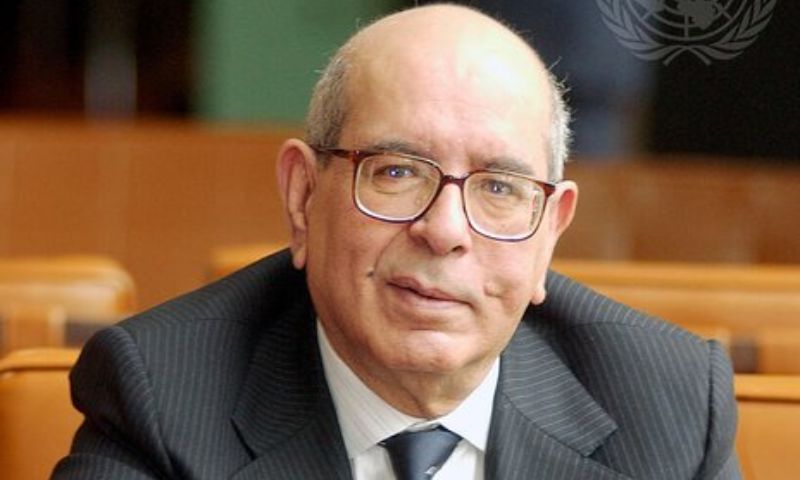



UNITED NATIONS: Diplomats, senior United Nations officials, colleagues, friends and family members gathered at the UN Headquarters to honor the life and legacy of veteran Pakistani diplomat Rafeeuddin Ahmad, whose nearly five decades of service to international diplomacy left a lasting mark on the global organization.
The memorial ceremony was organized on Wednesday by the Permanent Mission of Pakistan to the United Nations in collaboration with the United Nations Development Programme and the United Nations Department of Economic and Social Affairs (DESA).
The event drew a large audience of diplomats, former UN officials and members of the international community who came together to celebrate Ahmad’s contributions to multilateral diplomacy and international cooperation.
Presiding over the ceremony, Pakistan’s Permanent Representative to the UN, Asim Iftikhar Ahmad, described the late diplomat as “a son of Pakistan and a citizen of the world,” saying his passing had left a profound void within the United Nations.
He noted that Ahmad’s more than five decades of international service set a high standard for future diplomats and public servants. “His life reflected the values of dialogue, diplomacy and the patient pursuit of peace,” the ambassador said, adding that Pakistan was immensely proud of the legacy he left behind.
Speakers at the event highlighted Ahmad’s long and distinguished career at the United Nations, where he played a key role in promoting sustainable development, economic cooperation and inclusive policymaking within the multilateral system.
During his career, Ahmad served in several senior roles, including as Special Adviser on Iraq to former UN Secretary-General Kofi Annan and as an Under-Secretary-General. His work was widely credited with strengthening international cooperation and advancing development-oriented policies within the UN framework.
Recalling the early phase of Ahmad’s career, Ambassador Asim Iftikhar Ahmad noted that he began his UN service in the 1970s at the United Nations Economic and Social Council and later served as Chef de Cabinet to former Secretary-General Kurt Waldheim.
In that role, he acted as a principal aide during major diplomatic challenges, including the Iran Hostage Crisis, and contributed to the Secretary-General’s task force on the Falklands War.
Speakers also reflected on Ahmad’s leadership in various assignments across Southeast Asia, including humanitarian and peace initiatives in Cambodia and engagements involving Laos, Thailand and Myanmar.
His career also included involvement in delicate negotiations, such as securing the release of a detained crew in Kandahar, as well as serving as Associate Administrator of the UN Development Programme.
Delivering remarks on behalf of UN Secretary-General António Guterres, DESA Under-Secretary-General Li Junhua said Ahmad’s life exemplified the values of integrity, humility and commitment to international cooperation.
He said the best way to honor Ahmad’s legacy was to continue advancing the principles he believed in – strengthening multilateralism, practicing ethical leadership and striving for a more just and peaceful world.
Family members of the late diplomat also shared personal reflections. His elder son, Zia Ahmed, thanked the Pakistani mission and Ahmad’s colleagues for organizing the memorial and for the respect shown to his father.
He described Ahmad as a professional known for his calm judgment, deep institutional knowledge and ability to offer thoughtful solutions to complex problems. Beyond his professional accomplishments, he remembered him as a devoted family man who treated everyone with dignity and kindness.
His younger son, Kamaluddin Ahmed, said the gathering provided comfort as he reflected on his father’s lifelong dedication to the United Nations. He recalled accompanying him to UN meetings in Geneva during his childhood, experiences that shaped his own values of sincerity, humility and integrity.
Several other distinguished speakers paid tribute to Ahmad’s contributions, including former Pakistani Foreign Secretary Shamshad Ahmad Khan and former Pakistani Permanent Representative to the UN Munir Akram. They remembered him as a principled diplomat who believed deeply in the UN system and served as a mentor to many younger diplomats.
Participants who were unable to attend the ceremony in person also shared tributes through recorded video messages, including senior international officials and former UN leaders.
A documentary highlighting key moments from Ahmad’s life and diplomatic career was screened during the ceremony, offering a glimpse into the remarkable journey of a Pakistani diplomat whose service helped shape international cooperation over several decades.
Speakers concluded that Rafeeuddin Ahmad’s enduring legacy lies not only in his professional achievements but also in the humanity, wisdom and mentorship he brought to the United Nations and the global diplomatic community.