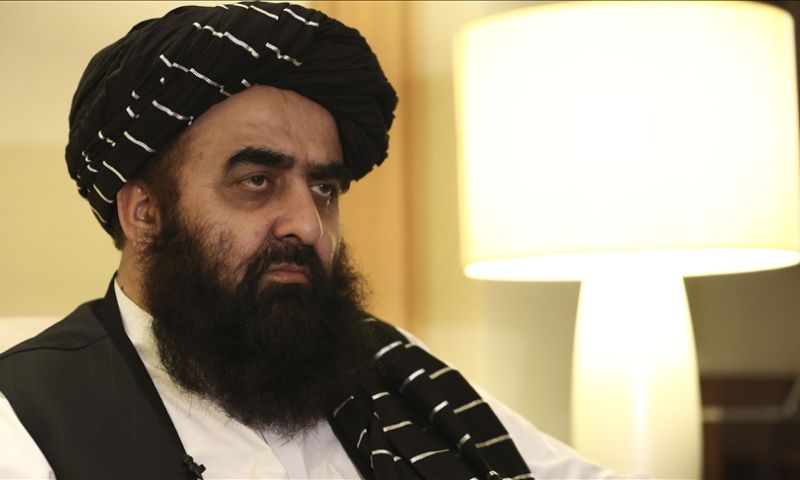



DOHA: The United Nations Security Council committee has agreed to allow Taliban’s Foreign Minister Mawlawi Amir Khan Muttaqi to travel to Pakistan to meet his Chinese and Pakistani counterparts.
Reuters said that Pakistan’s United Nations mission had requested the UN to lift a ban on Muttaqi so that he could travel to Pakistan between May 6 and May 9 “for the meeting with Chines and Pakistani foreign ministers.”
Muttaqi has long been subjected to the travel ban, asset freeze and arms embargo under United Nations Security Council sanctions.
The previous month, the United Nations Security Council committee allowed Muttaqi to travel to Uzbekistan to meet foreign ministers of Afghanistan’s neighbouring countries to discuss urgent security, peace and stability matters.
Afghanistan’s TOLO news outlet said that Pakistani media had been reporting on the upcoming visit and that Muttaqi would meet with Foreign Minister Bilawal Bhutto-Zardari and his Chinese counterpart. According to TOLO news, Afghanistan’s foreign ministry did not comment on Muttaqi’s upcoming visit to Pakistan.
Pakistan media reported that the acting Foreign Minister Amir Khan Muttaqi will visit Pakistan this Friday for four days. The report said that Muttaqi will meet with Pakistan FM Bilawal Bhutto Zardari.
The Afghan foreign ministry has yet to comment.#TOLOnews pic.twitter.com/A30DGCssf7— TOLOnews (@TOLOnews) May 1, 2023
The news about the Taliban official’s visit to Pakistan comes as representatives of nearly two dozen countries and world institutions met on Monday in Qatar with United Nations Secretary-General Antonio Guterres for negotiations on Afghanistan, focusing mainly on the plight of girls and women under the Taliban regime.
United Nations spokesperson Stephane Dujarric said that Taliban represetatives were not invited to attend the closed-door two-day meeting in Doha.
“The meeting aimed “to achieve a common understanding within the global community on how to engage with the Taliban government”, said Dujarric, who noted that recognition of Taliban “isn’t up for discussion”. “Key discussion topics included girls’ and women’s rights, inclusive governance, countering terrorism and drug trafficking,” he said.
Since coming to power in 2021, the Taliban have imposed strict curbs on women, which the United Nations labels as “gender-based apartheid”.
Taliban foreign ministry spokesperson
Taliban foreign ministry spokesperson Abdul Qahar Balkhi told Al Jazeera: “Any meeting about Afghanistan without the participation of the Taliban government is ineffective and counterproductive,”
Afghan women have been barred from schools and universities and prevented from holding government jobs.
The previous month, the Taliban extended the ban on women working with United Nations agencies. The Taliban administration said the ban was an “internal problem” that should not influence foreign dealings.
But, in response, the United Nations ordered the review of its critical relief operation in Afghanistan, where several in the 38-million-strong population rely on food aid.
The United Nations has said that the Taliban face an “appalling choice” over whether to maintain its relief efforts in Afghanistan.
Before leaving for Doha, Guterres said on social media that “reversing all measures that ban women’s rights to work is key to reaching the millions of citizens in Afghanistan that require humanitarian assistance”.
Though not invited to the negotiations, Sohail Shaheen, the head of the Taliban government representative office in Doha, said he had met with delegation members from the United Kingdom and China. He said the United Nations meeting and “the significance of engagement” were among the topics raised.