


DOHA, Qatar: Turkiye has conveyed “friendly” advice to Iran not to expand the ongoing conflict with the United States and Israel across the Middle East, Foreign Minister Hakan Fidan said on Thursday.
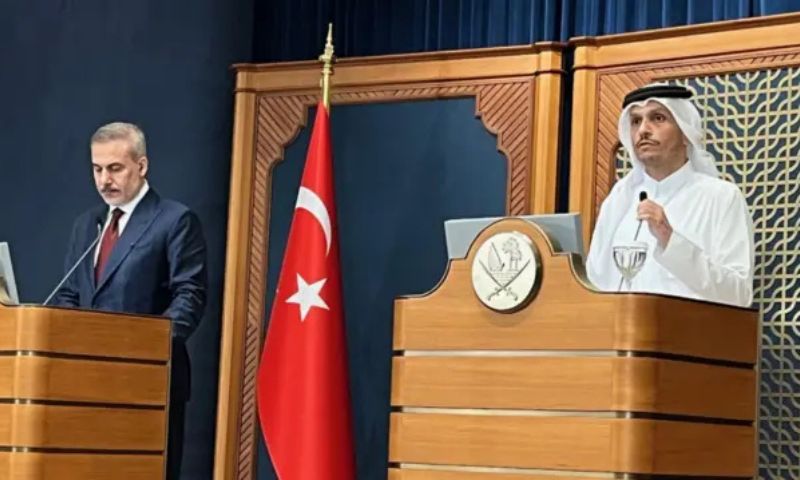
Speaking at a joint press conference in Doha with Qatar’s Prime Minister Mohammed bin Abdulrahman Al Thani, Fidan said Ankara was engaging both Washington and Tehran to help contain the crisis.
“We are conveying our friendly advice to Iran not to spread the war to the region,” he said, adding that attacks on regional countries were “unacceptable”.
Fidan described Israel as the primary driver of the conflict, accusing it of pushing the region into an “unprecedented crisis”.
At the same time, he stressed that Iran bore a “historic responsibility” to avoid further escalation.
“Just as attacks on Iran are wrong, Iran’s attacks on countries in the region are equally wrong,” he said, warning that Tehran’s actions risk deepening instability.
He added that Turkiye was working with all parties to prevent the conflict from spiralling into a broader regional war.
Qatar calls for immediate end to war
Qatar called for an unconditional and immediate halt to the conflict.
“This war needs to stop immediately. The aggression needs to stop immediately,” Sheikh Mohammed said.
He warned that any expansion of the war would undermine regional stability. “Any expansion of the war will never enable stability,” he added.
The Qatari premier criticised Iran’s targeting of neighbouring countries, calling such actions “unacceptable and unjustified”.
Attack on Ras Laffan gas facility
Sheikh Mohammed said Iran’s missile strike on the Ras Laffan gas facility represented a dangerous escalation with global consequences.
“The attack will affect millions of people around the world,” he said, warning of “significant repercussions for global energy supplies”.
State energy firm QatarEnergy said the attack had caused extensive damage to facilities at Ras Laffan, the world’s largest liquefied natural gas (LNG) hub.
Chief executive Saad al-Kaabi said the strikes had knocked out 17 per cent of Qatar’s LNG export capacity, with repairs expected to take between three and five years.
He described the attack as unprecedented, saying he had never imagined such a strike “from a brotherly Muslim country” during Ramadan.
Qatar supplies roughly 20 per cent of global LNG, and analysts say there is no immediate replacement for its output, raising concerns about prolonged disruptions to energy markets.
Trade and economic risks
The economic fallout of the conflict is expected to extend beyond energy markets.
The World Trade Organization warned that the war could significantly slow global trade, with merchandise trade growth projected to fall to as low as 1.4 per cent this year, down from 4.6 per cent in 2025.
WTO Director-General Ngozi Okonjo-Iweala said sustained increases in energy prices could have spillover effects on food security and raise costs for consumers and businesses worldwide.
Officials warned that continued attacks on energy infrastructure and regional states could destabilise the Middle East and disrupt global markets further.
Fidan reiterated that diplomacy based on “mutual respect” remained the only viable path forward.