


WASHINGTON: President Donald Trump has warned that the United States could face a prolonged conflict with Iran and declined to rule out deploying ground troops, as his administration sought to clarify its messaging over the widening war.
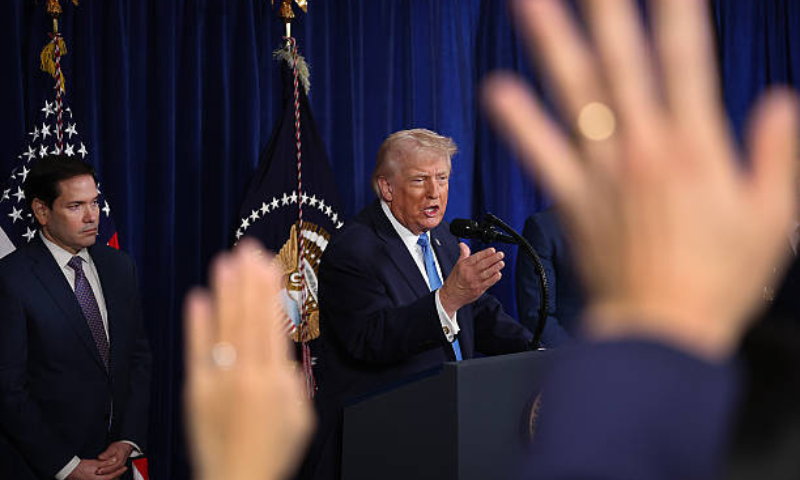
Speaking briefly at the White House — his first public remarks since launching US strikes under Operation Epic Fury — Trump defended the military campaign as necessary and described it as the “last, best chance” to confront Washington’s decades-long adversary.
The 79-year-old Republican, who campaigned on reducing US military entanglements abroad, acknowledged that the operation could extend beyond initial projections.
“From the beginning, we projected four to five weeks, but we have capability to go far longer than that,” Trump said, adding that operations were currently running ahead of schedule.
He also, for the first time, laid out four explicit objectives for the campaign.
“First, we’re destroying Iran’s missile capabilities…Second, we’re annihilating their navy…Third, we’re ensuring that the world’s number-one sponsor of terror can never obtain a nuclear weapon,” he said.
“Finally we are ensuring the Iranian regime can’t continue to arm, fund and direct terrorist armies outside of their borders.”
Rubio’s remarks add to mixed messaging
Later, Secretary of State Marco Rubio offered additional context that appeared to complicate the administration’s narrative, suggesting that the timing of US military action was linked to anticipated Israeli operations.
“We knew that there was going to be an Israeli action. We knew that that would precipitate an attack against American forces, and we knew that if we didn’t preemptively go after them before they launched those attacks, we would suffer higher casualties,” Rubio told reporters.
When pressed on whether the United States faced an imminent threat from Iran — a key constitutional threshold given that Congress holds the authority to declare war — Rubio again referenced Israeli plans rather than citing a direct Iranian attack in progress.
Trump himself did not make that justification in his earlier remarks.
The president has so far avoided delivering a formal national address or holding a major press conference to explain the strategic rationale behind what has become the most significant US military conflict in the Middle East in nearly two decades.
Instead, he has issued statements via social media and conducted brief phone interviews with select media outlets.
In a call with CNN on Monday, Trump hinted at further escalation.
“The big wave hasn’t even happened,” he said. “The big one is coming soon.”
Ground troops not ruled out
At a Pentagon press conference earlier in the day, Defense Secretary Pete Hegseth and Chairman of the Joint Chiefs of Staff Dan Caine addressed operational questions. Hegseth signaled that deploying US troops inside Iran had not been ruled out.
Asked directly whether there were already “boots on the ground,” Hegseth said: “No, but we’re not going to go into the exercise of what we will or will not do.”
He sought to distinguish the unfolding conflict from the prolonged US wars in Iraq and Afghanistan.
“This is not Iraq. This is not endless,” said Hegseth, an Iraq veteran.
Trump later reinforced that ambiguity in an interview with the New York Post, refusing to categorically reject the possibility of ground deployment.
“I don’t have the yips with respect to boots on the ground,” Trump said, using a golf term for anxiety. “Every president says, ‘There will be no boots on the ground.’ I don’t say it.”
Such a move could significantly increase US casualties, which currently stand at six service members killed since the operation began.
Domestic criticism and political balancing
The president’s limited public explanation of the war has drawn criticism from parts of his own Make America Great Again (MAGA) base, many of whom supported his longstanding pledge to end foreign wars and avoid deeper Middle Eastern entanglements.
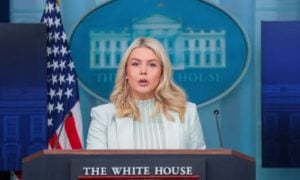
In response to criticism online, White House Press Secretary Karoline Leavitt said Trump had laid out “clear objectives,” defending the administration’s handling of the conflict.
The White House has moved in recent hours to align messaging across departments, as questions persist over the legal basis, strategic scope, and potential duration of the campaign.
With Trump openly warning of a longer war and declining to rule out ground operations, uncertainty remains over whether Operation Epic Fury will remain a limited aerial and naval campaign — or expand into a broader and more costly confrontation.