


Key Points:
- Trump says Iran “wants a deal” but proposal falls short.
- Tehran sends fresh offer through Pakistan as mediator.
- Trump praises Pakistan’s leadership amid ongoing diplomacy.
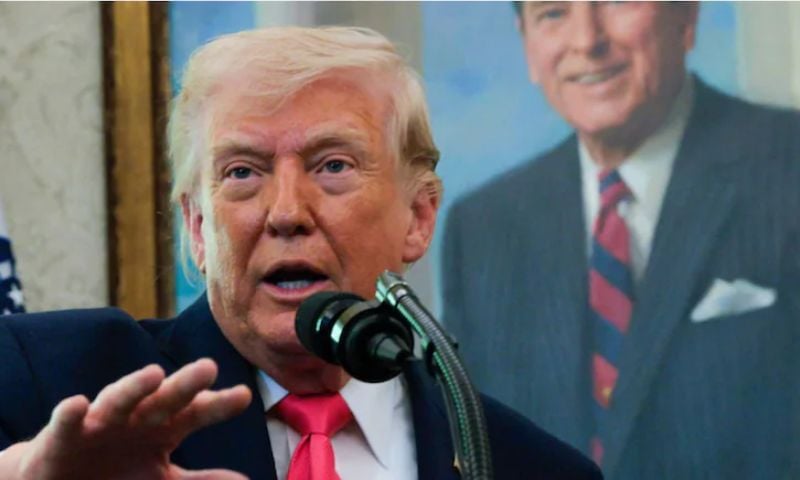
ISLAMABAD: US President Donald Trump on Friday warned against an “early” end to the war with Iran and said he was “not satisfied” with Tehran’s latest proposal, signalling continued uncertainty in ongoing diplomatic efforts.
Speaking to reporters in Washington, Trump said, “Iran wants to make a deal, but I’m not satisfied with it, so we’ll see what happens,” signalling continued uncertainty over diplomatic progress.
Despite ongoing diplomatic engagement, Trump warned against an “early” end to the war, saying any agreement must be durable.
He added that the United States may need to restart military action if negotiations fail and that he remains uncertain whether a final deal can be reached.
Trump said the US would not leave Iran early as the deadlock over the two-month-old war persisted despite a ceasefire https://t.co/fotMq9fMvr pic.twitter.com/ys7JImOgDa
— Reuters (@Reuters) May 2, 2026
Trump did not elaborate on what he sees as the proposal’s shortcomings.
The president said negotiations have continued by phone after he called off his envoys’ trip to Pakistan last week. He expressed frustration with Iran’s leadership, which he described as fractured.
“It’s a very disjointed leadership,” he said. “They all want to make a deal, but they’re all messed up.
.@POTUS on Iran: “They want to make a deal, but I’m not satisfied with it, so we’ll see what happens.” pic.twitter.com/7H4jkuLXuh
— Rapid Response 47 (@RapidResponse47) May 1, 2026
Pakistan mediation
The latest Iranian proposal was conveyed through Pakistan, which is playing a mediating role in efforts to revive talks between Washington and Tehran.
Trump confirmed that discussions are currently being conducted remotely, saying negotiations are taking place by phone rather than through direct, in-person meetings. He added that while Washington holds Pakistan in high regard, travel for talks remains a logistical challenge.
“I have great respect for Pakistan and for the field marshal and the prime minister,” Trump said.
War warning
Despite ongoing diplomatic engagement, Trump indicated that a return to conflict remains a possibility. He said the United States may need to restart military action if negotiations fail, adding that he is uncertain whether a final agreement can be reached.
“I’m not sure we’re going to get to a deal,” he told reporters.
“Do we want to go and just blast the hell out of them and finish them forever — or do we want to try and make a deal? I mean, those are the options,” he said when asked about next steps, adding he would “prefer not” to take the first option “on a human basis”.
Iran leadership claims
Trump also claimed that divisions within Iran’s leadership were complicating the negotiation process.
“There’s tremendous discord… the leadership is very disjointed,” he said, suggesting that multiple factions within the Iranian system were struggling to align on a unified position.
Limited progress
While acknowledging some movement in talks, Trump said Iran had made “strides” towards a deal but not enough to secure an agreement.
He questioned whether negotiations would ultimately succeed, underscoring the fragile nature of the current diplomatic efforts.
Nuclear Warning
Trump also ruled out the possibility of Iran acquiring nuclear weapons, while criticising European allies for what he described as insufficient support for US policy.
“I’m not happy with Italy and I’m not happy with Spain,” he said, accusing them of failing to take a firm stance.
He added that any acceptance of a nuclear-armed Iran would have severe global consequences, saying such a scenario would create unprecedented risks and insisting it “is not going to happen.”
President Trump posts on Truth Social: Iran can’t get their act together. They don’t know how to sign a nonnuclear deal.
They better get smart soon! President DJT pic.twitter.com/tFEwmalvrD
— Donald J Trump Posts TruthSocial (@TruthTrumpPost) April 29, 2026
U.S. Position
The United States has maintained a firm and consistent stance centered on preventing Iran from acquiring nuclear weapons. Officials, including Donald Trump, have repeatedly emphasized this as a non-negotiable red line. Washington’s demands include a complete halt to uranium enrichment—reportedly for an extended period—and the transfer of Iran’s stockpiles of highly enriched uranium.
In parallel, the U.S. is pressing for the full reopening of the Strait of Hormuz to ensure safe and unrestricted international navigation, without threats, closures, or toll impositions. It has also called on Tehran to end its support for regional proxy groups and what it describes as destabilizing activities.
To reinforce its position, the U.S. continues to rely on economic and military pressure, including sanctions and a naval blockade of Iranian ports, with contingency planning for a prolonged standoff. Officials say these measures are aimed at safeguarding long-term national and regional security interests.
Iranian Position
Iran, for its part, has tied progress in negotiations to immediate de-escalation measures. Tehran is demanding the lifting of the U.S. naval blockade and an end to attacks as part of any agreement or parallel confidence-building steps.
Sanctions relief remains a central condition for Iran, which has indicated willingness to engage in nuclear discussions only if economic restrictions are eased. Iranian officials have also called for broader talks addressing the conflict and the future management of the Strait of Hormuz, potentially including conditions that preserve its strategic interests.
While Iran has shown some flexibility in recent proposals—particularly in discussing nuclear and maritime issues concurrently—it continues to resist making major upfront concessions on its nuclear program. Tehran is also seeking guarantees against future military or economic pressure.
Ongoing Mediation
Negotiations remain ongoing but tense, with Pakistan playing a central intermediary role between the two sides. The talks are unfolding against the backdrop of a broader economic and security standoff in the Gulf region, with no immediate breakthrough in sight.