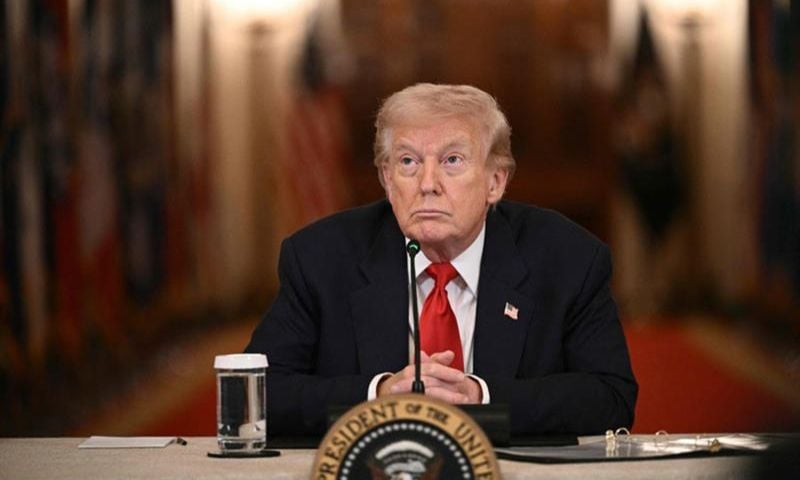



TEHRAN, Iran: United States President Donald Trump on Saturday threatened to intensify bombing campaigns against Iran, while Iranian President Masoud Pezeshkian vowed the country would never surrender despite continued US and Israeli air strikes.
The warning came as fresh strikes hit targets in Tehran and other areas, raising fears of a prolonged regional conflict that has already spread across multiple countries and strategic waterways.
“Today Iran will be hit very hard!” Trump wrote on his Truth Social platform.
“Under serious consideration for complete destruction and certain death, because of Iran’s bad behaviour, are areas and groups of people that were not considered for targeting up until this moment in time,” he added.
Fresh strikes hit Tehran
Israel confirmed carrying out some of the largest attacks since the aerial bombardment campaign began a week ago.
According to Israeli military statements, the overnight attacks targeted a military academy, an underground command centre and a missile storage facility in Tehran.
Pre-dawn images captured by AFP showed flames and smoke rising from Tehran’s Mehrabad International Airport, one of two airports serving the Iranian capital.
The Israeli military later said its air force conducted a “broad wave of attacks” across Tehran overnight, including strikes on Mehrabad Airport.
In a statement, the Israeli army claimed the airport was used by Iran’s Islamic Revolutionary Guard Corps (IRGC) Quds Force for weapons and funds.
The military also said it destroyed 16 aircraft belonging to the Quds Force during the raids.
בשדה התעופה 'מהראבאד' שבטהרן: חיל האוויר השמיד 16 מטוסים של יחידת ׳כוח קדס׳ שהעבירו אמצעי לחימה לארגון הטרור חיזבאללה
חיל האוויר בהכוונת אמ״ן, השלים במהלך הלילה גל תקיפות נרחב ברחבי טהרן ולעבר תשתיות צבאיות בשדה התעופה ׳מהראבאד׳ שבטהרן.
שדה התעופה 'מהראבאד', שימש את יחידת ׳כוח… pic.twitter.com/c1UtJuE9kI
— צבא ההגנה לישראל (@idfonline) March 7, 2026
Iranian authorities have not issued any statement so far to confirm the strikes.
Iran rejects surrender demand
Iran’s President Masoud Pezeshkian responded defiantly to Trump’s earlier demand for “unconditional surrender”.
Speaking in a televised address broadcast by state media, Pezeshkian said Iran’s enemies would never achieve such an outcome.
“Iran’s enemies must take their wish for the unconditional surrender of the Iranian people to their graves,” he said.
In separate remarks posted on X, Pezeshkian said Iran had sought to maintain friendly relations with neighbouring states but reserved the right to defend itself.
“The Islamic Republic of Iran has always emphasised the preservation and continuation of friendly relations with the governments of the region based on good neighbourliness and mutual respect for national sovereignty and territorial integrity,” he said.
“This does not negate Iran’s inherent right to defend itself against military aggression by the United States and the Zionist regime.”
He added that Iranian strikes were defensive and directed at military targets.
“We have not attacked our friendly and neighbouring countries; rather, we have targeted US military bases, facilities, and installations in the region,” he said.
جمهوری اسلامی ایران بر حفظ و تداوم روابط دوستانه با دولت های منطقه بر مبنای حسن همجواری و احترام متقابل به حاکمیت ملی و تمامیت سرزمینی همواره تاکید دارد. این امر نافی حق ذاتی ایران برای دفاع از خود در برابر تجاوز نظامی آمریکا و رژیم صهیونیستی نیست.
— Masoud Pezeshkian (@drpezeshkian) March 7, 2026
Iran launches missiles and drones across Gulf
Despite sustained attacks on its military infrastructure, Iran continued launching missiles and drones across the region.
Air raid alerts and explosions were reported over Jerusalem, as well as in Gulf cities including Dubai and Manama.
Saudi authorities intercepted a ballistic missile targeting an air base hosting US military personnel near Riyadh.
The United Arab Emirates said its air defence systems intercepted 15 ballistic missiles and 119 drones on Saturday.
However, video footage showed one projectile striking Dubai airport. Mobile phone footage verified by AFP showed an explosion near an airport building and parked aircraft close to a passing train.
Jordan’s military spokesman Mustafa Hayari said Iran had launched 119 missiles and drones toward “vital installations” in the kingdom over the past week.
Iran’s Revolutionary Guards also said they fired at the oil tanker Prima in the Gulf while it attempted to pass through the Strait of Hormuz, a critical global shipping chokepoint that Iran has effectively closed.
Regional tensions widen
Iran’s Foreign Minister Abbas Araghchi accused the United States of targeting civilian infrastructure.
He said US strikes hit a freshwater desalination plant on Qeshm Island, affecting water supply to 30 villages.
“Attacking Iran’s infrastructure is a dangerous move with grave consequences. The US set this precedent, not Iran,” Araghchi said.
The U.S. committed a blatant and desperate crime by attacking a freshwater desalination plant on Qeshm Island. Water supply in 30 villages has been impacted.
Attacking Iran's infrastructure is a dangerous move with grave consequences. The U.S. set this precedent, not Iran.
— Seyed Abbas Araghchi (@araghchi) March 7, 2026
Meanwhile, Iran’s foreign ministry spokesperson Esmaeil Baqaei criticised the United States for allegedly attacking Tehran’s Azadi Sports Complex.
“This is Tehran’s Azadi Sports Complex, a football stadium, targeted by the same United States whose president received a FIFA ‘Peace Prize’,” Baqaei said, questioning whether FIFA or the International Olympic Committee would respond.
This is Tehran’s Azadi Sports Complex، a football stadium، targeted by the same United States whose president received a FIFA “Peace Prize.”
Any comment from FIFA or IOC?! pic.twitter.com/T2BHVvgkSD
— Esmaeil Baqaei (@IRIMFA_SPOX) March 7, 2026
The war has also expanded to Lebanon, where Israeli forces intensified strikes on Beirut’s southern suburbs, a stronghold of Hezbollah group.
Israel’s Defence Minister Israel Katz warned Lebanese President Joseph Aoun that Lebanon would pay a “very heavy price” if Hezbollah was not disarmed.
Lebanon’s health ministry said at least 217 people have been killed in Israeli air strikes during the past week.
Prime Minister Nawaf Salam warned that a “humanitarian disaster is looming”.
Iran’s health ministry said on Friday that at least 926 people had been killed and around 6,000 injured since the conflict began.
Global implications
The war began last Saturday when joint US and Israeli strikes killed Iran’s supreme leader Ayatollah Ali Khamenei, triggering a wider military confrontation across the region.
The conflict has since spread beyond Iran and Israel to include Lebanon, Cyprus, Turkey and Azerbaijan, while US forces also sank an Iranian warship off Sri Lanka.
US Defence Secretary Pete Hegseth said Washington was “not concerned” by reports that Russia may be sharing intelligence with Iran about US troop movements.
Russian President Vladimir Putin, however, urged an “immediate” ceasefire during a phone call with President Pezeshkian on Friday, according to the Kremlin.
Global markets have reacted sharply to the conflict. Stock markets have fallen while crude oil prices have surged amid fears of disruptions to Middle East energy supplies.
Trump said the United States had inflicted severe damage on Iran’s military capabilities.
He claimed US strikes had destroyed 42 Iranian naval vessels and significantly damaged the country’s air force and communications systems.
The US president also said facilities linked to Iran’s nuclear programme were targeted, claiming Tehran had been close to acquiring a nuclear weapon before the attacks.
Pakistan engages in diplomacy
Amid the escalating conflict, Pakistan’s Deputy Prime Minister and Foreign Minister Ishaq Dar spoke with Iranian Foreign Minister Abbas Araghchi to discuss the “evolving regional situation”.
According to Pakistan’s Foreign Office, the two leaders “exchanged views on recent developments and agreed to remain in touch”.
Deputy Prime Minister / Foreign Minister @MIshaqDar50 spoke with Iranian Foreign Minister @araghchi on the evolving regional situation. The two leaders exchanged views on recent developments and agreed to remain in touch. pic.twitter.com/J5yYjmPSix
— Ministry of Foreign Affairs – Pakistan (@ForeignOfficePk) March 7, 2026
The conflict is now entering its second week, with no clear path to de-escalation.
Trump has rejected renewed negotiations with Tehran and reiterated that any agreement would require Iran’s “unconditional surrender”.
He has also suggested the United States would support rebuilding Iran’s economy if a new leadership acceptable to Washington replaces the country’s late supreme leader.
Iran’s ambassador to the United Nations, Amir Saeid Iravani, rejected that suggestion.
“The selection of Iran’s leadership will take place strictly in accordance with our constitutional procedures and solely by the will of the Iranian people, without any foreign interference,” he said.