
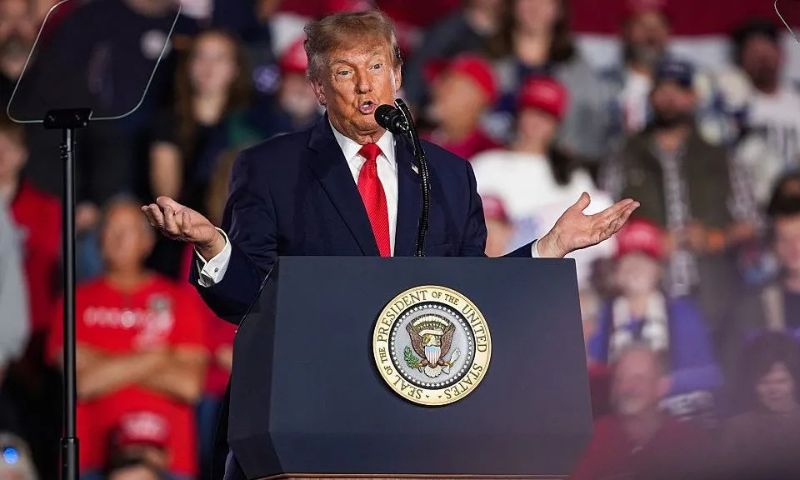
WASHINGTON: US President Donald Trump said Tuesday he will accept the results of the midterm elections where incoming figures indicate a Democratic wipeout of his Republican Party in Congress.
“I am absolutely willing to accept those results,” he told The New York Times. “We’ll work with the Democrats, and we’ll, you know, look forward to working with them. We’ll probably work something out.”
The conciliatory remarks came after repeated attempts by Trump to cast doubt over the fairness of the elections, adding to fears that he would refuse to accept defeat.
Democrats have won control of the US House of Representatives from Republicans, according to projections by CNN and NBC News, setting the stage for a confrontation with President Donald Trump during the final two years of his presidency.
The projected victory gives Democrats control of the chamber’s committees and the power to investigate the administration, challenge its policies and block parts of Trump’s legislative agenda.
The party has also made significant gains in the Senate, overturning Republican-held seats in North Carolina and South Carolina in two major election-night victories.
The results represent a sharp setback for Republicans, who entered the midterm elections controlling both chambers of Congress. The outcome is being viewed as a nationwide verdict on Trump’s second term, with economic pressures, rising fuel prices and the US war against Iran emerging as major campaign issues.
Historic Senate Upsets
One of the night’s biggest surprises came in South Carolina, where Democratic paediatrician Annie Andrews defeated Republican Darline Graham, according to media projections.
Graham had been appointed to the Senate following the death of her brother, longtime Republican Senator Lindsey Graham, in July. She received Trump’s backing in the race but failed to retain the seat for the Republicans.
The result marks a historic breakthrough for Democrats in the deeply conservative southern state, where the party had not won a Senate election since 1998.
The South Carolina victory followed another major Republican loss in North Carolina, where former Democratic governor Roy Cooper defeated Republican candidate Michael Whatley to capture an open Senate seat.
Democrats also held key Senate positions in Georgia, where Jon Ossoff won re-election against Republican challenger Mike Collins, and New Hampshire, where Chris Pappas secured victory. Pappas becomes the first openly gay man elected to the US Senate.
Republicans also retained some important positions. Ashley Moody won Florida’s special Senate election, securing the seat previously held by Marco Rubio.
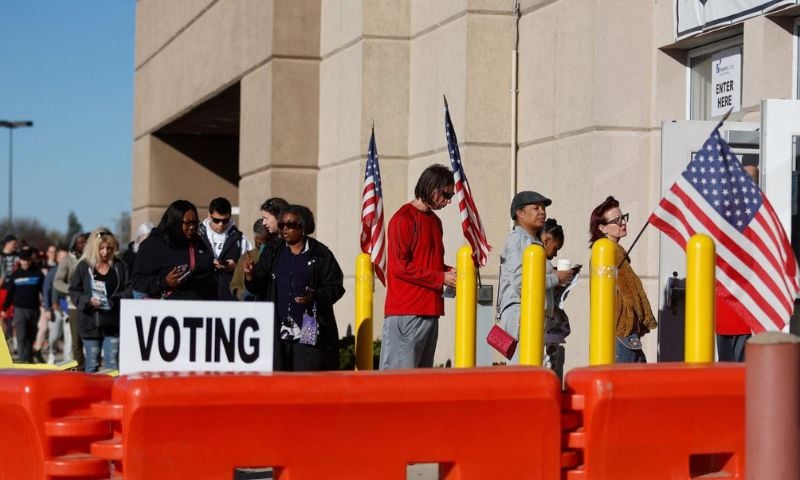
Republicans entered election day with a 53-47 Senate majority. Democrats needed a net gain of four seats to take control. With North Carolina and South Carolina now projected Democratic gains, the contest for the upper chamber remains open.
House Changes Hands
The projected Democratic takeover of the House marks the most consequential shift of the election so far.
All 435 seats were contested, with Democrats needing a net gain of just three seats to end Republican control.
The party’s gains extended beyond traditional Democratic strongholds, with results pointing to growing competition in districts that backed Trump comfortably in the 2024 presidential election.
In Georgia, Democratic Representative Lucy McBath won re-election in the state’s sixth congressional district.
The House victory puts Democratic leader Hakeem Jeffries in line to become speaker, replacing Republican leadership if the projected majority is confirmed.
A Democratic-controlled House would have the authority to launch investigations into the administration’s handling of the Iran war, immigration enforcement and allegations of corruption. It could also block or delay legislation backed by the White House.
Governors’ Races
Democrats also made gains in state-level contests.
In Georgia, former Atlanta mayor Keisha Lance Bottoms won the governorship, becoming the first Black woman elected governor in US history and ending 24 years of Republican control of the state.
In Florida, Republican Byron Donalds won the governorship, becoming the state’s first Black governor.
The election also featured gubernatorial contests in 36 states, alongside thousands of state legislative races and ballot measures.
Trump Faces Backlash
The results have delivered a significant political warning to Trump, whose approval ratings have remained near historic lows amid public dissatisfaction over the economy and his administration’s policies.
Early CBS News exit polling put his job approval among voters at 38 per cent. The cost of living, tariffs and the war with Iran were among the issues weighing on voters, with higher fuel prices adding to economic pressure.
Democratic Senator Jon Ossoff described the party’s victories as a rejection of Trump’s “depravity, corruption and incompetence”.
A White House official, however, told AFP that the mood around the president was “defiant” and said Trump would continue to resist what the administration calls the “radical left”.
“Buckle up,” the official said.
Trump had defended his record in a television appearance on election day, praising his tariffs, immigration crackdown and military campaign against Iran.
“We have to keep America great. We’re great now. We were terrible two years ago,” he told Fox News.
The president had also acknowledged the possibility of an opposition-controlled Congress, saying in a podcast released before election day: “I veto everything,” before adding that he might eventually negotiate with Democrats.
What Comes Next
A Democratic-controlled House will give the opposition party powerful tools to scrutinise the administration, summon officials and investigate government decisions.
If Democrats also take the Senate, Trump would face further obstacles in securing confirmation of federal judges and senior administration appointments.
For now, the House result marks a clear change in Washington’s political balance, while the Senate remains the decisive unanswered question.
The outcome will have implications beyond the United States, as the balance of power in Congress could influence decisions on trade, tariffs, immigration, military operations and Washington’s relations with allies and rivals around the world.