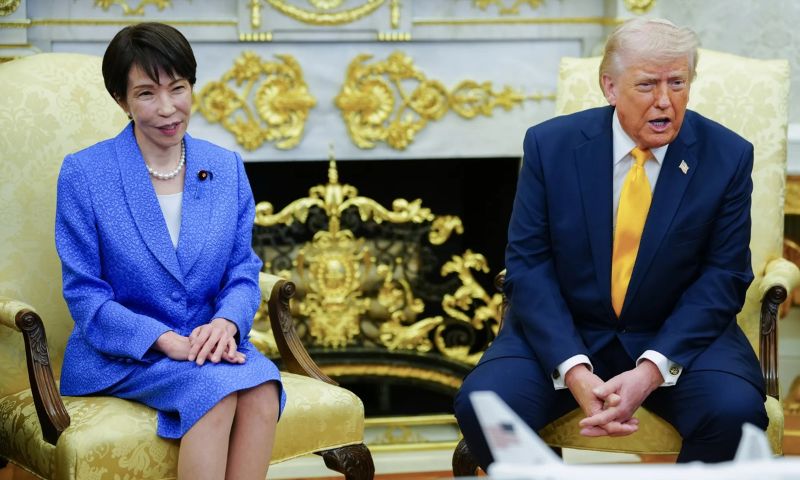



WASHINGTON: US President Donald Trump said on Thursday he was not planning to deploy American ground troops to the Middle East as Washington intensifies military operations against Iran and prepares further large-scale strikes.
“I’m not putting troops anywhere,” Trump told reporters at the White House during an Oval Office meeting with Japanese Prime Minister Sanae Takaichi, according to Reuters.
“If I were, I certainly wouldn’t tell you. But I’m not putting troops.”
The comments came as US Defence Secretary Pete Hegseth said the United States would launch the “largest strike package yet” on Iran later on Thursday.
Hegseth said US forces had already struck more than 7,000 targets, significantly weakening Iran’s military capabilities, particularly its ballistic missile production and naval assets.
“Our objectives remain unchanged,” he said, adding that the campaign aimed to dismantle Iran’s missile systems, defence industrial base and navy, and ensure it does not acquire nuclear weapons.
He rejected suggestions that the war risked becoming a prolonged conflict, saying it was “not a forever war”.
Trump also said he had urged Israeli Prime Minister Benjamin Netanyahu not to target Iran’s energy infrastructure, adding that Netanyahu had agreed.
“I told him, ‘Don’t do that’, and he won’t do that,” Trump said.
He praised Japan for “stepping up” in response to the crisis, while criticising NATO allies for not doing enough.
No timeline for end of war
Hegseth said there was no fixed timeline for ending the war, stressing that the decision would ultimately rest with Trump.
“We wouldn’t want to set a definitive time frame,” he told reporters. “It will be at the president’s choosing… when we’ve achieved what we need to.”
Despite sustained strikes, senior US officials acknowledged that Iran retains some military capability.
General Dan Caine said Tehran still had “some capability” to strike US assets, although its overall capacity had been significantly degraded.
Trump makes bold claims
Trump suggested the conflict could end soon, saying the impact on Iran had not been as severe as expected.
“Thought impact of Iran would be worse, will be over with soon,” he said.
He also made unverified claims about Iran’s leadership, saying it was “gone” and that the country was “looking for new leaders again”, without providing evidence.
The United States has approved military sales worth $16.46 billion to the United Arab Emirates and Kuwait, according to reports, in a move aimed at reinforcing their defensive capabilities following Iranian missile and drone attacks.
US Treasury Secretary Scott Bessent said Washington could also ease restrictions on Iranian oil already at sea and release strategic reserves to stabilise global energy markets.
Energy war intensifies
The conflict has increasingly targeted energy infrastructure, exacerbating volatility in global markets.
Iran has struck facilities across the Gulf, including Qatar’s Ras Laffan LNG hub, while also issuing evacuation warnings for oil and gas sites in the UAE and Qatar ahead of further attacks.
The escalation followed Israel’s strike on Iran’s South Pars gas field, a critical component of Iran’s energy supply.
Strait of Hormuz crisis
The conflict has disrupted shipping through the Strait of Hormuz, a key route for around one-fifth of global oil supplies.
A group of major powers — including Britain, France, Germany, Italy, Japan and the Netherlands — said they were ready to support efforts to ensure safe passage through the waterway.
NATO Secretary General Mark Rutte said allies were discussing options to reopen the route, amid rising concerns over global energy security.
UN Secretary-General Antonio Guterres urged all sides to end the conflict, warning it risked spiralling out of control.
“It is high time to end this war,” he said, calling for the reopening of the Strait of Hormuz.
Meanwhile, Russia called for the establishment of a safety zone around Iran’s Bushehr nuclear plant, warning of the risk of a catastrophic incident if it were struck.
Economic risks and funding pressures
The war is also placing growing pressure on global markets and US finances.
The Pentagon is seeking additional funding for the conflict, with reports suggesting a request of up to $200 billion, although Hegseth did not confirm the figure.
“It takes money to kill bad guys,” he said, adding that the administration would work with Congress to secure funding.