


WASHINGTON: United States President Donald Trump has rejected Iran’s response to Washington’s latest peace proposal, describing Tehran’s counteroffer as “totally unacceptable”, as the month-long ceasefire in the Middle East appeared increasingly unstable amid renewed military tensions and drone incidents.
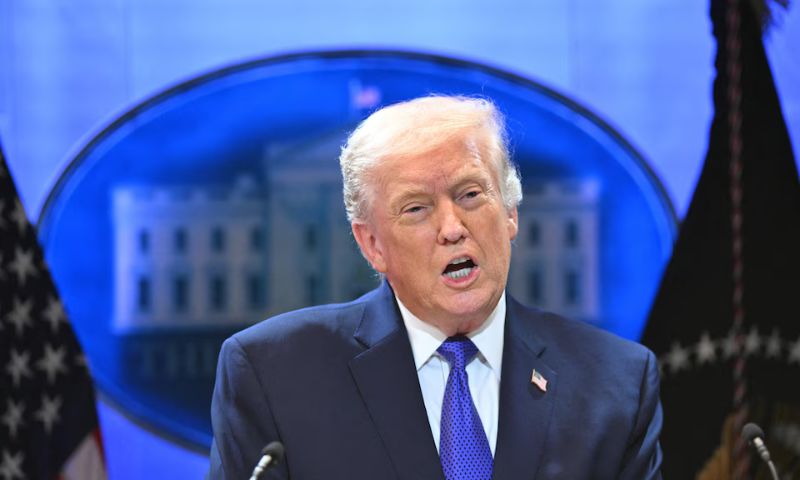
Trump made the remarks in a brief post on his Truth Social platform after reports emerged that Iran had formally responded to a US-backed framework aimed at easing hostilities and reopening negotiations over Tehran’s nuclear programme.
“I have just read the response from Iran’s so-called ‘Representatives.’ I don’t like it — TOTALLY UNACCEPTABLE!” Trump wrote.
— Rapid Response 47 (@RapidResponse47) May 10, 2026
The Iranian reply was reportedly delivered to Washington through Pakistani mediators. According to Iran’s semi-official Tasnim news agency, Tehran’s counterproposal stressed the immediate lifting of US sanctions, an end to the American naval blockade around the Strait of Hormuz following an initial agreement, and guarantees preventing any future military attacks on Iran.
The US proposal submitted last week was said to contain a 14-point memorandum outlining steps to reopen the Strait of Hormuz while paving the way for broader negotiations regarding Iran’s nuclear activities.
Among the key American demands were a suspension of Iranian uranium enrichment for up to two decades, the transfer abroad of Iran’s highly enriched uranium stockpile, and the dismantling of major nuclear facilities.
However, according to reports published by the Wall Street Journal, Iran rejected the dismantling of its facilities and instead proposed a shorter enrichment freeze, partial export of enriched uranium, and dilution of the remaining stockpile.
Earlier on Sunday, Trump also accused Tehran of “playing games” with the United States and the international community for decades, warning that Iran “will be laughing no longer”.
The latest diplomatic deadlock emerged as the ongoing ceasefire – brokered by Pakistan and implemented on 8 April – showed visible signs of strain across the Gulf region.
Israeli Prime Minister Benjamin Netanyahu warned that the conflict with Iran could not be considered over while Tehran continued to possess highly enriched uranium.
“It’s not over, because there’s still nuclear material — enriched uranium — that has to be taken out of Iran,” Netanyahu said in excerpts from an interview with CBS programme 60 Minutes.
He further insisted that Iran’s enrichment sites “have to be dismantled” and suggested that the preferred method would involve physically entering Iran to secure the nuclear material under an international arrangement.
Netanyahu claimed Trump had indicated a willingness “to go in there”. Trump, however, appeared to adopt a comparatively less urgent tone regarding Iran’s uranium reserves during a separate interview on the programme Full Measure.
He said the stockpile remained under close surveillance through US military monitoring systems, including the Space Force.
“We’ll get that at some point,” Trump said, adding that any attempt to access the facilities would be detected and met with force.
The US president also warned that military operations against Iran could resume if necessary, stating that American forces had completed “probably 70 per cent” of intended targets but retained the ability to strike additional sites.
His remarks come as Washington faces mounting international pressure to preserve the ceasefire ahead of Trump’s expected visit to China later this week. Beijing has strongly advocated for restoring stability in the Gulf and ensuring uninterrupted navigation through the Strait of Hormuz.
The future of Iran’s estimated 440 kilograms of uranium enriched to 60 per cent purity remains one of the most contentious issues in ongoing negotiations.
The International Atomic Energy Agency (IAEA) has previously stated that much of the material is stored deep beneath mountainous terrain in central Iran.
Iranian military officials insist the stockpile remains under strict protection. Brigadier General Mohammad Akrami Nia stated on Iranian state television that Iranian forces were on “full readiness” amid fears that foreign powers could attempt infiltration or airborne operations aimed at seizing the material.
Meanwhile, Russian President Vladimir Putin said Moscow’s proposal to remove and safeguard Iran’s enriched uranium stockpile as part of a negotiated settlement remained under consideration.
Regional tensions escalated further on Sunday following reports of multiple drone incursions across Gulf states.
The United Arab Emirates said its forces intercepted drones entering national airspace, which it claimed were launched from Iran.
Kuwait also reported unidentified drones entering its airspace early on Sunday, though authorities stopped short of publicly assigning responsibility.
Qatar confirmed that a drone strike caused a small fire aboard a vessel in its territorial waters near the coast. The targeted ship was reportedly travelling from Abu Dhabi.
Qatari Prime Minister Sheikh Mohammed bin Abdulrahman Al Thani later warned Iran against using the Strait of Hormuz as leverage, stressing that freedom of maritime navigation must not be endangered.
Another drone strike was reported near Erbil in northern Iraq, where a camp linked to an Iranian Kurdish opposition group was targeted.
The Strait remains at the centre of the crisis after Iran closed the vital waterway following the initial US-Israeli offensive launched on 28 February.
Trump’s subsequent initiative, named “Project Freedom”, aimed to escort commercial vessels safely through the Gulf. However, the operation was suspended after only 36 hours following Iranian attacks on US naval assets and commercial infrastructure.
Tehran has since demanded that all vessels transiting the Strait coordinate with Iranian authorities and reportedly imposed a $2 million transit toll.
Iranian state media on Sunday reported that a Panama-flagged vessel bound for Brazil had successfully passed through the waterway.