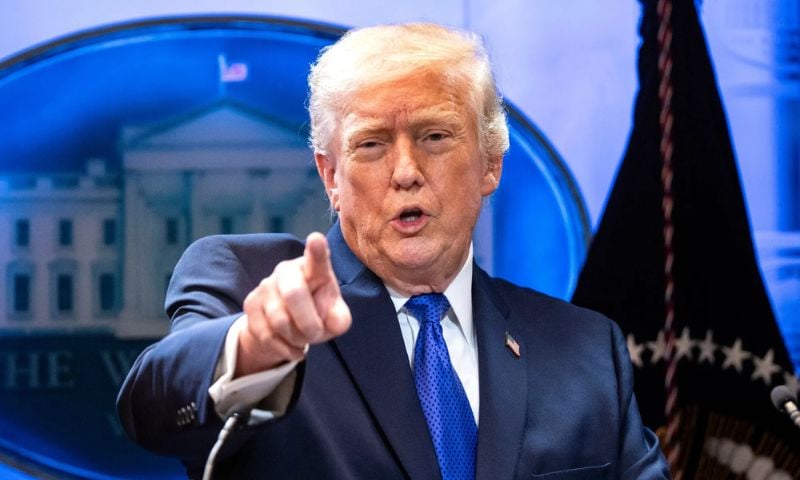



WASHINGTON: US President Donald Trump said on Saturday he was raising tariffs on goods entering the United States from 10 percent to 15 percent “effective immediately”, a day after the Supreme Court ruled that he had exceeded his authority in imposing sweeping import duties under emergency powers.
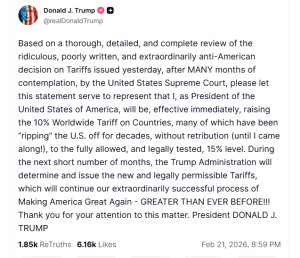
In a post on his Truth Social platform, Trump said the increase followed a “thorough review” of what he described as the court’s “extraordinarily anti-American decision” to rein in his tariff programme.
“We are hereby raising the Tariffs to the fully allowed, and legally tested, 15% level,” he wrote, adding that his administration would in the coming months determine and issue new “legally permissible” tariffs.
The announcement came hours after the conservative-majority Supreme Court ruled 6–3 that the 1977 International Emergency Economic Powers Act (IEEPA) does not authorise a president to impose tariffs.
Supreme Court setback
In the majority opinion, Chief Justice John Roberts wrote that IEEPA “contains no reference to tariffs or duties”, concluding that Trump’s use of the law to levy import taxes exceeded presidential authority.
The US Constitution grants Congress the power to impose taxes and tariffs.
The court said that if lawmakers had intended to grant such sweeping powers under IEEPA, “it would have done so expressly”.
The ruling marked one of the most significant judicial setbacks for Trump since he returned to the White House last year.
Justice Brett Kavanaugh, a Trump appointee, dissented alongside Justices Clarence Thomas and Samuel Alito.
Kavanaugh noted that the ruling “says nothing today about whether, and if so how, the government should go about returning the billions of dollars that it has collected from importers”.
The case was brought by businesses and 12 US states, most led by Democrats, who argued that Trump had overstepped executive authority.
‘Alternative authorities’
Speaking to reporters after the ruling, Trump signalled he would continue to pursue tariffs under different legal provisions.
“All the deals — we’re just going to do it a different way,” he said, adding that trade agreements negotiated under the threat of tariffs would remain intact.
Referring to India, he said: “The India deal is on.”
Trump argued that the court’s decision clarified rather than weakened presidential trade powers.
“In order to protect our country, a president can actually charge more tariffs than I was charging in the past,” he said.
Under US law, the president can impose tariffs of up to 15 percent for 150 days in certain circumstances, although such measures could face fresh legal challenges.
Treasury Secretary Scott Bessent has indicated the administration may rely on other statutory authorities, including national security provisions and laws permitting retaliatory measures against countries deemed to engage in unfair trade practices.
Analysts say these alternatives may lack the breadth and speed that IEEPA offered.
Economic and political fallout
Trump has made tariffs central to his economic and foreign policy. He launched a global trade offensive during his second term, unsettling financial markets and straining ties with allies.
Announced with fanfare last April, the tariffs imposed under IEEPA have raised more than $130 billion from importers, according to official estimates.
The Penn Wharton Budget Model has estimated that potential refunds could total $175 billion if the duties are ultimately struck down.
The Congressional Budget Office projected that if all tariffs remained in place, they could generate roughly $300 billion annually over the next decade.
US net customs duty receipts reached a record $195 billion in fiscal year 2025, according to Treasury Department data.
However, the administration has not released updated tariff revenue figures since mid-December 2025.
Trump previously suggested that Americans could receive “a little rebate” because of the revenue generated by tariffs.
On Saturday, he acknowledged that any refund process could take years.
Democratic governors seized on the ruling to demand compensation.
Illinois Governor JB Pritzker sent Trump a letter demanding nearly $9 billion in tariff refunds for families in his state, or about $1,700 per household, citing estimates by Yale University experts of the average annual cost of tariffs to US households.
“Your tariff taxes wreaked havoc on farmers, enraged our allies and sent grocery prices through the roof,” Pritzker wrote, urging the White House to “cut the check”.
California Governor Gavin Newsom made a similar demand, saying the tariffs amounted to “an illegal cash grab” and that “every dollar unlawfully taken must be refunded immediately — with interest”.
New York Governor Kathy Hochul described the tariffs as “an unlawful backdoor tax” on families and businesses, though she stopped short of calling for refunds.
Pritzker and Newsom are widely seen as potential Democratic contenders in the 2028 presidential race.
Global response cautious
Canada welcomed the ruling. International Trade Minister Dominic LeBlanc said it confirmed that the tariffs were “unjustified”, though sector-specific duties on steel, aluminium and automobiles remain in place.
European governments reacted cautiously. France’s trade minister, Nicolas Forissier, told the Financial Times that Brussels had “appropriate instruments at its disposal” should further action be required.
He referred to the EU’s anti-coercion instrument, which could target US technology firms, and to a suspended package of retaliatory tariffs covering more than $106 billion of US goods.
An EU trade spokesperson said Brussels was studying the decision carefully and remained in close contact with Washington.
The United Kingdom also said it was analysing the implications for its trade arrangements.
Markets react
Financial markets responded positively to the court’s decision. Major US stock indices rose, while Europe’s STOXX 600 extended gains.
Shares in European luxury groups including LVMH and Hermès advanced.
US Treasury yields edged higher and the dollar weakened, though it remained on track for its strongest weekly performance since October. Gold prices retreated from earlier highs.
Despite the legal setback, Trump’s latest move suggests tariffs will remain central to his approach to trade policy.