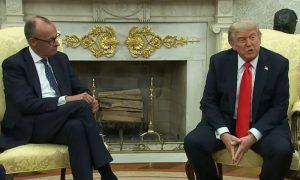
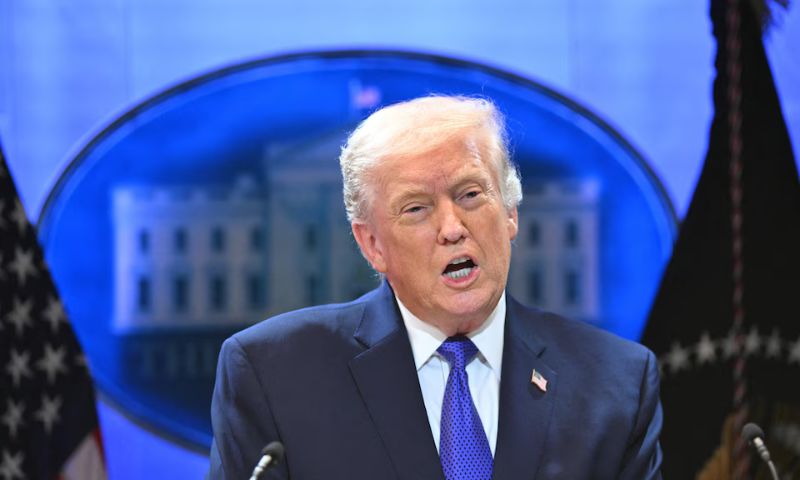



WASHINGTON: US President Donald Trump said on Tuesday that the United States will provide government-backed insurance and guarantees for ships operating in the Gulf, after Iranian attacks disrupted traffic through the Strait of Hormuz and sent oil prices sharply higher.
“Effective IMMEDIATELY, I have ordered the United States Development Finance Corporation (DFC) to provide, at a very reasonable price, political risk insurance and guarantees for the Financial Security of ALL Maritime Trade, especially Energy, traveling through the Gulf,” Trump wrote on his Truth Social platform.
He said the coverage would be available to all shipping lines.
“If necessary, the United States Navy will begin escorting tankers through the Strait of Hormuz, as soon as possible,” he added.
“No matter what, the United States will ensure the FREE FLOW of ENERGY to the WORLD,” Trump stated.
"Effective IMMEDIATELY, I have ordered the United States Development Finance Corporation (DFC) to provide, at a very reasonable price, political risk insurance and guarantees for the Financial Security of ALL Maritime Trade… If necessary, the United States Navy will begin… pic.twitter.com/pIJyFwL78j
— The White House (@WhiteHouse) March 3, 2026
The US International Development Finance Corporation (DFC) is the government’s development finance agency.
The agency’s mission is to advance US foreign policy and strengthen national security by mobilising private capital globally.
Trump said he would announce additional measures at a later date.
Strait of Hormuz disruption
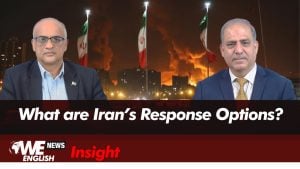
The announcement came after Iran was reported to have largely shut down the Strait of Hormuz, a vital trade artery connecting the Arabian Gulf to the Indian Ocean.
Around 20 percent of the world’s oil supply passes through the narrow waterway in Gulf.
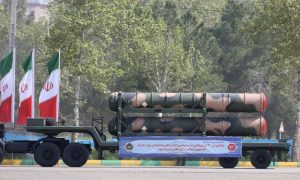
Brigadier General Ebrahim Jabbari, a senior adviser to the commander-in-chief of Iran’s Islamic Revolutionary Guard Corps, said on Monday that vessel and oil tanker transit through the strait had been halted.
He warned that ships attempting passage would be targeted.
His remarks, delivered during relatively thin global trading hours, heightened fears of deeper supply disruptions.
Some insurance companies have reportedly scaled back coverage for vessels operating in the region amid the escalating attacks.
Global oil prices surge
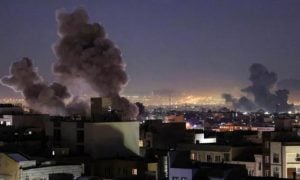
Energy prices have climbed sharply since the United States and Israel launched strikes across Iran early on Saturday, killing senior leaders including Supreme Leader Ayatollah Ali Khamenei, according to US and Israeli officials.
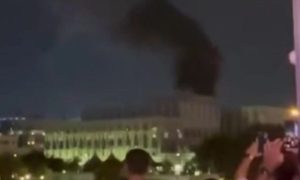
Iran has responded with missile and drone attacks targeting US bases, diplomatic facilities and military personnel across the region, as well as multiple Israeli cities.
Oil prices were already trending higher before the latest strikes.
On February 27, Brent crude closed up 2.8 percent at $73 per barrel, while West Texas Intermediate (WTI) rose 2.6 percent to $67.17.
With markets closed on February 28 and March 1, the initial reaction to the weekend strikes was delayed.
When trading resumed on March 2, Brent jumped 7.1 percent to close at $78.15, while WTI climbed 6.2 percent to $71.33.
Later that day, Jabbari’s comments pushed Brent to test $80.80 in early Asian trading, marking its highest level in nearly 15 months.
Overall, oil prices have risen by more than 15 percent since the conflict began.
Domestic impact in the US
Although the United States is largely self-sufficient in oil production, higher global prices have begun to affect domestic fuel costs.
The average price of a gallon of petrol in the US rose by more than 11 cents overnight to $3.11 on Tuesday, according to the AAA Gas Prices website.
Higher fuel costs risk adding to inflationary pressures and could weigh on public support for the conflict ahead of US midterm elections.
Earlier on Tuesday, Trump defended the military action.
“It had to happen,” he told reporters, acknowledging the human and economic costs.
“We have a little high oil prices for a little while, but as soon as this ends, those prices are going to drop — I believe — lower than even before.”