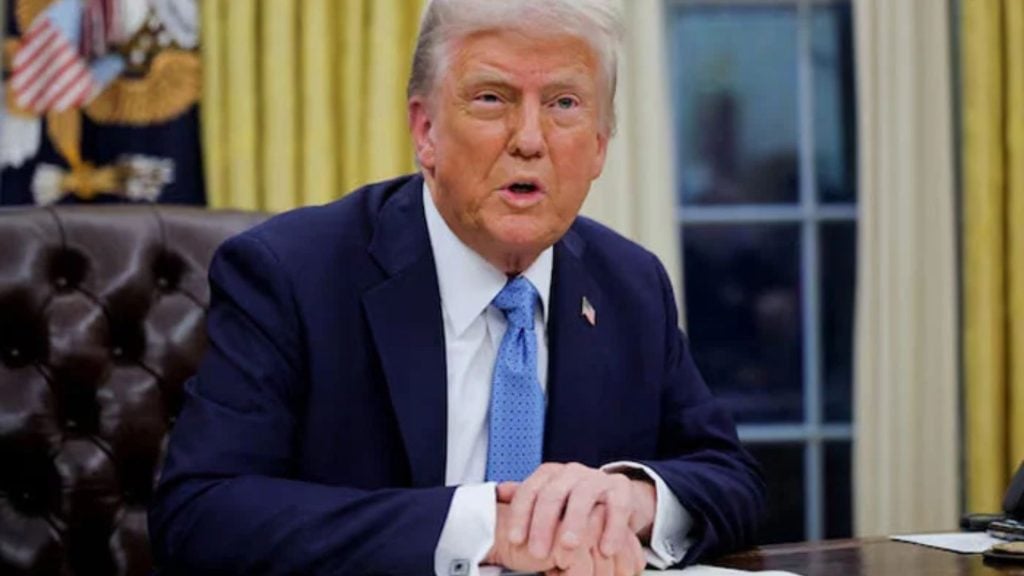



WASHINGTON: US President Donald Trump on Friday signed an executive order establishing a framework to prepare potential tariffs on countries that continue trade relations with Iran.
He simultaneously confirmed plans for a renewed round of diplomatic talks with Tehran next week. The executive order, takes effect on Saturday.
It authorizes a fresh process for the possible “imposition of tariffs” on nations maintaining commercial ties with Iran. Administration officials described the move as part of a broader strategy combining economic pressure with diplomatic outreach.
According to AFP, the announcement comes amid heightened regional and diplomatic activity, including the presence of a US naval strike group led by an aircraft carrier in Middle Eastern waters and indirect discussions on Iran’s nuclear program held in Muscat, Oman, earlier on Friday.
According to the executive order, tariffs may be applied to goods imported into the United States from any country that “directly or indirectly purchases, imports, or otherwise acquires” Iranian goods or services.
The measure builds on a warning issued by Trump last month, when he publicly floated the idea of imposing tariffs of up to 25 percent on countries trading with Tehran.
While the order does not automatically impose levies, it establishes a formal mechanism allowing the administration to act. The final tariff rate will be determined by Secretary of State Marco Rubio, with the document noting that the level could be, “for example,” 25 percent, consistent with figures previously cited by the president.
If implemented, the tariffs could affect trade flows involving several major economies, including Russia, Germany, Turkey, and the United Arab Emirates.
China remains Iran’s largest trading partner, accounting for more than a quarter of Iran’s total trade. According to World Trade Organization data, Iran recorded approximately $18 billion in imports and $14.5 billion in exports with China in 2024.
Despite the economic pressure outlined in the order, Trump emphasized progress on the diplomatic front. Speaking to reporters aboard Air Force One while traveling to his Mar-a-Lago residence in Florida, he described the Oman-mediated talks as constructive.
“We likewise had very good talks on Iran,” Trump said. “We’re going to meet again early next week.”
The Muscat discussions marked the first engagement between Washington and Tehran since the United States joined Israel’s conflict with Iran in June through strikes on nuclear-related sites. Oman has long served as a trusted intermediary between the two countries.
Diplomatic relations between Iran and the United States have remained severed since the 1979 Islamic Revolution, following the seizure of the US embassy in Tehran and the 444-day hostage crisis. Since then, direct engagement has been limited and episodic.
Inside Iran, authorities have maintained tight controls, including an ongoing internet blackout, amid a prolonged crackdown following economic protests that began in December.
The US-based Human Rights Activists News Agency (HRANA) reported on Friday that it has verified the deaths of 6,505 protesters, along with 214 members of the security forces and 61 bystanders.
US officials say the administration’s approach aims to balance diplomatic engagement with economic tools to encourage stability, compliance with international norms, and a path toward de-escalation.