


DOVER AIR FORCE BASE, Delaware: The bodies of the first six American service members killed in the escalating conflict with Iran were returned to the United States on Saturday, marking a somber milestone in a war that could shape both the nation’s future and President Donald Trump’s presidency.
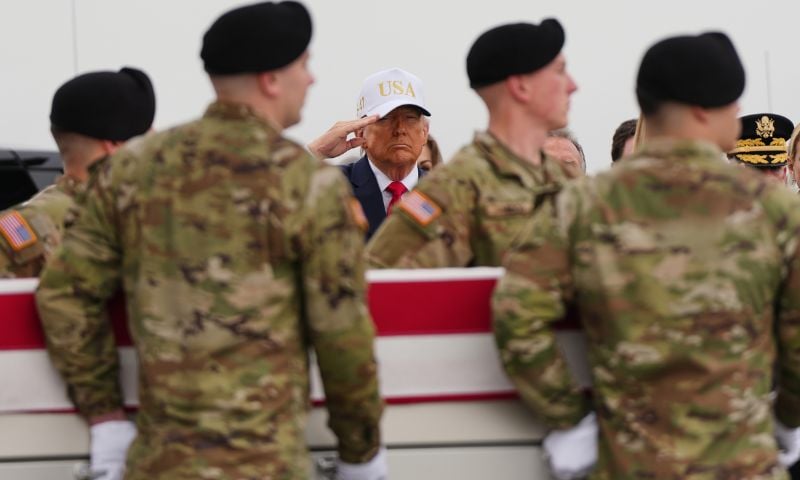
Under gray skies at Dover Air Force Base, the remains of the soldiers were carried from a U.S. Air Force C-17 transport plane during a solemn ceremony known as a “dignified transfer.”
President Donald Trump, Vice President JD Vance, Defense Secretary Pete Hegseth, and senior military officials stood in silent tribute as the flag-draped cases were removed from the aircraft, according to The Washington Post.
The fallen service members were killed in Kuwait six days earlier when an Iranian drone struck their operations center. Their deaths represent the first confirmed American casualties since the United States launched military operations against Iran.
The soldiers were identified as Chief Warrant Officer 3 Robert M. Marzan, 54, of Sacramento; Maj. Jeffrey R. O’Brien, 45, of Indianola, Iowa; Sgt. Declan J. Coady, 20, of West Des Moines, Iowa; Sgt. 1st Class Nicole M. Amor, 39, of White Bear Lake, Minnesota; Capt. Cody A. Khork, 35, of Winter Haven, Florida; and Sgt. 1st Class Noah L. Tietjens, 42, of Bellevue, Nebraska.
Family members, including spouses and young children, quietly watched the ceremony as a light breeze moved across the airfield. Trump spent more than an hour privately meeting with the families before the transfer ceremony began.

Speaking afterward aboard Air Force One, the president acknowledged the painful reality of the conflict. “It’s a very sad day. I hate to do it, but it’s part of war,” Trump said. “It’s the bad part of war.”
A war Trump says will be short
The Iran conflict represents a turning point for Trump, who previously criticized prolonged U.S. military engagements in the Middle East. Now, he finds himself presiding over a new war that could either remain limited or evolve into a much broader confrontation.
Trump described the military campaign as a “short excursion” that he expects to last only a few weeks. So far, the U.S. response has relied mainly on airstrikes targeting Iranian military infrastructure.
However, the president did not rule out deploying American ground troops if circumstances require it. “If there were a very good reason, we would do it,” he said, suggesting that military escalation remains an option.
Uncertain path ahead
Despite the administration’s expectation of a brief conflict, the war’s outcome remains uncertain. Analysts warn that confrontation with Iran — a nation with a population nearly twice the size of Iraq’s — could easily expand into a prolonged regional struggle similar to past U.S. wars in the Middle East.
Trump framed the operation as a long-delayed effort to confront Iran’s leadership, arguing that previous administrations avoided decisive action. “This is something that should have been done decades ago,” he said, comparing the campaign to removing a cancer.
A president at war
The ceremony in Dover highlighted the emotional weight of Trump’s new role as a wartime president. Unlike earlier visits to receive fallen service members from conflicts he inherited, these casualties came from a war he chose to launch.
During the ceremony, Trump and senior officials stood in silence for more than half an hour as each flag-covered case was carried across the tarmac. A chaplain delivered a prayer while military personnel saluted.
The president later reflected on the difficulty of consoling grieving families — a responsibility he has previously called one of the hardest aspects of the presidency. “These soldiers are coming home in a different way than they expected,” Trump said earlier in Florida before departing for Delaware.
How the war could end
Trump offered several possible outcomes for the conflict. One scenario, he said, would see Iran’s leadership concede defeat. Another possibility is the collapse of the regime itself. “It could end where they cry uncle,” Trump said. “Or it could end where they can’t fight anymore and there’s no one left to cry uncle.”
He added that the United States wants to prevent a cycle of repeated confrontations with Iran in the future. “We don’t want to come back every five or ten years and do this again,” he said. For now, the return of the first fallen soldiers underscores the human cost of a conflict that may only be beginning.