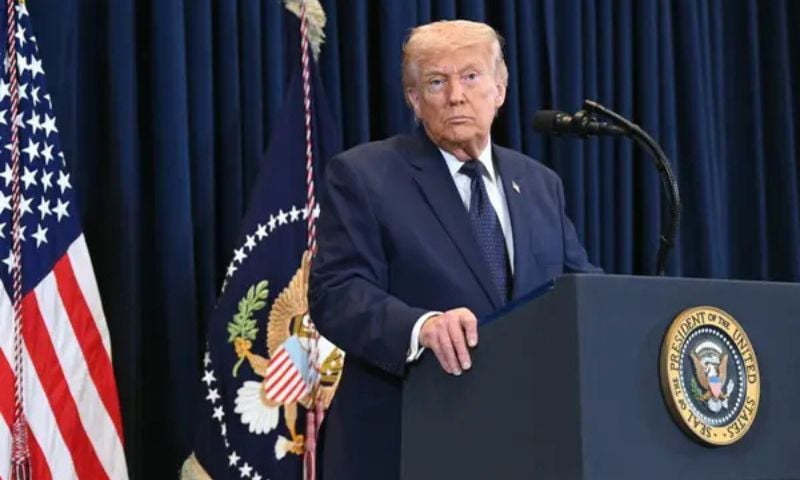



WASHINGTON: US President Donald Trump told leaders of the Group of Seven (G7) during a virtual meeting this week that Iran was “about to surrender”, according to a report by Axios on Friday citing three officials from G7 countries briefed on the call.
The remarks came as the war between Iran and the United States and Israel continued for 14th day, rising regional tensions and mounting concerns over global energy supplies.
According to the Axios report, Trump told allies during the Wednesday morning call that he had “got rid of a cancer that was threatening us all”, while highlighting the success of the US military campaign against Iran, known as Operation Epic Fury.
Trump also reportedly claimed that Iran’s leadership structure had been severely disrupted by the US and Israeli strikes.
“There is no one to surrender because nobody knows who the leader is,” he told the G7 leaders, according to the report.
Strait of Hormuz closure
The conflict began on February 28 when the United States and Israel launched joint strikes targeting Iran’s leadership and military infrastructure.
The attacks killed Iran’s long-time supreme leader Ayatollah Ali Khamenei and several senior officials in Tehran.
Since then, Iran has launched retaliatory missile and drone attacks against Israel and US military bases across the region.
Iran has also blocked the Strait of Hormuz, a vital maritime chokepoint through which around 20 percent of the world’s oil shipments normally pass.
Iranian state television reported on Friday that the country had launched a new wave of missile strikes against Israel, describing it as a fresh barrage targeting “the occupied territories”.
Iran Supreme Leader vows retaliation
Iran’s new Supreme Leader, Mojtaba Khamenei — the son of the late Ali Khamenei — issued his first public statement on Thursday through state television.
In the message, read out by a presenter rather than delivered in person, he vowed to avenge those killed in the attacks and warned that Iran would continue blocking the Strait of Hormuz.
“I assure everyone that we will not neglect avenging the blood of your martyrs,” Khamenei said in the statement.
He also warned neighbouring countries hosting US bases that they risked becoming targets if those facilities remained operational.
The new leader said Iran could use “the lever of blocking the Strait of Hormuz” and hinted at opening additional fronts in the conflict.
There remains uncertainty about Khamenei’s physical condition.
Iranian officials have said he was wounded during the initial strikes, though details remain unclear.
Trump threatens further strikes
Speaking to Fox News on Friday, Trump said he believed Mojtaba Khamenei was alive but injured.
“I think he probably is (alive). I think he is damaged, but I think he’s probably alive in some form,” Trump said in the interview.
The US president also warned that American forces would intensify their military campaign.
“We’re going to be hitting them very hard over the next week,” Trump told Fox News, adding that the United States could escort commercial vessels through the Strait of Hormuz if necessary.
“We would do it if we needed to,” he said.
In comments posted on social media, Trump used harsh language against Iranian leaders, describing them as “deranged scumbags” and saying the United States was “totally destroying” the Iranian government.
Highest of US strikes on Iran
US Defence Secretary Pete Hegseth said the scale of the campaign had grown rapidly.
“Between our air force and that of the Israelis, over 15,000 enemy targets have been struck. That’s well over 1,000 a day,” Hegseth told a news conference.
He said Friday would see the highest number of US strikes since the start of the conflict.
The Pentagon chief also said Washington would not allow Iran to challenge shipping in the Strait of Hormuz.
“The United States will not allow shipping in the Strait of Hormuz to be contested,” Hegseth said.
He added that the US had “a range of options” to deal with Iran’s nuclear programme, including the possibility that Iran might decide to abandon its nuclear ambitions.
Strait of Hormuz crisis
The strategic waterway has become a central focus of the conflict.
Chairman of the US Joint Chiefs of Staff General Dan Caine described the strait as a “tactically complex environment” and said military planners were carefully assessing options to secure shipping lanes.
“It’s a tactically complex environment,” Caine said, noting that the US military wanted to ensure safe operations before escorting vessels at scale.
Hegseth said there was no clear evidence that Iran had placed naval mines in the strait.
Despite that, the United States has made securing energy flows through the waterway a priority.
Israeli strikes and Iran’s missile attacks
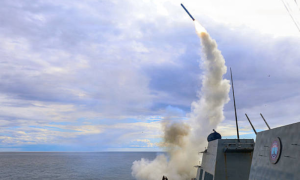
Israel said its air force struck more than 200 targets in western and central Iran over the past day, including ballistic missile launchers, air defence systems and weapons production facilities.
The strikes are part of Israel’s campaign known as Operation Roar of the Lion.
Iran has continued its own attacks. An Iranian missile struck a Bedouin Arab town in northern Israel near Nazareth, damaging several homes.
Israel’s ambulance service said 58 people were injured, including one person in moderate condition.
Elsewhere in the region, US Central Command said it was conducting rescue operations after one of its refuelling aircraft went down in Iraq in an incident involving another aircraft.
An Iran-aligned militia group known as the Islamic Resistance in Iraq claimed responsibility for downing the plane.
French President Emmanuel Macron said one soldier had been killed and several others wounded in an attack in northern Iraq.
Energy markets shaken
The closure of the Strait of Hormuz has sent oil prices sharply higher and disrupted global supply chains.
In an attempt to stabilise markets, the United States on Thursday issued a 30-day licence allowing countries to purchase Russian oil that is currently stranded at sea.
US Treasury Secretary Scott Bessent described the price surge as a temporary disruption.
“The temporary increase in oil prices is a short-term and temporary disruption that will result in a massive benefit to our nation and economy in the long term,” he said in a statement.
Trump also noted that rising prices could benefit the United States economically, pointing out that the country is the world’s largest oil producer.
Political backlash in Washington
Trump’s comments have drawn criticism from opposition Democrats, who accuse the administration of downplaying the war’s humanitarian impact.
Lawmakers have demanded more information about civilian casualties, particularly a strike that killed dozens of children at an Iranian girls’ school.
US Central Command has appointed an officer outside the command to conduct an investigation into the incident, Hegseth said.