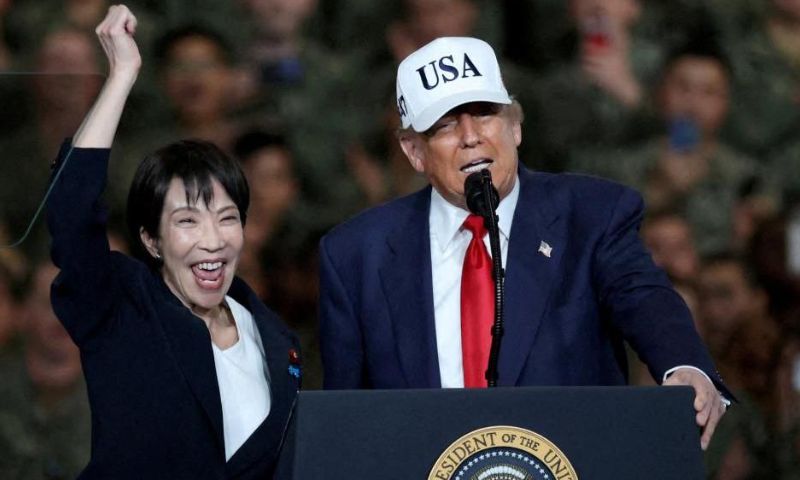



TOKYO: Japanese Prime Minister Sanae Takaichi won the full endorsement of US President Donald Trump on Friday, just two days before snap elections that opinion polls suggest could deliver her coalition a commanding super-majority.
Japan’s first woman prime minister is hoping to capitalise on strong public support in Sunday’s vote after assuming leadership of Asia’s second-largest economy in October.
“Takaichi has already proven to be a strong, powerful, and wise Leader, and one that truly loves her Country,” Trump wrote on his Truth Social platform, announcing that she would visit the United States on March 19.
Trump said Washington and Tokyo were working toward a “very substantial” trade agreement and continuing close cooperation on national security, offering what he described as his “Complete and Total Endorsement.”
“Prime Minister Takaichi is someone who deserves powerful recognition for the job she and her Coalition are doing,” he added.
While US presidents have traditionally avoided endorsing candidates in foreign elections, Trump has repeatedly broken with convention, previously backing leaders such as Argentina’s President Javier Milei and Hungary’s Prime Minister Viktor Orban, according to AFP.
Takaichi, 64, made a strong diplomatic push to welcome Trump to Japan shortly after taking office, endorsing him for the Nobel Peace Prize and presenting him with golf memorabilia.
In July, trade officials reached an agreement under which Washington lowered tariffs on Japanese goods to 15 percent from a threatened 25 percent, in exchange for Japanese investment commitments.
Trump has not publicly commented on Takaichi’s recent tensions with China after she suggested in November that Japan would intervene militarily if Beijing attempted to seize self-ruled Taiwan by force.
China has never governed democratic Taiwan but claims the island as its own and has not ruled out the use of force to annex it.
Polls signal landslide
Pollsters—while cautioning that a significant number of voters remain undecided—forecast a resounding victory for Takaichi in Sunday’s lower house elections following a strong honeymoon period.
She appears to have revitalised the long-dominant but increasingly fragile Liberal Democratic Party (LDP), which had suffered voter defections due to inflation and a high-profile political slush fund scandal.
Despite her ultraconservative positions, Takaichi has gained broad support among younger voters, a notable shift in an ageing society where older generations have traditionally shaped election outcomes.
“Her gamble of calling elections will pay handsome dividends as she will gain a strong mandate and probably a standalone majority that will help her enact an ambitious array of economic and security reforms,” said Jeff Kingston, professor of history and Asian studies at Temple University Japan.
“Trump will welcome the election of a conservative leader with a strong mandate. He likes winners, and she has delivered on boosting defence spending and supporting the investment deal to reduce tariffs,” Kingston told AFP.
Surveys ahead of Sunday’s vote indicate that the LDP is likely to comfortably surpass the 233 seats required for a majority in the 465-seat lower house.
A smartphone-based poll of more than 220,000 respondents released by the Mainichi Shimbun on Friday suggested the LDP could secure more than 300 seats.
Combined with seats held by coalition partner Japan Innovation Party (JIP), the ruling bloc could achieve a two-thirds super-majority, according to the newspaper.
Meanwhile, the newly formed Centrist Reform Alliance—comprising the main opposition Constitutional Democratic Party (CDP) and the LDP’s former partner Komeito—is projected to lose up to half of its current 167 seats, according to other polls.
Market jitters persist
Beyond diplomatic friction with China, Takaichi has unsettled financial markets. Yields on long-term Japanese government bonds have reached record highs, while the yen has fluctuated sharply.
Investor concerns centre on Japan’s massive public debt—more than twice the size of its economy—amid Takaichi’s proposed $135-billion stimulus package and pledges to cut taxes.
However, Abhijit Surya of Capital Economics said fears of fiscal recklessness were overblown.
“In the event that the government did attempt to play fast and loose with the public finances, we would expect bond markets to put it in check,” he said.