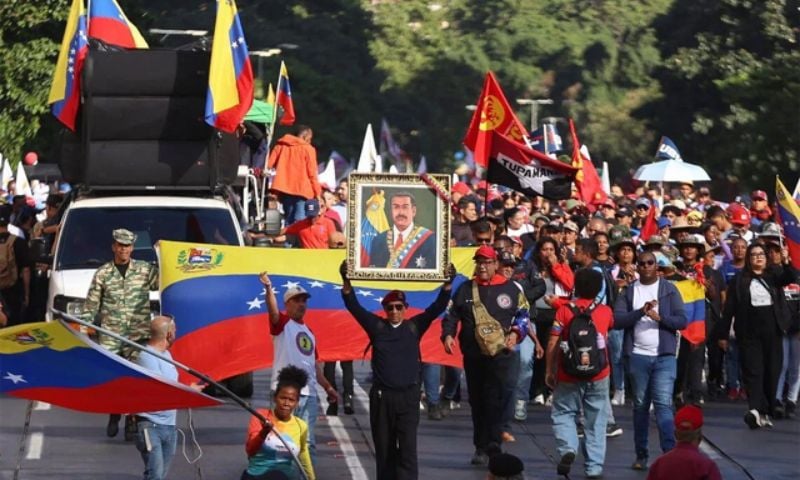



CARACAS, Venezuela: Thousands of supporters of Venezuela’s former leader Nicolás Maduro marched through the streets of Caracas on Tuesday, calling for his release a month after he was ousted in a deadly US military operation and taken to New York to face drug trafficking charges.
“Venezuela needs Nicolás,” demonstrators chanted as the crowd advanced through the capital, marking exactly one month since Maduro was dramatically toppled and removed from the country. The protest underscored the deep political divisions gripping the crisis-hit nation following his arrest.
Interim President Delcy Rodríguez has been navigating a delicate balancing act since assuming power, seeking to maintain the backing of Washington while also holding together a government and public still heavily influenced by loyalists to Maduro, according to AFP.
Several demonstrators, many of them public sector workers, carried photographs of Maduro and his wife, Cilia Flores, who was also detained during the US raid.
The march, organized by the government, stretched several hundred meters and was accompanied by trucks blasting music as participants waved Venezuelan flags.
“These people are not American,” said Maduro’s son, Nicolás “Nicolasito” Maduro Guerra, a deputy in Venezuela’s National Assembly, addressing the crowd. “We have achieved a profound anti-imperialist consciousness.”
Many protesters were dressed in the red colors associated with the ruling Chavista movement, named after Maduro’s socialist predecessor Hugo Chávez.
“We feel confused, sad, angry. There are a lot of emotions,” said José Perdomo, a 58-year-old municipal employee who attended the march.
While expressing loyalty to Maduro, Perdomo also voiced support for Rodríguez, saying he backed “the decisions taken by our interim president.” He added, “Sooner or later they will have to free our president.”
A fragile transition
Rodríguez, a long-time ally of Maduro who previously served as his vice president, has faced mounting international and domestic pressure since taking office.
US President Donald Trump has said he is prepared to work with her administration provided it aligns with Washington’s demands, particularly granting access to Venezuela’s vast oil reserves.
Under that pressure, Rodríguez has begun releasing political prisoners and has opened the country’s long-nationalized hydrocarbons sector to private investment.
The moves have coincided with a thaw in diplomatic relations between Caracas and Washington, which were severed in 2019 after Maduro was accused of stealing his first reelection.
That rapprochement was underscored by the arrival in Caracas on Saturday of US envoy Laura Dogu. In a video released by the US mission on Tuesday, Dogu outlined a three-phase plan for Venezuela aimed at ending with “the transition to a friendly, stable, prosperous and democratic Venezuela.”
Rodríguez confirmed that the meeting had taken place, describing it as a “frank conversation.”
Calls for amnesty
Earlier on Tuesday, hundreds of university students and relatives of political prisoners also marched in Caracas, demanding swift approval of an amnesty law promised by Rodríguez as part of her efforts to ease political tensions.
The interim president said she was working “intensely” on the proposed amnesty, which she said would allow the country, after years marked by “political violence and extremism,” to pursue a broader national policy of reconciliation.
The bill has yet to be formally introduced in parliament, which is led by Rodríguez’s brother, Jorge Rodríguez, himself a prominent Chavista and Maduro ally. Opposition lawmaker Stalin González told AFP he expects the first debate on the amnesty law to take place on Thursday.
“I hope that the amnesty opens the door to reconciliation, coexistence, peace and democracy,” González said.
Large-scale anti-government protests have been rare since a crackdown on demonstrations following Maduro’s contested claim to another reelection in 2024, a period during which more than 2,000 people were jailed.
“Freedom is in the streets and no one can stop it!” protesters shouted during Tuesday’s marches.
The Venezuelan opposition has continued to call for fresh elections in the wake of Maduro’s ouster, arguing that only a new vote can restore democratic legitimacy to the country’s leadership.