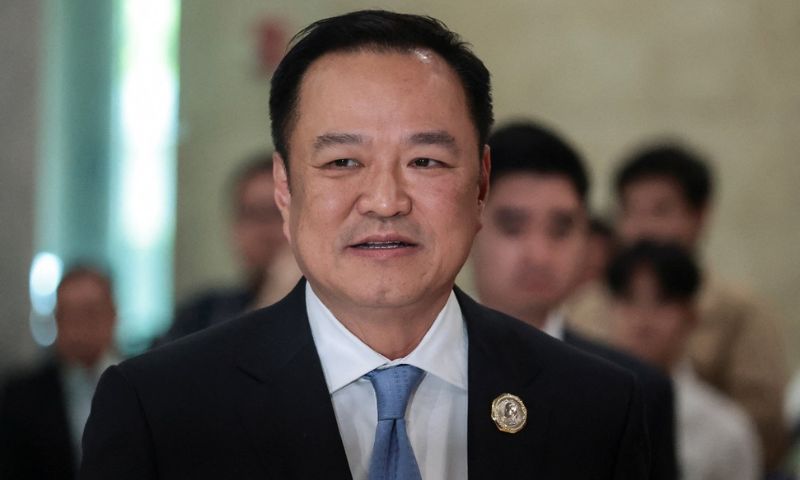



BANGKOK: Thailand’s newly formed parliament on Thursday elected Anutin Charnvirakul as prime minister, reaffirming his leadership after his party’s strong performance in recent elections.
House Speaker Sophon Zaram announced that Anutin secured 293 votes, comfortably surpassing the majority required to form the government. His main challenger, progressive leader Natthaphong Ruengpanyawut, received 119 votes, while 86 lawmakers abstained.
Addressing the media ahead of the vote, Anutin expressed his commitment to public service, stating that he would continue to respond swiftly to issues affecting citizens.
The 59-year-old leader heads the conservative Bhumjaithai Party, which emerged as the largest party in February’s elections.
According to AFP, the party capitalized on a platform focused on national security and border control, including pledges to strengthen measures along Thailand’s frontier with Cambodia following last year’s deadly clashes.
Anutin’s path to continued leadership was also shaped by political shifts within the country. The Pheu Thai Party, associated with former prime minister Thaksin Shinawatra, joined a coalition government alongside Bhumjaithai and several smaller parties, ensuring a parliamentary majority.
He initially rose to power in September after the removal of his predecessor, Paetongtarn Shinawatra, who was dismissed by a court ruling over an ethics controversy linked to a leaked conversation that sparked political backlash.
As prime minister, Anutin now faces a complex set of challenges. Thailand’s economy has shown signs of slowing growth, with its tourism sector struggling to recover and increased competition from regional economies such as Vietnam.
Rising global fuel prices, exacerbated by the ongoing Middle East conflict, are also placing pressure on the country’s economy.
In addition to economic concerns, tensions along the Cambodia border remain unresolved despite a fragile ceasefire. The disputed boundary has been a source of periodic conflict, with military activity intensifying as recently as December.
Political analysts suggest that while security concerns played a role in the elections, public attention is now shifting toward economic stability and cost-of-living issues.
Meanwhile, the reformist People’s Party, which finished second in the elections, will lead the opposition. However, several of its members, including its leader, are facing legal challenges that could impact their political future.
With a fresh mandate, Anutin’s government is expected to focus on stabilizing the economy while navigating both domestic and international pressures in the months ahead.