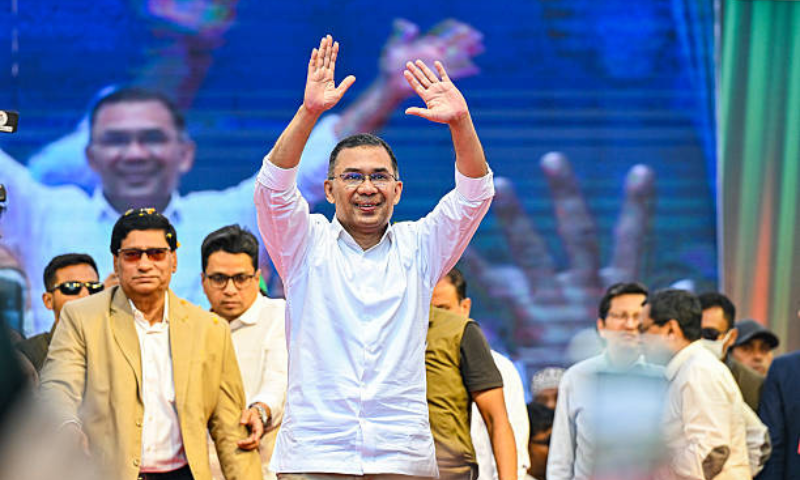



DHAKA: Bangladesh’s prime minister-designate Tarique Rahman and newly elected lawmakers were sworn into parliament on Tuesday, marking the first seating of an elected legislature since the 2024 uprising that toppled former premier Sheikh Hasina.
The oath was administered by Chief Election Commissioner AMM Nasir Uddin, as members pledged allegiance to the constitution and the people of Bangladesh.
Rahman, leader of the Bangladesh Nationalist Party (BNP), is expected to be formally elected parliamentary leader by his party before being invited by President Mohammed Shahabuddin to form the government. The prime minister’s oath is expected later.
Rahman’s BNP-led coalition secured 212 seats in the February 12 elections, comfortably ahead of the Jamaat-i-Islami-led alliance, which won 77 seats. Jamaat, however, has challenged results in 32 constituencies despite its leader pledging to act as a “vigilant, principled, and peaceful opposition.”
Rahman has pledged to restore economic stability and strengthen institutions after 18 months of interim administration following Hasina’s removal from power.
Landslide mandate
In his victory speech, Rahman described the outcome as a triumph for democracy. “This victory belongs to Bangladesh, belongs to democracy,” he said. “This victory belongs to people who aspire to and have sacrificed for democracy.”
The election was the first since last year’s uprising that forced Hasina from office and ushered in a caretaker administration led by Nobel laureate Muhammad Yunus.
Rahman warned that his government would inherit a fragile economy and weakened institutions. “We are about to begin our journey in a situation marked by a fragile economy left behind by the authoritarian regime, weakened constitutional and statutory institutions, and a deteriorating law and order situation,” he said.
Bangladesh, a nation of 170 million people and the world’s second-largest garment exporter, has faced months of political turmoil that unsettled investors and strained public finances.
Political reset
Rahman’s return to power marks a dramatic comeback. He came back to Bangladesh in December after 17 years in self-imposed exile in Britain.
Hasina’s Awami League was barred from contesting the vote, and the former premier — sentenced to death in absentia for crimes against humanity — rejected the election as “illegal” in a statement from India.
India, however, congratulated the BNP on its “decisive win,” signalling a possible reset in previously strained ties.
Only seven women were directly elected, though 50 additional reserved seats will be allocated proportionally. Four members of minority communities — including two Hindus — secured seats in the new parliament.
Despite weeks of tension ahead of the vote, election day passed without major unrest, and the country has so far reacted calmly to the results, raising hopes for a period of relative stability after a turbulent chapter in Bangladesh’s political history.