


MOSCOW: Russia has warned that Afghanistan remains a major threat to regional security, saying the Taliban regime continues to allow conditions in the country that enable terrorist groups to operate on Afghan soil.
A Russian Foreign Ministry official said the Taliban regime has failed to prevent terrorist groups from operating on Afghan territory despite repeated assurances to neighbouring countries.
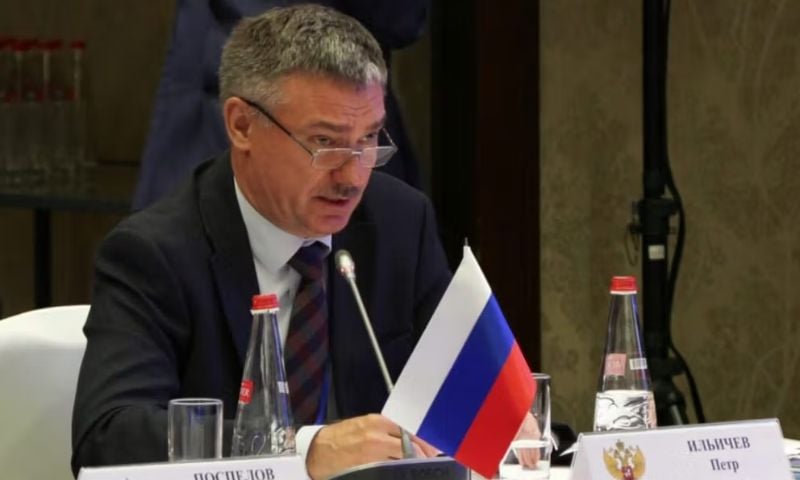
Pyotr Ilyichev, Director of the Russian Foreign Ministry’s Department for New Challenges and Threats, said that around 20 terrorist groups with between 20,000 and 23,000 fighters are currently present in Afghanistan, posing a threat to regional stability.
The senior Russian official made the remarks during the 19th meeting of heads of counterterrorism structures from Commonwealth of Independent States (CIS) member countries, according to Russia’s state news agency TASS.
“The security situation in Afghanistan remains critical,” Ilyichev said, warning that the threat was particularly acute for states bordering Afghanistan.
Ilyichev said the Taliban regime continued to allow conditions that enabled terrorist groups to operate inside Afghanistan.
The Russian official also expressed concern about terrorist groups gaining access to modern technologies, including commercial satellite communications and the potential use of artificial intelligence (AI), TASS reported.
He also raised concerns about the risks of cross-border terrorist attacks and efforts by terrorist groups to radicalise vulnerable segments of society in neighbouring countries.
The Russian official said the threat was compounded by growing links between terrorist groups and organised criminal networks.
According to Ilyichev, these terrorist groups finance their activities through narcotics trafficking, illicit arms trading, the smuggling of precious stones and metals, and wildlife trafficking.
Several United Nations reports and assessments by regional intelligence agencies have continued to highlight the presence of terrorist groups, including the banned Tehrik-e-Taliban Pakistan (TTP) and ISIS-Khorasan (ISIS-K), in Afghanistan.
At regional forums such as the Collective Security Treaty Organisation (CSTO), CIS and Moscow Format meetings, Russia has repeatedly called for measures to prevent Afghanistan from becoming a safe haven for terrorists and has advocated strengthening the southern borders of Central Asian states.
Earlier on Monday, addressing the UN Security Council, Russia’s Deputy Permanent Representative to the United Nations, Anna Evstigneeva, said Afghanistan’s Taliban regime failed to take action against terrorist groups.
“Another source of concern is the continued presence of ISIL-Khorasan in Afghanistan,” Evstigneeva told the Security Council.
“Unfortunately, the efforts undertaken by the authorities to combat terrorist threats are currently insufficient.”
She warned that ISIS-K was strengthening its position through recruitment and financing efforts while seeking to destabilise Afghanistan and the broader region.
According to Evstigneeva, the group was also exploiting the presence of terrorists linked to the Tehreek-e-Taliban Pakistan (TTP) and the East Turkestan Islamic Movement (ETIM), also known as the Turkistan Islamic Party.
“Terrorists are exploiting every opportunity to destabilise the situation in the country and the region as a whole,” she said.
Russia also highlighted concerns over military equipment left behind after the withdrawal of US-led NATO forces from Afghanistan in 2021.
Evstigneeva said the status of weapons abandoned during the withdrawal remained unclear and continued to contribute to regional security risks.
According to the Russian diplomat, there were concerns that such equipment could ultimately benefit terrorist organisations operating in Afghanistan.
The latest Russian statements underscore persistent international concerns about Afghanistan’s security environment nearly five years after the Taliban returned to power.