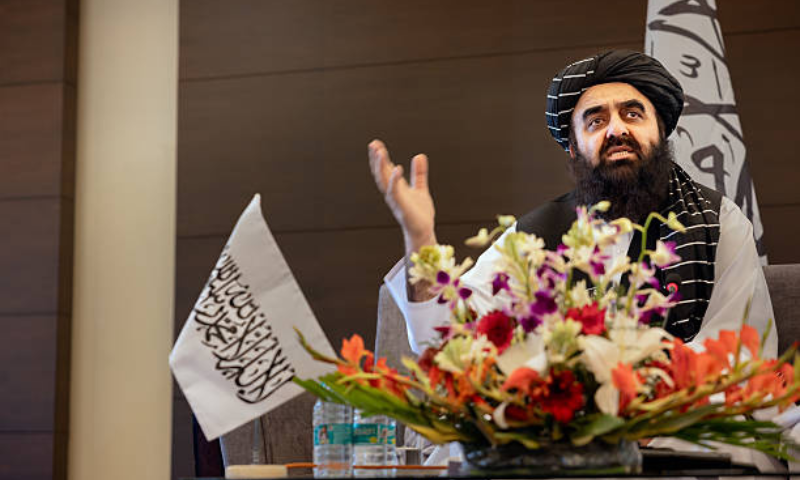



ISLAMABAD: Afghanistan has announced that any Afghan using the country’s soil to carry out attacks against another state will be treated as a criminal, Foreign Minister Amir Khan Muttaqi said, reaffirming the Taliban administration’s pledge to prevent cross-border militancy.
“Anyone using Afghan soil to target another country will be dealt with as a criminal,” Muttaqi declared on Thursday .
Speaking at a ceremony in a Kabul madrassa, Muttaqi said the Islamic Emirate had an unambiguous commitment to prevent its soil from being used for hostile acts. “We have a pledge and commitment that Afghan soil will not be used against any other country,” he said. “If any Afghan violates this principle, the Islamic authorities have the full right to stop them and hold them accountable.”
Muttaqi anchored his remarks in the recent guidance issued by Afghanistan’s senior religious scholars, who he said “occupy the position of guides for the nation and the wider Muslim community.” He explained that their resolutions provide a religious framework for both governance and national security.
No Right to Conduct Operations Abroad
Muttaqi underscored that the scholars were unequivocal in their view that Afghan territory must not be used for external operations. “There is unanimous agreement that the Islamic Emirate does not grant anyone the right to carry out operations in other countries,” he said. “Anyone attempting to do so may lawfully be stopped and prevented.”
He said the leaders of the Islamic system had pledged that Afghan soil would not be misused for hostile purposes. “The scholars insist that adherence to this commitment is mandatory for all. The Emirate is fully entitled to restrain any actor seeking to violate this principle,” the foreign minister added.
Call for Unity and Against Internal Hostility
Muttaqi concluded by echoing the scholars’ calls for unity within the Muslim community, urging Afghans to avoid enmity and division. “They have stressed the importance of solidarity, brotherhood, and mutual respect as guiding principles for relations among Muslims,” he said.
According to the foreign minister, the scholars emphasised that just as the establishment of an Islamic government is obligatory for Muslims, its protection is equally a religious duty. “Defending the Islamic system is not the responsibility of the military alone,” he said. “It is a collective obligation upon the entire nation, the community at large, and every individual.”
He added that the scholars had clarified that any aggression—“whether from near or far”—against the Islamic government makes resistance a religious duty. “Our ulema state that confronting such hostility becomes a collective responsibility,” Muttaqi noted.
Context: Remarks Follow Major Kabul Assembly of 1,000 Scholars
Muttaqi’s comments came just two days after a significant gathering of more than 1,000 Afghan clerics and religious leaders in Kabul urged the interim Taliban government to prevent militant groups from using Afghan soil to launch attacks abroad, including cross-border assaults into Pakistan.
The resolution called on the Islamic Emirate to ensure that Afghan territory is not used to destabilise neighbouring states and to curb the movement of fighters across borders. These remarks were widely interpreted as indirectly referencing Pakistan’s concerns over the presence of Tehreek-e-Taliban Pakistan (TTP) sanctuaries inside Afghanistan.
Diplomats and analysts say the coordinated messaging—from both the ulema and the foreign minister—suggests Kabul is attempting to signal responsiveness to regional security concerns at a time of heightened tensions with Pakistan and increasing scrutiny from neighbouring countries.