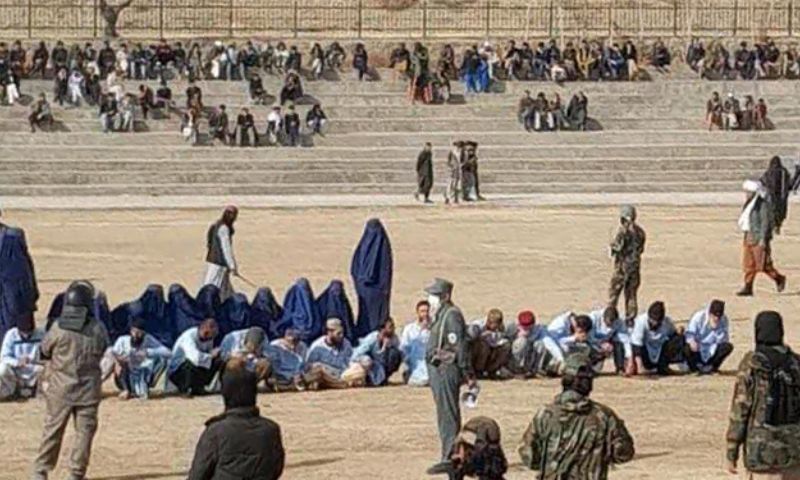



KABUL: The Taliban publicly flogged at least 1,186 people and carried out six public executions across Afghanistan between March 2025 and March 2026, according to official statements released by the group’s judiciary.
The figures, compiled from announcements by the Taliban’s Supreme Court and reported by Amu TV, underscore the ongoing use of corporal punishment as a standard judicial practice. The punishments spanned dozens of provinces, including major urban centers such as Kabul, Herat, and Kandahar, as well as remote areas like Badakhshan, Ghor, and Helmand.
Judicial statements indicate that corporal punishment intensified in the latter half of the year. Among those flogged were nearly 100 women, many of whom were punished in public settings over an eight-month period.
Human rights researchers say the expansion of such measures reflects a broader pattern of restrictive governance under Taliban rule and raises serious concerns about due process.
“These punishments violate basic human rights standards and create a climate of fear in society,” said Abdul Ahad Farzam, a human rights researcher.
Executions and retributive justice
Public executions during the year were carried out under the principle of qisas (retributive justice), with residents in at least four provinces witnessing the killings.
In the most recent case, a man was executed in a sports stadium in Khost province before thousands of spectators, including children. Additional executions were reported in Badghis, where three people were put to death, along with one case each in Farah and Nimroz.
New penal code and crackdown on dissent
Alongside physical punishments, the Taliban introduced a new penal code during the year, which drew widespread international criticism over its severity and lack of legal safeguards.
Authorities also intensified enforcement against dissent. In Kapisa province, a man was sentenced to 39 lashes and 18 months in prison for what officials described as “propaganda against the system.” In Badghis, another individual was flogged and jailed for allegedly insulting Taliban leader Hibatullah Akhundzada.
International condemnation
While Taliban officials have defended the punishments as an enforcement of Islamic law, rights groups and international observers warn that such practices are deepening Afghanistan’s isolation and eroding fundamental freedoms.
The continued use of corporal punishment, they say, highlights the absence of fair trial standards and the consolidation of a judicial system rooted in punitive measures rather than legal safeguards.