


Key points
- Seven planets are briefly visible
- Heavenly show for last time until 2040
- Astrophotographers capture stunning images
ISLAMABAD: Skywatchers are in for a treat this week as seven planets – Mars, Jupiter, Uranus, Venus, Neptune, Mercury, and Saturn are briefly visible in the evening sky.
This phenomenon, known as a “planetary parade” is a rare sight, and it will be the last time seven planets can be seen simultaneously so well until 2040.
The best chance to see as many planets as possible will be just after sunset on Friday.
Stunning photographs
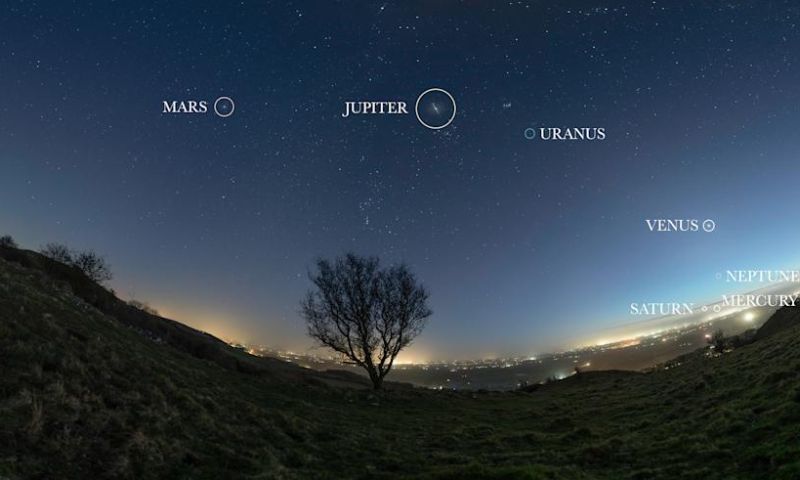
Astrophotographer Josh Dury captured stunning photographs of the seven-planet alignment on February 22 from the Mendip Hills, Somerset, UK.
“A fantastic, yet challenging photographic opportunity to observe all planets during a small window in time,” Dury told Space.com in an email.
For most, three of the brightest planets — Venus, Jupiter and Mars — will be easily visible to the naked eye. Those with a clear unobstructed view of the horizon may also be able to spot Saturn and Mercury, while Uranus and Neptune can be spotted with binoculars, a small telescope, or in Dury’s case — a very well-positioned and timed photograph!
Even though the planets are separated by huge distances in space and orbit the Sun at different speeds, there are moments when they appear to align from Earth’s perspective, according to AFP.
Mercury has now joined the six other planets already in formation, and experts say the best chance of seeing all seven in the UK is from Tuesday to Friday.
Heavenly show
The heavenly show has already dazzled spectators around the world, from Mexico to Japan, though with different timings.
The UK is holding events across the country to celebrate the parade, including astronomer-led tours in a Welsh national park and open evenings at an observatory in the Scottish city of Dundee.
If Britain’s notoriously fickle weather brings clear skies at the right time, Venus, Mars and Jupiter will be the easiest to see, astronomy education officer Jessica Lee, of London’s Royal Greenwich Observatory, explained.
“With just your eyes”
“They can be spotted with just your eyes, even from a place like London. Venus, the evening star, is really bright, while Mars is high in the southern sky, between the constellations of Orion and Gemini and Jupiter is also high in the south.”
But stargazers will not be able to make out the full lineup with the naked eye.
“Uranus is really close to Jupiter but is so faint that most people would need a telescope,” Lee said.
“Saturn is just above the horizon as the Sun is setting, so you might be able to see it if you have a clear view of the western horizon.
“You’ll have to have a telescope to see Neptune but Mercury is just visible where the Sun is setting for a short period of time.”