
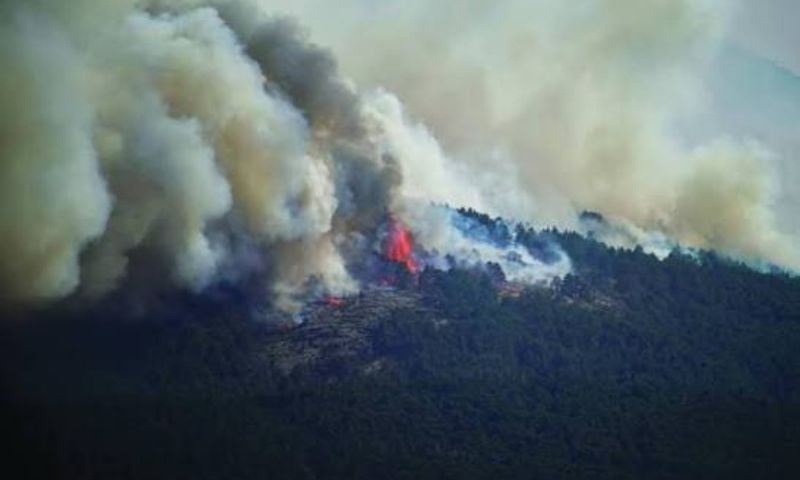
MADRID: Wildfires continued to rage across Spain and France on Thursday as an intense heatwave tightened its grip on southern Europe, with authorities warning that the risk of fresh blazes remained extremely high despite signs of improvement in the region’s largest wildfire.
Europe has already witnessed an exceptionally destructive wildfire season this year, with vast areas of land consumed by flames following repeated heatwaves and prolonged dry conditions.
Scientists say climate change is intensifying extreme weather events, increasing the frequency and severity of heatwaves, droughts and wildfires while also contributing to more violent storms.
Spain’s largest wildfire of 2026, burning in the central province of Guadalajara, has so far destroyed around 32,000 hectares of land. Although firefighters have made significant progress in containing the blaze, emergency officials cautioned that the danger has not yet passed.
The fire, which erupted several days ago, forced evacuations from 34 municipalities and confinement orders in 14 others. Authorities have now allowed residents of five villages to return home, though restrictions remain in place in several affected areas.
During a visit to the fire-hit region, Spanish Prime Minister Pedro Sánchez said the country had already recorded 22 major wildfires this year, with approximately 100,000 hectares burned before the traditional peak of the wildfire season.
He noted that the figure already matches Spain’s average annual area destroyed by wildfires over the past decade, stressing the need for stronger prevention measures alongside emergency response efforts.
Spain’s national weather agency, AEMET, warned that wildfire conditions remain “very high to extreme” across most of mainland Spain and the Balearic Islands. The agency said soaring temperatures, dry thunderstorms and Saharan dust are creating particularly dangerous conditions for fire outbreaks.
Although temperatures are expected to ease slightly in parts of the country today (Thursday), forecasters warned that hot, dry winds could push temperatures to between 42°C and 44°C in Mediterranean regions before a temporary cooling trend arrives on Friday. Meteorologists also expect another surge of intense heat early next week.
Meanwhile, France is battling multiple wildfires as authorities seek to prevent further devastation after two firefighters lost their lives on Tuesday when their fire engine became trapped by flames in the south-western Gironde region.
French officials have appealed to the public to avoid activities that could spark fires, including the use of barbecues in heat-affected areas. Authorities estimate that nine out of ten wildfires are caused, either deliberately or accidentally, by human activity.
A wildfire in Gironde has already burned around 100 hectares of woodland between Bordeaux and Cap Ferret, forcing the evacuation of approximately 600 residents near the village of Saumos while road access to nearby coastal resorts was temporarily diverted.
Gironde prefect Sophie Brocas announced an immediate ban on forestry work and any activities involving internal combustion engines in vulnerable areas, citing the extremely dry conditions and the emergence of several new fire outbreaks.
France’s weather service has warned that western, south-western and parts of south-eastern France will continue to face a very high wildfire risk for the remainder of the week.
In the south-eastern Var region, firefighters have benefited from slightly cooler temperatures and lighter winds while tackling a wildfire that has scorched 2,500 hectares, damaged dozens of homes and forced around 400 people to flee.
French Interior Minister Laurent Nunez, who travelled to Gironde to honour the two firefighters killed in the line of duty, said around 44,000 hectares have already burned across France this year — well above the long-term average. Elsewhere, emergency services are also responding to another wildfire in the Hautes-Alpes region.
Beyond western Europe, the weather emergency has taken a different form in the Balkans, where violent storms have replaced extreme heat.
In North Macedonia, powerful storms injured at least 11 people, three of them seriously, after strong winds uprooted trees, damaged buildings and caused widespread power outages.
Neighbouring Kosovo also experienced torrential rain and damaging hailstorms, with authorities warning that further severe weather, including lightning, flooding and additional disruption to electricity supplies, remains possible.
In Greece, where temperatures are forecast to exceed 41°C, authorities have prohibited outdoor work during the hottest hours of the day. Similar restrictions have also been introduced in Cyprus to protect workers from dangerous heat exposure.
According to climate experts, Europe remains the world’s fastest-warming continent, with rising global temperatures making prolonged heatwaves and destructive wildfires increasingly frequent and severe.