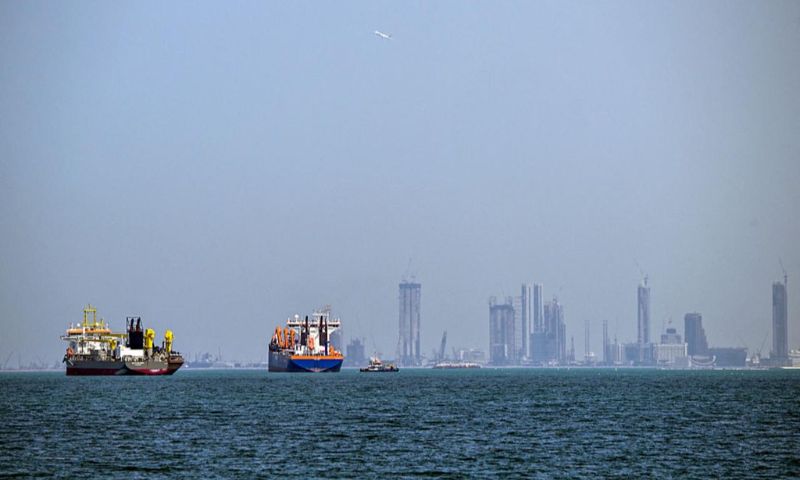



SEOUL: South Korea said Sunday it is carefully reviewing a call by US President Donald Trump urging allied nations to deploy naval vessels to help secure shipping routes through the Strait of Hormuz, one of the world’s most critical energy corridors.
A senior South Korean presidential official said Seoul is observing Trump’s remarks and will deliberate the issue in close coordination with the United States before making any decision.
The official emphasized that the government is examining various options to safeguard energy transportation routes that are vital to the country’s economy.
The development comes amid heightened tensions in the Middle East after US-Israeli forces launched military action against Iran on February 28.
Iran has since responded with threats and attacks that have disrupted maritime traffic in the Strait of Hormuz, a narrow passageway that normally carries about one-fifth of the world’s oil supply.
Earlier, Trump had announced that the US Navy would escort oil tankers through the waterway to ensure safe passage.
In a social media post on Saturday, he also called on several countries—including South Korea and Japan—to send their own naval ships to help keep the strategic route open.
Seoul, however, has stopped short of committing to the proposal. Officials say the government is conducting a comprehensive review of possible measures to ensure the safety of energy shipments while maintaining close communication with Washington.
According to AFP, South Korea, like many Asian economies, depends heavily on imported energy resources that travel through the Strait of Hormuz. The ongoing conflict has already strained global energy markets, prompting the South Korean government to introduce a temporary fuel price cap—the first such intervention since the Asian financial crisis in 1997—to cushion domestic consumers from rising costs.
Japan has also responded cautiously to the US request. Takayuki Kobayashi, policy chief of Prime Minister Sanae Takaichi’s ruling Liberal Democratic Party, said the legal threshold for dispatching Japanese naval forces to the region remains extremely high under current laws.
Speaking on Japan’s public broadcaster NHK, Kobayashi noted that while Tokyo cannot completely rule out the possibility, any such move would require careful consideration given the ongoing conflict.
In his post, Trump also mentioned other major powers—including China, France and Britain—expressing hope that nations affected by disruptions in the strait would contribute naval support to maintain the flow of global energy supplies.
As tensions persist, countries reliant on Middle Eastern oil are increasingly assessing how to protect critical shipping lanes while avoiding deeper involvement in the escalating regional conflict.