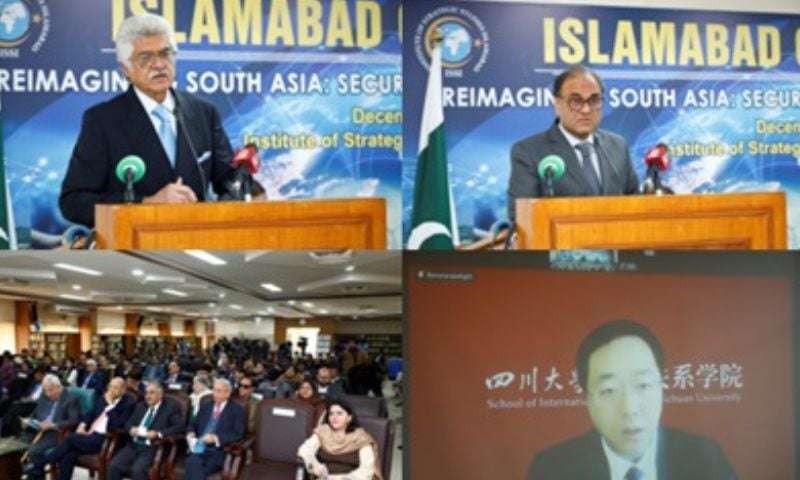



ISLAMABAD: South Asian scholars have collectively denounced extremist ideologies and voiced strong opposition to attempts at weaponising resources in the region, emphasising the need for peace, stability, and cooperative development across South Asia.
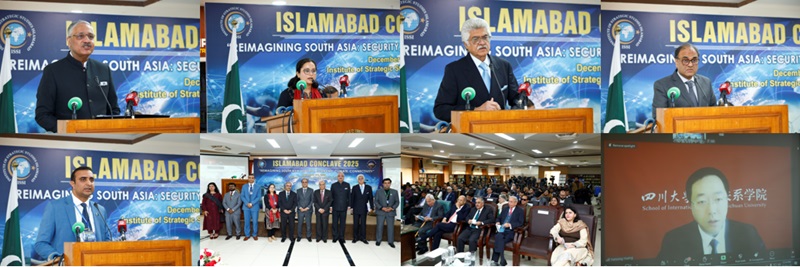
They expressed their views at the Islamabad Conclave 2025 hosted by India Study Centre (ISC) at the Institute of Strategic Studies Islamabad (ISSI) on Wednesday.
General Zubair Mahmood Hayat, former Chairman Joint Chiefs of Staff Committee, in his keynote speech, stated that the world’s shift toward multipolarity represents a unique and unprecedented era, driven by digital autonomy, climate pressures, and the emergence of civilisational states.
He observed that South Asia occupies a “centre-stage” in this transformation but continues to lack an independent and self-reliant security framework.
He called on major powers to avoid repeating historical mistakes that fuel regional militarisation and instead assist South Asian countries in building their own problem-solving capacities.
He stressed that regional nations must harness the opportunities of multipolarity for economic growth, strengthen institutional resilience, and work collectively to tackle non-traditional challenges, including climate change, water scarcity, pandemics, and environmental hazards.
Earlier, in his welcome address, ISC Director Dr. Khurram Abbas highlighted renewed global interest in South Asia, ongoing political transitions, and the lack of meaningful regional integration as key factors reshaping the region’s geopolitical landscape.
Ambassador Imran Ahmed Siddiqui pointed to rising hegemonic tendencies and the instrumental use of foreign policy for domestic political gains as significant barriers to regional cooperation.
Former Ambassador Zamir Akram observed that the involvement of multiple global powers presents both opportunities and risks, suggesting that a balanced engagement by the US, China, and Russia could contribute to South Asia’s stability, although border tensions between nuclear-armed neighbours remain a serious concern.
Dr. Shilata Pokharel, energy and security politics expert from Nepal, noted that smaller states such as Nepal, the Maldives, and Bhutan are seeking to capitalise on global power rivalries to their advantage.
Meanwhile, Professor Huang Yunsong, Associate Dean of International Studies, Sichuan University, China urged regional governments to move beyond traditional security-focused approaches and prioritise geo-economics and inclusive cooperation to tackle shared challenges.