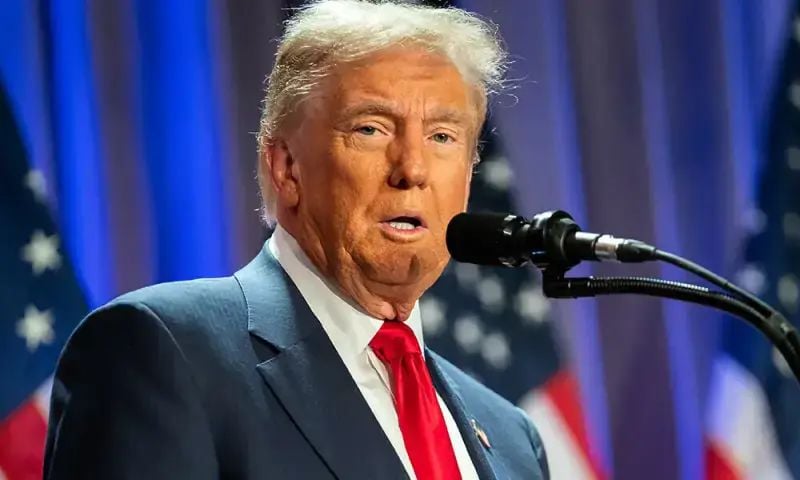



WASHINGTON: US President Donald Trump said he wants to resolve the confrontation with Iran through diplomacy but warned he would never allow Tehran to develop nuclear weapons, using his State of the Union address to outline a dual-track approach of negotiations and pressure.
Speaking to a joint session of Congress on Tuesday, Trump confirmed that Washington is engaged in active negotiations with Tehran aimed at reaching a new agreement on Iran’s nuclear program.
“We are in negotiations with them, they want to make a deal, but we haven’t heard those secret words: ‘We will never have a nuclear weapon,'” Trump said in his State of the Union speech.
“My preference is to solve this problem through diplomacy, but one thing is certain: I will never allow the world’s number one sponsor of terror, which they are by far, to have a nuclear weapon.”
President Donald Trump has used his State of the Union address to signal a preference for diplomacy with Iran, even as he maintained a hardline stance against the country’s nuclear ambitions.
Speaking to lawmakers, Trump reiterated that negotiations are ongoing and suggested Tehran is seeking an agreement under mounting economic and political pressure.
He has stressed that whilst he favours a diplomatic path, his administration remains committed to the longstanding US policy of preventing Tehran from acquiring nuclear capabilities.
“I will never allow the world’s largest funder of terrorism to possess a nuclear weapon,” the President has vowed.
Despite the talk of diplomacy, Trump has used the address to highlight the domestic turmoil within Iran, claiming that “the regime has killed 32,000 protesters” during recent unrest.
He has framed his administration’s “maximum pressure” strategy as the catalyst for bringing Tehran back to the table, asserting that the US is negotiating from a position of unprecedented strength.
“For decades, American policy has been based on not allowing Iran to obtain a nuclear weapon,” Trump has said.
He has noted that whilst the military option remains on the table, a “diplomatic solution” is his preferred outcome to ensure regional stability and national security.
Trump claimed Iran is seeking to develop missiles that can strike the United States — long-range weapons technology that only a limited number of countries possess.
“They’ve already developed missiles that can threaten Europe and our bases overseas, and they’re working to build missiles that will soon reach the United States of America,” Trump said during his State of the Union address.
In 2025, the US Defense Intelligence Agency said Iran could potentially develop a militarily viable intercontinental ballistic missile by 2035 “should Tehran decide to pursue the capability,” but did not say if it had made such a decision.
Tehran currently possesses short- and medium-range ballistic missiles with ranges that top out at about 1,850 miles (3,000 kilometers), according to the US Congressional Research Service.
The continental United States is more than 6,000 miles from Iran’s western tip.
Washington and Tehran have concluded two rounds of talks aimed at reaching a deal on Iran’s nuclear program to replace the agreement that Trump tore up during his first term in office.
The United States has repeatedly called for zero uranium enrichment by Iran but has also sought to address its ballistic missile program and support for armed groups in the region — demands Iran has rejected.
Trump has sent a massive US military force to the Middle East, deploying two aircraft carriers as well as more than a dozen other ships, a large number of warplanes, and other assets to the region.
He has repeatedly threatened to strike Iran if negotiations fail to reach a new agreement. Talks with Tehran are currently set to continue on Thursday.
Divided Capitol Spectacle
At the US Capitol, Donald Trump delivered his State of the Union address with trademark confidence, arriving late to a sharply divided chamber where Republicans applauded enthusiastically and many Democrats remained seated in silent protest.
The House floor took on a theatrical air, with Supreme Court justices looking on just days after striking down Trump’s global tariffs policy.
Attendance was thinner than usual due to a Democratic boycott, while emotional moments came from guests, including survivors of Jeffrey Epstein’s crimes and members of the US men’s Olympic ice hockey team, whose recognition briefly united the chamber in chants of “USA! USA!”
Trump opened with a triumphant portrayal of the nation’s economy and global standing, despite polls suggesting public skepticism, and defended his tariff policies while dismissing the court’s ruling as mistaken.
Democrats staged restrained protests — wearing symbolic white attire, displaying accountability pins, and, in one case, holding a sign criticizing Trump before being ejected — while their main response remained pointed silence.
Outside the Capitol, activists held a rival “People’s State of the Union” and lawmakers issued rebuttals in real time, underscoring deep political divisions as the address built to its familiar crescendo: a declaration that America had never been stronger.