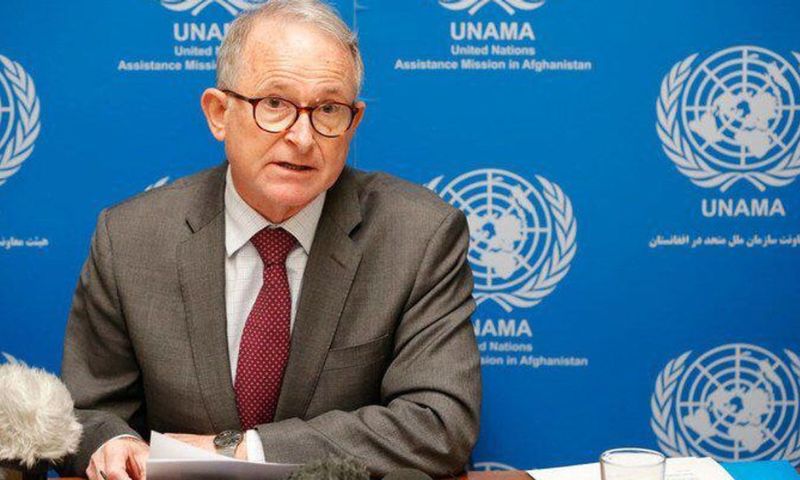



UNITED NATIONS: In a sobering address to the 78th session of the United Nations General Assembly (UNGA), UN Special Rapporteur on Human Rights in Afghanistan, Richard Bennett, delivered a stark critique of the dire human rights situation in Afghanistan.
Bennett’s speech underscored the urgency of addressing a range of interconnected challenges currently facing the war-torn nation.
Bennett’s remarks emphasized the ongoing struggle for access to education for women and girls in Afghanistan. Despite global calls to reopen schools and universities, female students continue to be deprived of their right to education. The UN special rapporteur pointed out that this situation is rooted in a series of issues plaguing the country, including the repressive policies and practices enforced by the Taliban, a culture of impunity, an ongoing humanitarian and economic crisis, recent deadly earthquakes, and the looming threat of massive involuntary returns. These complex issues necessitate immediate and decisive action to prevent further suffering and potential instability in both Afghanistan and the region.
Of particular concern is the plight of women and girls in Afghanistan. Bennett highlighted a disturbing trend where women’s economic activities outside the home are increasingly restricted, and girls and women are denied access to education beyond the sixth grade. Despite the de facto authorities claiming that this suspension is temporary, it has already persisted for over two years. Bennett stressed the urgency of the situation, urging the Afghan authorities to fulfil their international obligations by promptly reopening schools and universities for girls and women with curricula in line with international standards.
In his report, Bennett also called for the removal of restrictions on girls’ education in Afghanistan, emphasizing the fundamental importance of education as a cornerstone of human rights.
Naseer Ahmad Faiq, the Chargé d’Affaires of the Afghanistan Permanent Mission to the UN, echoed these concerns during the Third Committee session at UNGA78. Faiq emphasized the systematic discrimination against the fundamental human rights and freedoms of women and girls, which he described as a grave violation of human rights, amounting to gender persecution and gender apartheid, as imposed by the Taliban.
The Georgetown Institute for Women, Peace, and Security released a report that ranked Afghanistan at the bottom of a list of 177 countries regarding the status of women, while Denmark topped the list. This report emphasized the dire situation faced by women in fragile states, where intimate partner violence is prevalent, conflict is widespread, and maternal mortality rates are significantly higher than the global average.
The international community remains deeply concerned about the severe human rights violations occurring in Afghanistan. Activists and experts have called for the establishment of a stable government in Afghanistan that adheres to international principles and norms, as defined by the United Nations. This would not only address the immediate humanitarian crisis but also provide a foundation for the protection of human rights in the country.
The Islamic Emirate, however, has expressed its opposition to the mission of UN Special Rapporteur Richard Bennett, dismissing his reports as unrepresentative of the situation in Afghanistan. This disagreement highlights the ongoing challenges in accurately assessing and addressing the human rights crisis in the nation. Despite these disagreements, the international community remains committed to advocating for the rights and well-being of the Afghan people, especially women and girls, who continue to face significant obstacles and violations of their fundamental rights.