
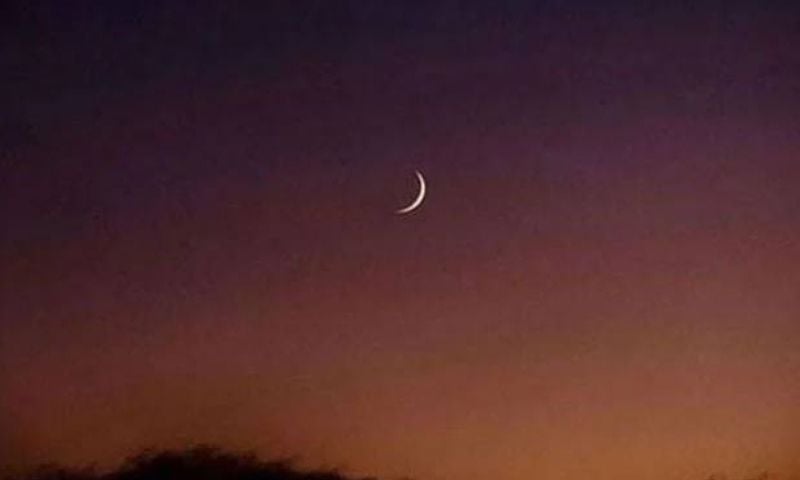



KARACHI: Pakistan’s Ruet-e-Hilal Research Council has said the crescent moon marking the start of the Islamic month of Shaban is unlikely to be sighted in the country on the evening of January 19.
Based on scientific calculations, the council said Shaban-ul-Muazzam 1447 Hijri is expected to begin on Wednesday, January 21, following the completion of 30 days of Rajab-ul-Murajjab.
Secretary General of the Ruet-e-Hilal Research Council, Mufti Khalid Ejaz, said the new moon will be born at 12:52am Pakistan Standard Time on the night between January 18 and 19.
However, he said that at sunset on January 19, the age of the moon across Pakistan will be less than 18 hours.
A minimum age of around 19 hours is generally considered necessary for the crescent to be visible.
Mufti added that the time gap between sunset and moonset will also fall short of the required threshold.
The difference is expected to be about 29 minutes in Gilgit and Muzaffarabad, 30 minutes in Peshawar, Islamabad, Lahore and Charsadda, 31 minutes in Quetta, and 33 minutes in Karachi and Jiwani.
For a reliable sighting, a minimum gap of around 40 minutes is usually required.
“Based on these scientific facts, even if the sky is clear, the crescent will not be visible on the evening of January 19, neither with the naked eye nor with binoculars nor through a telescope,” the council said.
Start of Shaban and Ramazan
The research council said Shaban is likely to begin in Pakistan on January 21. It stressed that the official announcement will be made by the Central Ruet-e-Hilal Committee, the constitutional body responsible for confirming the start of Islamic months based on moon sighting testimonies.
Pakistan’s space agency, the Pakistan Space and Upper Atmosphere Research Commission (SUPARCO), has issued a similar assessment.
SUPARCO said the new moon of Shaban will be born on January 19, 2026, at 12:52am.
At sunset that day, the moon’s age is expected to be around 17 hours and 36 minutes, with the sunset-to-moonset gap in coastal areas estimated at about 33 minutes.
Due to the moon’s low altitude and the short visibility window, SUPARCO said the chances of sighting the crescent with the naked eye on January 19 are extremely slim.
Based on these indicators, the agency said the start of Shaban is more likely to fall on January 20 or later.
SUPARCO emphasised that its projections are purely astronomical and that the final decision rests with the Central Ruet-e-Hilal Committee.
The Ruet-e-Hilal Research Council has also shared preliminary projections for the holy month of Ramazan.
Mufti Ejaz said the Ramazan crescent is expected to be sighted on February 18, making the first day of fasting likely to fall on February 19.
He said Eidul Fitr could fall around March 21, based on current calculations. However, he stressed that these dates are tentative and subject to official confirmation.
“The final and decisive announcement regarding Shaban, Ramazan and Eid will be made by the Central Ruet-e-Hilal Committee,” Mufti Ejaz said.