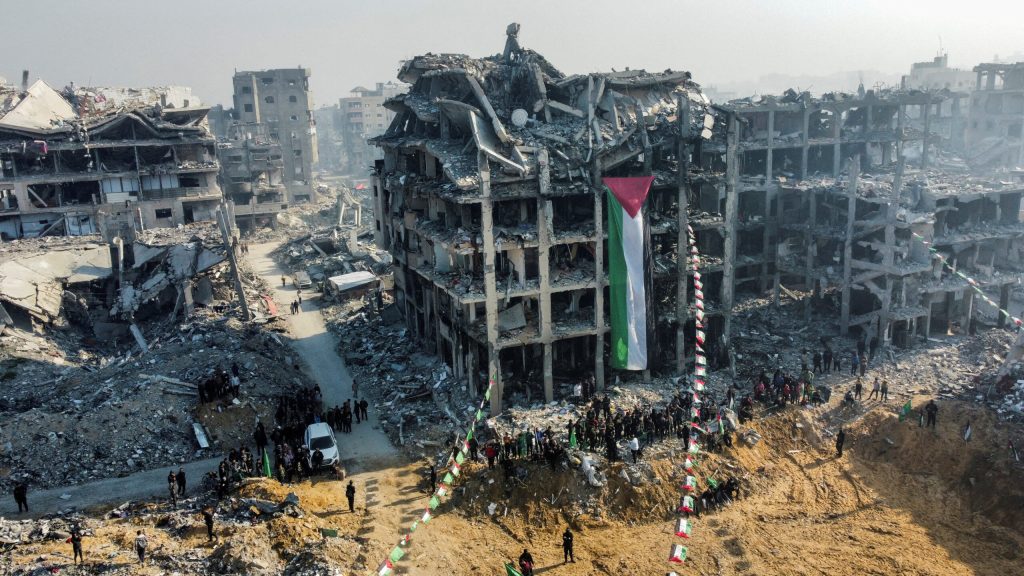



GAZA: Hamas has warned that the second phase of the Gaza ceasefire cannot proceed while Israel continues what the group calls repeated violations of the agreement, casting serious doubt on a US-brokered plan aimed at rebuilding the devastated enclave.
Palestinian authorities say the death toll has now climbed to more than 70,366, with aid deliveries falling far below agreed levels and Israeli strikes reported despite the truce, deepening Gaza’s already catastrophic humanitarian crisis.
Hossam Badran, a member of Hamas’s political bureau, told AFP that Israel was “evading its commitments,” stressing that mediators must “ensure the occupation completes the first phase” of the deal.
More than 70,366 Palestinians have been killed and 171,064 injured since Israel launched what Palestinian authorities describe as a genocidal war in October 2023, according to Gaza’s Health Ministry. Despite the ceasefire, authorities say 377 Palestinians have been killed and 980 injured by Israeli fire since October 10 alone.
Aid falls far short of commitments
Gaza’s Government Media Office said an average of just 226 aid trucks entered daily—well below the 600 trucks stipulated under the agreement. UNICEF reported a surge in acute malnutrition among children, with admissions now five times higher than in February. MSF warned that medical facilities remain overwhelmed and critically undersupplied.
Residents of Rafah, Khan Younis, and Gaza City reported Israeli airstrikes and demolitions. The Health Ministry said one person was killed and six wounded in the past 24 hours. Nearly all recent casualties, authorities say, are women and children.
Phase Two faces political obstacles
The US-brokered plan—approved by the UN Security Council—envisions reconstruction, a new governing mechanism without Hamas, and an International Stabilization Force to oversee security. US President Donald Trump is the only named member of the proposed “Board of Peace” expected to supervise Gaza’s administration.
Hamas says it will not disarm until Israel ends its occupation, though senior official Bassem Naim suggested weapons could be “stored” during a political process.
Gaza authorities warned of flooding and collapsing shelters as a winter storm approaches, threatening tens of thousands living in tent camps.
Reporters Without Borders said Israel was responsible for nearly half of all journalist deaths worldwide this year, calling Israel “the worst enemy of journalists.” Foreign media access to Gaza remains tightly restricted.
Border reopening
Israel said it will reopen the Allenby Crossing with Jordan—closed since September—to facilitate humanitarian supplies under reinforced security. The crossing remains essential for goods entering Gaza and travel for millions of West Bank Palestinians.
On humanitarian access, Gaza’s Government Media Office said an average of 226 aid trucks have been entering the enclave each day, far below the minimum 600 trucks Israel is required to allow under the ceasefire terms.
Phase one of the agreement involves the exchange of Israeli hostages for Palestinian prisoners, while the broader plan envisages reconstruction of Gaza and the creation of a new governing structure without Hamas, laying the groundwork for an internationally supervised administration.