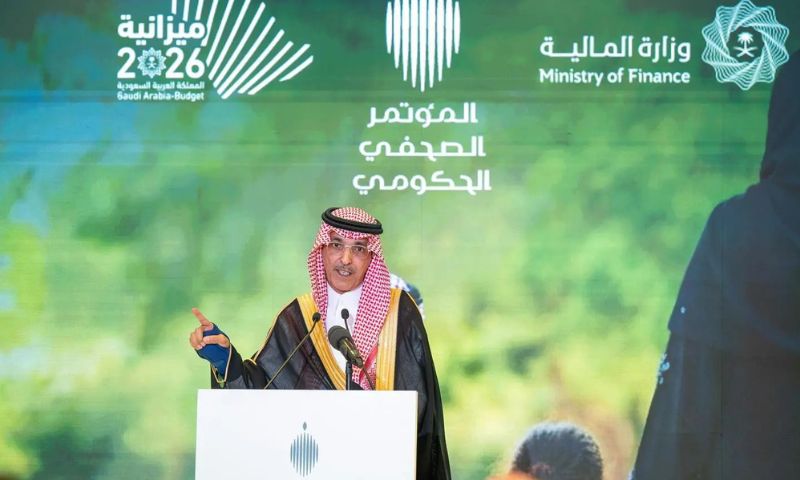



RIYADH: Saudi Arabia will maintain its expansionary fiscal approach in the 2026 budget, with total expenditure projected to reach SAR1.313 trillion, Minister of Finance Mohammed Aljadaan announced during a press conference on the approval of the Kingdom’s 1447/1448 AH (2026) budget.
Minister Aljadaan emphasized the importance of medium-term planning and economic stability, noting that expenditure is expected to continue rising to SAR1.419 trillion by 2028, supported by accelerating economic activity and improving revenues, according to SPA.
Despite heavy spending on major national strategies and megaprojects, the minister said the government remains committed to strengthening core public services. Spending on education, health, social, and municipal services is set to reach SAR533 billion in 2026.
Vision 2030 Progress and Next Phase
Providing an update on Saudi Vision 2030, Minister Aljadaan said 93% of the performance indicators are achieved or on track, while 85% of initiatives have been completed or are progressing as planned. A total of 299 indicators have already met their targets ahead of 2030.
He added that the Kingdom will enter a “phase of maximizing impact” next year, preparing the structure for the post-2030 economic environment.
Strategic Deficit and Borrowing
Discussing the 2025 fiscal performance, Minister Aljadaan stated that expenditures reached SAR1.336 trillion, with revenues at SAR1.091 trillion, resulting in a SAR245 billion deficit.
He reiterated that the Kingdom’s deficit is a “targeted strategic deficit”, designed to finance high-return projects even when borrowing is required.
“The aim is for this borrowing of SAR245 billion to generate a return higher than its cost — and this is happening,” he said, citing an average 5% non-oil GDP growth over the past four to five years.
Spending will continue to rise through 2026–2028 so long as returns exceed borrowing costs, the Minister added.
Non-Oil Growth and Private Sector Expansion
Minister Aljadaan highlighted substantial structural reforms since the launch of Vision 2030. Private sector investment as a share of GDP has grown by 40% in under eight years, which he described as “extremely difficult to achieve in such a short period.”
He said the contribution of non-oil activities has reached 55.4%, a “historic” level, with expectations of meeting or surpassing the 2030 target ahead of schedule.
The number of micro, small, and medium enterprises has surged from 500,000 to 1.7 million, creating 1.2 million jobs under Vision 2030, he added.
GDP Outlook and Sustainability
By the end of 2025, real GDP growth is expected to reach 4.4%, while nominal GDP is forecast to rise to SAR5.6 trillion by 2028.
Minister Aljadaan stressed that Saudi Arabia has not yet reached full fiscal sustainability, as revenues remain sensitive to oil price fluctuations. Long-term stability will come from achieving Vision 2030’s diversification goals, he noted.
He also referred to a statement by His Royal Highness Prince Mohammed bin Salman bin Abdulaziz Al Saud, Crown Prince and Prime Minister, where he stated that the primary goal is the citizen and the support the citizen receives.
The minister noted that these are very simple examples of social support provided in the 2025 budget. “The structural transformations in the economy that have occurred since the launch of the Saudi Vision 2030 are transformations that are usually difficult to achieve in economies over a short period from the launch of the Vision — whether in terms of private sector investment as a percentage of GDP changing by approximately 40% in a period of less than eight years since the actual implementation of the Vision’s programs began.
He also clarified that Vision 2030 does not aim to eliminate oil dependence entirely, as oil will remain a key national asset “for many years and decades.”
PIF Growth and Long-Term Strategy
The Minister praised the rapid expansion of the Public Investment Fund (PIF), whose assets have grown from SAR150 billion to over SAR800 billion in a short period. However, he emphasized that PIF does not distribute profits to the government, as its mandate is long-term investment for future generations.
Spending on Health, Education, and Privatization
Minister Aljadaan said spending on health and education will exceed SAR460 billion in 2025, adding that this does not conflict with ongoing privatization plans.
He explained that privatizing hospitals, for instance, requires government budgeting to purchase services from the private operators to ensure continued public access.
Flexibility in Project Structuring
Addressing long-term planning, the Minister noted that projecting 15 years ahead requires agility. Projects may be resized or accelerated depending on evolving needs and developments.