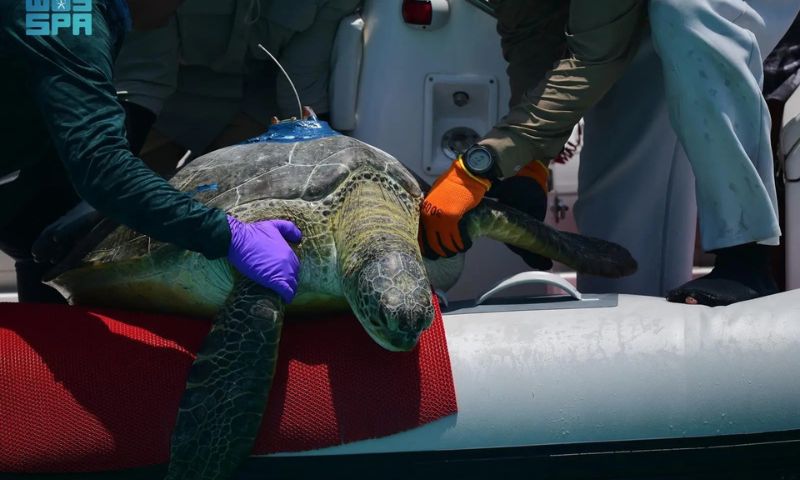



TABUK, Saudi Arabia: Saudi Arabia has launched a live satellite tracking programme for hawksbill and green turtles, marking a milestone with the first-ever tagging of a pre-nesting, egg-carrying green turtle in the Red Sea.
The initiative taken by Prince Mohammed bin Salman Royal Reserve will help address a critical regional knowledge gap and support coordinated, cross-border conservation strategies for these globally endangered species, the Saudi Press Agency (SPA) reported on Wednesday.
The team, led by Dr. Ahmed Mohammed, Senior Marine Ecologist at the Prince Mohammed bin Salman Royal Reserve, and Dr. Hector Barrios-Garrido, Senior Marine Megafauna Specialist at KAUST Beacon Development, successfully captured and tagged three critically endangered hawksbill turtles and seven green turtles in the water.
The satellite tags transmit real-time movement data, identifying foraging areas, migratory routes, and—most importantly—the nesting site of the egg-carrying green turtle, ensuring targeted protection and management measures.
This initiative builds on the reserve’s long-term commitment to marine conservation, expanding its turtle nest monitoring and protection programme launched in 2023.
The reserve safeguards 4,000 square km of Red Sea waters, representing 1.8% of the Kingdom’s marine area, along a 170 km coastline, the longest managed by a single entity in Saudi Arabia.
By linking NEOM and Red Sea Global, the reserve forms an 800 km corridor of protected Red Sea coastline, providing a vital refuge for five of the world’s seven sea turtle species and serving as a key breeding ground for green and hawksbill turtles.
Ranger teams actively monitor turtle activity both on land and at sea, safeguarding nesting sites essential for natal homing, the biological instinct that drives turtles to return to the same beaches where they were born.
“Critically endangered hawksbill turtles face an extremely high risk of extinction in the wild within our lifetime. With fewer than 200 breeding-age females remaining in the Red Sea, their survival depends on closing vital knowledge gaps to enable their effective conservation,” said CEO of Prince Mohammed bin Salman Royal Reserve Andrew Zaloumis.
He added, “Hawksbill turtles hatching on the reserve’s protected beaches range across 438,000 km² of open sea bordered by eight MENA countries, before returning some three decades later to the same sandy beach to lay their eggs. Our satellite tagging and tracking programme is a game-changer, providing the real-time data needed to identify their critical staging, foraging, and rookery areas across the Red Sea. The data will support national and regional conservation efforts to drive forward a much-needed unified ecosystem-wide turtle conservation management plan.’’
One of eight Royal Reserves, the 24,500 square km Prince Mohammed bin Salman Royal Reserve spans from the lava plains of the Harrats to the deep waters of the Red Sea, linking NEOM, Red Sea Global, and AlUla.
The reserve also hosts the Public Investment Fund’s Wadi Al Disah project and Red Sea Global’s Destination AMAALA.
Despite covering just 1% of Saudi Arabia’s land area and 1.8% of its marine territory, the reserve encompasses 15 distinct ecosystems and is home to over 50% of the Kingdom’s species, making it one of the most biodiverse protected areas in the Middle East.