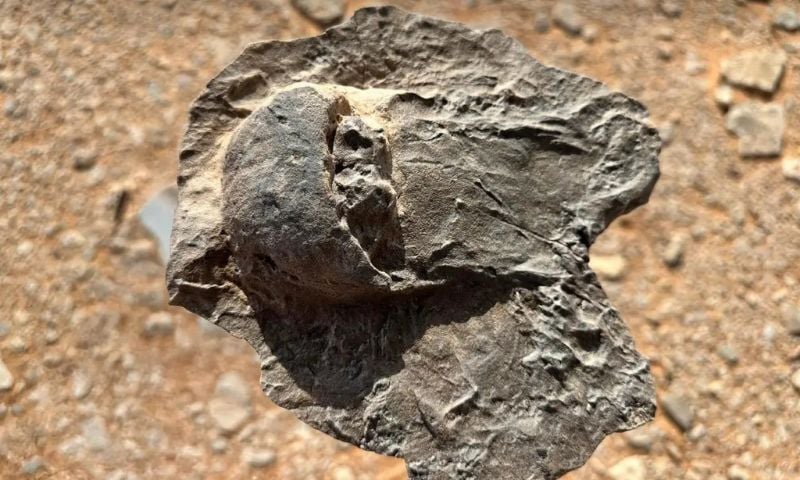



RIYADH: The Royal Commission for AlUla (RCU) has announced the discovery of rare horseshoe crab fossils dating back approximately 465 million years.
The findings are part of a peer-reviewed study published in Gondwana Research, a leading international journal in geological sciences, the Saudi Press Agency (SPA) reported on Thursday.
The fossils were discovered in AlGharameel Nature Reserve in AlUla, offering valuable new insights into the region’s natural history.
The fossils date back to the Middle Ordovician period, roughly 485–444 million years ago, making them among the oldest known horseshoe crab specimens worldwide. Notably, they are exceptionally large compared to other fossils from the same era.
As part of the efforts to further strengthen #AlUla’s position as a leading global destination for geological research, @RCU_SA has announced the discovery of rare horseshoe crab fossils estimated to be approximately 465 million years old. The discovery has been formally… pic.twitter.com/aoMpWl2yhM
— الهيئة الملكية لمحافظة العلا (@RCU_SA) January 8, 2026
All specimens were preserved upside down—a previously unrecorded mode of preservation—accompanied by trace fossils showing attempts by the organisms to return to their natural position.
This rare evidence of ancient behaviour offers valuable insights when interpreted alongside contemporary biological knowledge, supporting advanced scientific research.
Geological stratigraphic analysis indicates that intense seasonal storms were common during this period, suggesting that these organisms lived in shallow coastal environments impacted by such events, which contributed to their preservation in sedimentary deposits.
The findings provide a clearer understanding of AlUla’s ancient coastal environment and offer a new scientific perspective on the region’s geological and environmental history.
They also underscore the Royal Commission for AlUla’s ability to generate precise data that advances research and innovation in the study of the area’s natural heritage.
The discovery also represents a previously unclassified species, investigated through two research phases in collaboration with a team led by Dr Russell Bicknell, an academic at Flinders University in Adelaide.
The second phase, scheduled for the first half of 2026, will include the collection of additional samples and further study of the new species in preparation for its formal scientific classification.