



KEY POINTS
- Russian national legally hunted a trophy Markhor with record 41-inch horns.
- High-value trophy hunting is credited with aiding the recovery of Pakistan’s near-threatened national animal.
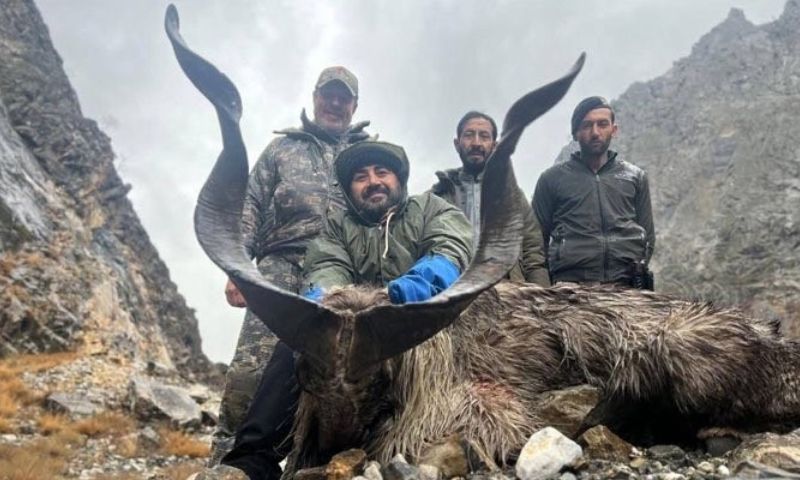
CHITRAL, Pakistan: A Russian national has hunted a markhor in Pakistan’s Gahirat-Golen conservancy in Chitral after securing a trophy licence for $68,000, with wildlife officials saying the animal’s horns measured a record 41 inches and that the hunt was conducted under a government-regulated conservation programme.
the Khyber Pakhtunkhwa (KP) Wildlife Department said that the impressive horns of the harvested Markhor measured 41 inches in length.
The hunt was conducted under Pakistan’s Community-Based Trophy Hunting Programme (CBTHP), a regulated initiative designed to combine conservation with local community development.
Conservation Through Controlled Hunting
Markhor, Pakistan’s national animal, is a wild goat species native to the high-altitude regions of Central Asia, the Karakoram, and the Himalayas.
It is classified as “Near Threatened,” and its hunting is strictly regulated under the Convention on International Trade in Endangered Species of Wild Fauna and Flora (CITES).
In October 2024, CITES approved a non-exportable hunting quota for six Markhors in the Kohistan and Chitral regions.
Acting on this, the KP Wildlife Department authorized the hunts, which have generated a total revenue of $246,700 for the current season.
Funding Communities and Conservation
A cornerstone of the CBTHP is its revenue-sharing model. The Wildlife Department stated that 80% of the proceeds from these trophy hunts are directly distributed to the local communities where the Markhor lives. The remaining 20% is deposited into the national exchequer.
“A significant portion of the revenue generated from this program will be used for the welfare and development of the local community,” the department maintained.
This model incentivizes community protection of the species and its habitat, as the villagers become direct financial stakeholders in the survival and growth of the Markhor population.
Annually, a limited number of three to four trophy licenses are issued for Markhor hunting, ensuring the activity remains sustainable and does not threaten the population.
Precedent and Program Impact
This recent hunt follows a similar event last year when a US citizen, Robert Myles Hall, hunted a Kashmir Markhor in the same conservancy for a trophy permit costing $125,000. That animal’s horns measured approximately 38 inches.
The substantial fees paid by international hunters underscore the high value placed on the Markhor trophy.
Wildlife officials argue that this controlled, high-cost hunting has been instrumental in the remarkable recovery of the Markhor population in Pakistan over recent decades, turning the species into a key economic asset for remote mountain communities.