
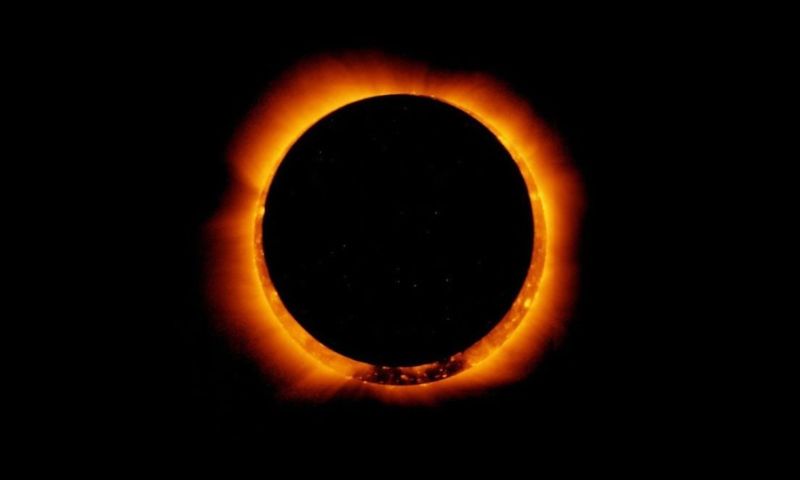



ISLAMABAD: The first solar eclipse of 2026, known as the “Ring of Fire,” is set to occur on February 17, offering skywatchers around the world a rare celestial spectacle.
According to the Pakistan Meteorological Department (PMD), this will be an annular solar eclipse, during which the Moon will cover the majority of the Sun while leaving a glowing ring of sunlight around its edges.
The eclipse is scientifically significant, but unfortunately will not be visible in Pakistan.
Globally, the eclipse will be fully observable from remote regions of Antarctica, where up to 96% of the Sun will be obscured for just over two minutes.
A partial eclipse will also be visible across parts of southern Africa, southern South America, and over the Atlantic, Pacific, and Indian Oceans.
In Pakistan Standard Time (PST), the eclipse is noted to begin at 2:56 p.m., reach its maximum at 5:12 p.m., and conclude at 7:28 p.m., but these timings are only for reference, as the eclipse cannot be observed locally.
Astronomers worldwide are encouraged to follow the event through live broadcasts or online streaming, while taking care not to look directly at the Sun without certified protective glasses, which can prevent serious eye damage.
This marks one of two solar eclipses Pakistan will experience in 2026, along with two lunar eclipses, though observers in the country will need to rely on digital or live coverage to witness this first annular event.
Additionally, tech giant Google has launched an interactive animation tool allowing users to explore the eclipse digitally, showing the Moon passing in front of the Sun and highlighting the Sun’s corona, making the rare phenomenon accessible even where it is not visible.