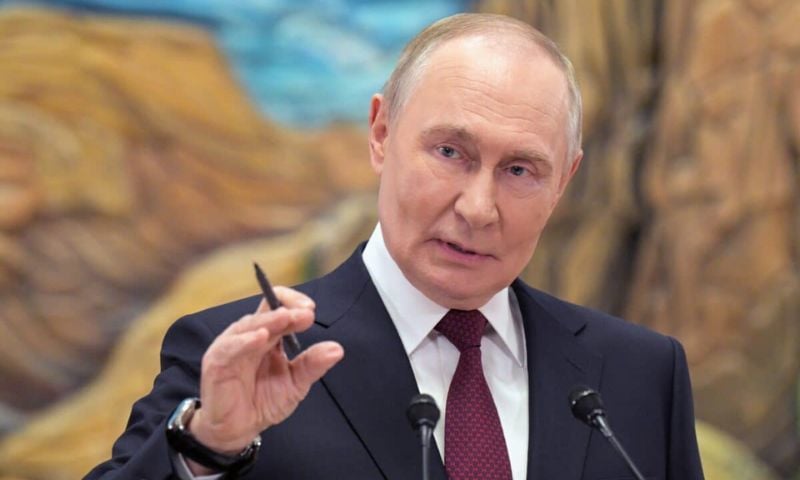



MOSCOW: President Vladimir Putin on Sunday declared that the development of Russia’s nuclear forces has become an “absolute priority,” following the expiry of the last remaining nuclear arms control treaty between Russia and the United States.
In a video message issued on Russia’s “Defender of the Fatherland Day,” Putin said strengthening the country’s nuclear triad was essential to maintaining national security and global strategic balance.
“The development of the nuclear triad, which guarantees Russia’s security and ensures effective strategic deterrence and a balance of forces in the world, remains an absolute priority,” he said.
His remarks came as Moscow and Washington – the world’s two largest nuclear powers – are no longer formally bound by any arms control agreement after the expiration of the New START treaty earlier this month.
The Russian leader used the military holiday, traditionally marked by patriotic displays and ceremonies, to reaffirm his commitment to bolstering the country’s armed forces, according to AFP.
He pledged continued efforts to strengthen the army and navy, drawing on combat experience gained during the nearly four-year conflict in Ukraine.
Putin said all branches of the armed forces would undergo further improvements, including enhanced combat readiness, greater mobility, and increased operational capability in challenging conditions.
“We will continue to strengthen the army and navy,” he said, adding that the military would refine its ability to operate “in all conditions, even the most difficult.”
His statement came just days before the fourth anniversary of Russia’s large-scale assault on Ukraine, a conflict that has devastated cities, displaced millions of people, and resulted in heavy casualties on both sides.
Despite the lapse of formal arms control commitments, Russian officials have said Moscow intends to maintain what they describe as a “responsible” approach to strategic nuclear capabilities and to continue observing the limits previously set under the treaty framework.
The end of the New START agreement marks a significant moment in global arms control efforts, raising concerns among analysts about the future of nuclear stability between the two powers.