


KEY POINTS
- Punjab introduces 1,100 electric vehicles to establish ‘e-mobility ecosystem’ and reduce environmental impact.
- Government is providing Rs 4 billion subsidy, covering 15% of down payment for general public and shouldering 60% of cost for women beneficiaries.
- With a 30% exclusive quota and a significantly reduced financial barrier, initiative is designed to boost female workforce participation.
- Pink and green e-taxis operating on roads of Lahore and other districts within next 48 hours, with plans to expand service to all 148 tehsils of Punjab.
LAHORE: Pakistan’s Punjab province marked a historic milestone in its push for cleaner transport on Thursday, rolling out the province’s first e-taxi scheme designed to boost both environmental sustainability and women’s participation in the workforce.
The initiative, inaugurated at a ceremony in Lahore, is a cornerstone of the government’s broader vision to cultivate a comprehensive ‘e-mobility ecosystem’ in the region.
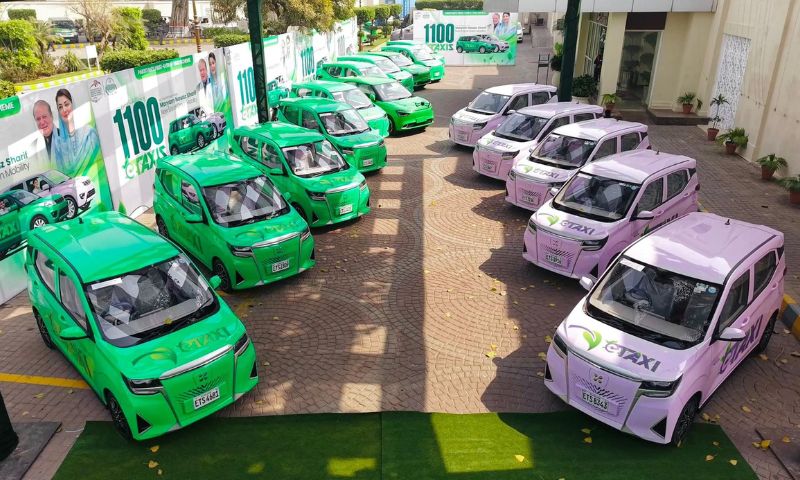
The scheme will see approximately 1,100 electric taxis distributed across the province at subsidised rates, with a notable 30 per cent quota reserved exclusively for women.
The colourful fleet of pink and green vehicles lined up behind the Chief Minister symbolised a new chapter for public transport in Pakistan’s most populous province.
E-taxi launch!
Pakistan’s first 100% electric taxi promoting eco friendly urban mobility.
Dedicated light purple E-taxis for women.
Dedicated Green E-Taxis for men. pic.twitter.com/rz1TXjsBoC— PMLN (@pmln_org) February 26, 2026
“Punjab has become the first province to launch an e-taxi scheme, the first of its kind,” Chief Minister Punjab, Maryam Nawaz announced.
“This is not only a win for the environment, but it will also open up significant employment opportunities.”
A financial boost for beneficiaries
Detailing the financial model of the scheme, the Chief Minister emphasised the government’s commitment to making the transition to electric vehicles accessible.
She revealed that the provincial government is providing a massive subsidy of up to Rs4 billion on the initial 1,100 vehicles.
To further lower the barrier to entry, the government will cover 15 per cent of the required 30 per cent down payment. This means eligible beneficiaries can take possession of a new e-taxi for an upfront cost of just Rs 690,000.
Every vehicle of Punjab’s E-Taxi Scheme to be equipped with panic buttons for passenger and driver safety. pic.twitter.com/dBGcS8x6N4
— PMLN (@pmln_org) February 26, 2026
Reinforcing the commitment to women’s inclusion, CM Maryam announced an even more generous package for female applicants.
“For women, the government will bear 60 per cent of the down payment cost,” she stated, highlighting the administration’s focus on creating inclusive transport opportunities.
Expanding the green vision
The Chief Minister positioned the e-taxi scheme as part of a larger, environmentally conscious strategy. She pointed to the province’s existing fleet of green buses as a precursor to this latest development.
“We have green buses as well, an example for the rest of the country,” she said, outlining ambitious plans to expand the e-transport service to all 148 tehsils of Punjab in the future.
The immediate future, however, is focused on the e-taxis. According to the Chief Minister, the people of Punjab will not have to wait long to see the new fleet in action.
“Within the next 48 hours, you will see these e-taxis on the roads of Lahore and other districts in Punjab,” she assured.
𝐏𝐚𝐤𝐢𝐬𝐭𝐚𝐧 𝐟𝐢𝐫𝐬𝐭 𝐞-𝐓𝐚𝐱𝐢 𝐒𝐜𝐡𝐞𝐦𝐞 is launching today under the leadership of Chief Minister Punjab @MaryamNSharif marking a major step towards clean mobility, employment generation, and inclusive transport opportunities.
𝗪𝗶𝘁𝗵 𝟭,𝟭𝟬𝟬 𝗲-𝘁𝗮𝘅𝗶𝘀,… pic.twitter.com/dNml1qyBoi— Transport & Masstransit Deptt (Punjab), Pakistan (@TransportDeptt) February 26, 2026
Following the launch, the Punjab Transport and Mass Transit Department took to social media platform X to celebrate the milestone.
In a post, the department stated that with the newly launched scheme, the government was “marking a major step towards clean mobility, employment generation, and inclusive transport opportunities.”