MUZAFFARABAD: What initially emerged as a movement claiming to advocate for public rights in Azad Jammu and Kashmir (AJK) has, according to government officials and observers, gradually revealed a far more troubling agenda marked by violence, confrontation with state institutions and attempts to incite rebellion.
The proscribed Jammu Kashmir Joint Awami Action Committee (JAAC) had presented itself as a platform seeking solutions to issues affecting ordinary citizens.
Throughout the course of its activities, the governments of Pakistan and Azad Jammu and Kashmir repeatedly engaged with the group through dialogue and negotiations in an effort to address its concerns and find mutually acceptable solutions.
However, officials say the committee’s demands continued to evolve beyond socioeconomic issues.
What began as calls for relief measures and public rights increasingly transformed into demands involving constitutional and political questions that required the participation of multiple stakeholders and amendments through established constitutional mechanisms.
Government representatives maintain that whenever demands related to public welfare and citizens’ rights were raised, authorities demonstrated willingness to engage and resolve issues.
However, they argue that certain demands fell outside the jurisdiction of the executive government and could only be addressed through constitutional procedures laid down by law.
Officials have pointed to the June 5, 2026 judgment of the Supreme Court of Azad Jammu and Kashmir concerning the issue of refugee seats, describing it as a detailed ruling that clearly explained the legal and constitutional complexities surrounding the matter.
According to government sources, neither the State of Azad Jammu and Kashmir, Pakistan’s political leadership, nor state institutions have shown any interest in demands aimed at abolishing refugee seats or altering constitutional arrangements through extra-parliamentary pressure.
Anti-State Narrative
Authorities argue that concerns regarding the committee’s intentions intensified after a series of statements and actions that they say went beyond peaceful political activism.
Officials said that rhetoric directed against state institutions, calls for the withdrawal of security forces, disruption of educational activities and inflammatory narratives contributed to growing suspicions about the organisation’s real objectives.
Government officials further contend that support expressed by hostile foreign media outlets, anti-state social media accounts and Indian media platforms for the committee’s activities raised serious questions about the forces seeking to exploit unrest in the region.
According to security analysts supporting the government’s position, these developments gradually exposed what they describe as an organised effort to challenge state authority under the cover of a public rights movement.
From Protest to Confrontation
Authorities maintain that from an early stage, certain leaders within the organisation adopted a confrontational approach, resulting in incidents of violence, clashes and lawlessness.
Officials stated that members of the group engaged in violent activities, promoted unrest and resorted to actions that endangered public order.
They argue that such conduct undermined the committee’s claims of peaceful activism and ultimately provided legal grounds for stronger state action.
As tensions escalated, the government moved to ban the organisation under relevant laws and initiated legal proceedings against several of its active leaders and organisers.
Officials say those actions were taken to prevent further instability and protect public order.
Hidden Agenda Comes Under Scrutiny
Government circles argue that subsequent developments have further reinforced concerns about what they describe as the committee’s hidden objectives.
According to officials, growing evidence pointed towards efforts aimed at creating instability in Azad Jammu and Kashmir rather than addressing public grievances through democratic and constitutional means.
They maintain that politically aware citizens have increasingly rejected the organisation’s methods and rhetoric, viewing them as incompatible with peaceful democratic activism.
Authorities further stated that hostile external actors attempted to exploit local grievances in pursuit of broader regional objectives.
Officials claim that when India failed to undermine Pakistan through direct means, efforts were made to create unrest within Azad Jammu and Kashmir through a small number of disruptive elements.
They argue that such attempts have now been exposed and defeated.
Khawaja Mehran Arshad’s Statement Triggers Outrage
The controversy intensified further following remarks by Khawaja Mehran Arshad, a key ringleader of the proscribed Jammu Kashmir Joint Awami Action Committee (JAAC) and a member of its core leadership.
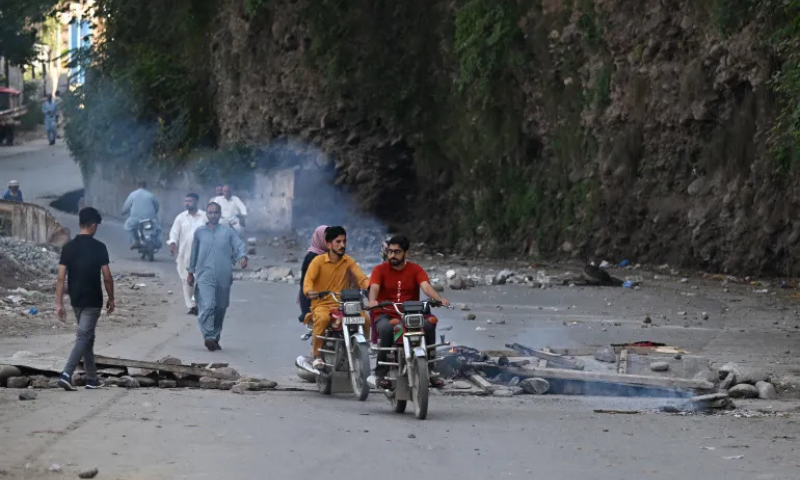
The statement came only days after the AJK Home Department declared the organisation proscribed under the Anti-Terrorism Act following violent clashes, attacks on law enforcement personnel and incidents involving road blockades in Rawalakot, Neelum Valley and other parts of the state.
During a protest gathering in Rawalakot attended by a limited number of supporters, Khawaja Mehran Arshad addressed serving personnel of the Pakistan Army and urged them to abandon their duties and return to Azad Jammu and Kashmir.
According to reports, he stated:
“میں ان لوگوں سے مخاطب ہوں جو پاکستان آرمی میں خدمات سرانجام دے رہے ہیں اور دفاع پاکستان کے لیے اپنا خون بہا رہے ہیں۔ میں ان سے کہہ رہا ہوں کہ اب مزید انتظار نہ کریں؛ بغاوت کریں اور اپنے ملک آزاد جموں و کشمیر واپس لوٹ آئیں”
“I am addressing those who are serving in the Pakistan Army and are shedding blood for the defence of Pakistan. I am asking them not to wait any more; commit mutiny and fall back to your country (Azad Jammu & Kashmir),” Arshad reportedly stated, addressing uniform personnel.
The remarks drew widespread condemnation from government officials and political figures, who described them as an attempt to incite rebellion within state institutions.
Senior officials stated that the speech marks a dangerous departure from the civic and economic narrative the banned JAAC originally claimed to represent.
“The state displayed maximum tolerance when the group raised domestic economic demands, but actively inciting mutiny within the military crosses the ultimate constitutional red line,” an official stated.
“This is no longer dissent; it is an overt act of rebellion against the state’s security apparatus.”
Legal Action and Calls for Accountability
Authorities argue that such statements amount to a direct challenge to the authority of the state and cannot be ignored.
The Government of Azad Jammu and Kashmir subsequently registered a case against Khawaja Mehran Arshad under Section 124-A relating to sedition and incitement against the state.
Officials say the action was necessary to uphold the rule of law, protect state institutions and prevent further escalation.
Supporters of the government’s position have welcomed the legal proceedings, arguing that any attempt to encourage rebellion within security institutions must be dealt with firmly and in accordance with the law.
Preserving the Writ of the State
Officials maintain that the measures being taken against members of the proscribed organisation are aimed solely at restoring public order, protecting citizens and ensuring the writ of the state.
They argue that democratic societies provide constitutional mechanisms through which grievances can be addressed and that attempts to achieve political objectives through violence, intimidation, or incitement cannot be tolerated.
As legal proceedings continue, authorities have reiterated their commitment to maintaining peace, safeguarding public security and ensuring that the affairs of the state remain governed through elected institutions and constitutional processes rather than pressure from disruptive groups.