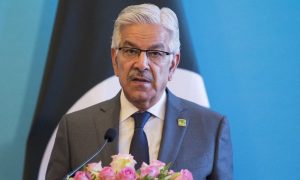
When the news broke out regarding the electronic signing of the interim peace framework between the United States and Iran, the objective geopolitical reality was clear: Pakistan’s statecraft had executed a monumental diplomatic manoeuvre. Acting as a core mediator alongside Qatar, Pakistani leadership successfully brokered a ceasefire. In the theatre of International Relations, it was a moment of structural competence.
Yet, the domestic response-spanning national television, digital media, and public discourse-revealed an entirely different, deeply unsettling phenomenon. Headlines did not focus on the strategic leverage Pakistan had secured. Instead, the nation became collectively fixated on a few lighthearted, transactional remarks.
When US Vice President JD Vance joked that his “two favourite people” were his wife and Pakistan’s Field Marshal, or when Donald Trump praised Pakistan in his tweets, a wave of euphoric triumph swept through the country. Mainstream narrative behaved as though Pakistan’s success was not validated by the peace itself, but by the fact that the white man in Washington had patted us on the back.
This is not a healthy expression of national pride. It is a textbook manifestation of a profound, intergenerational inferiority complex, a collective trauma that dictates that our existence, our capabilities, and our achievements remain entirely invisible until they are validated by the Western “Other.” This psychological decay is not restricted to the state level; it is a reflection of how the average post-colonial citizen lives their daily life.
To diagnose why a nuclear-armed state of over 240 million people acts like an anxious schoolchild awaiting a report card from the West, we must understand the intersection of post-colonial philosophy and psychology.
In philosophy, Jean-Paul Sartre introduced the concept of The Gaze (Le Regard), which describes how a human being’s self-awareness can be hijacked when they realise they are being watched by another. (See Being & Nothingness, Part 3 Chapter 1, Page 221)
The French theorist Frantz Fanon later weaponised this concept in post-colonial critique through his seminal work, Black Skin, White Masks. Fanon argued that the colonised subject does not look at themselves through their own eyes; they look at themselves through the eyes of the coloniser. (See Black Skin, White Masks, Chapter 5, Page 109)
When the Pakistani public behaves as though Trump’s praise is a glorious victory, they are operating within this exact pathology. In their minds, the United States is the absolute ‘Subject’-the only entity capable of defining reality, granting status, and dispensing worth.
Pakistan remains the ‘Object’-an entity that can only be defined by the Subject. Therefore, a word of praise from a Western head of state is not viewed logically as standard diplomatic rhetoric; it is treated as a psychological lifeline that temporarily cures a deep-seated sense of historical insignificance.
Edward Said’s foundational text, Orientalism, outlines how Western power structures systematically constructed the East as inherently backward, chaotic, and incapable of self-governance, while positioning the West as rational, structured, and superior. (See Orientalism, Chapter 1)
Over generations, the people of the subcontinent did not just endure this narrative; they internalised it. We became active participants in our own intellectual subjugation, building a society that implicitly believes that a particular accent, particular degrees, and particular careers are the highest forms of human currency.
This macro-level pathology at the state level does not exist in a vacuum; it trickles down directly into the psyche of the ordinary citizen. The same psychological mechanism that makes the media obsess over tweets by Trump makes the individual citizen chase validation in every crevice of daily life.
The post-colonial citizen is locked in a relentless, exhausting pursuit of external approval:
- We treat Urdu or regional languages as markers of the uneducated, while projecting English fluency as a direct metric of intelligence.
- A multi-billion-dollar cosmetic industry in the subcontinent thrives entirely on the psychological mutilation of people, convincing them that beauty is directly proportional to how closely their skin tone matches European standards.
- Children are forced into specific career moulds-medicine, engineering, military or civil service-not out of a desire for knowledge or mastery, but to satisfy the collective ego of the family network.
We search for validation everywhere because we have been stripped of the capacity to generate internal self-worth. We are a society of empty vessels, begging to be filled by the approval of anyone we perceive to be higher than us in the invisible colonial hierarchy.
The ultimate tragedy of this psychological servitude is that the antidote was already handed to this civilisation. Islamic psychology and philosophy offer a completely opposing blueprint for human dignity-one that anchors self-worth vertically (to the Divine) rather than horizontally (to human structures).
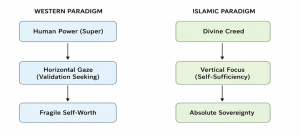
This superior psychology is flawlessly captured in one of the most defining moments in geopolitical history. When the Caliph Hazrat Umar (RA) travelled to Jerusalem to officially accept the keys to the city from the Patriarch Sophronius, he arrived in a manner that completely shattered the conventional psychology of empire. He was travelling with a single servant, alternating turns riding their lone camel. When they reached the muddy outskirts of Jerusalem, it was the servant’s turn to ride. Umar (RA) dismounted, walked through the mud, took off his shoes, placed his socks on his shoulders, and led the camel by its reins.
Seeing this, his military commander, Abu Ubaidah bin Jarrah (RA), became deeply anxious. He ran to the Caliph and said:
“O Commander of the Faithful! The people of this city-the Christian priests, the Jewish rabbis, and the grand dignitaries are all watching you. You are wearing a torn garment, walking in the mud, and leading a camel. It would be better if you wore a dress worthy of your stature so that you command respect in their eyes.”
Umar (RA) famously struck Abu Ubaidah on the chest and delivered a response that serves as the definitive manifesto against the inferiority complex:
“We were the most humiliated, low, and insignificant people on earth. Then ALLAH gave us honour and dignity through Islam. If we ever seek honour through anything other than what ALLAH has honoured us with, HE will humiliate us again.”
This is the peak of emotional and psychological sovereignty. Umar (RA) did not require a silk robe or the validation of the Roman or Persian elite to feel significant. His self-worth was anchored in a transcendent creed. He understood that human beings cannot give you honour; they can only give you temporary, conditional approval.
Had this superior psychology been absent from our founding fathers, the state of Pakistan would never have materialised. If Allama Iqbal and Quaid-e-Azam Muhammad Ali Jinnah had been infected with the virus of the validation loop, they would have spent their lives contentedly polishing the boots of British colonial masters or accepting a subordinate status under a permanent majoritarian hierarchy.
Iqbal’s entire poetic and philosophical corpus was a direct war against the post-colonial inferiority complex. He introduced the concept of Khudi-the absolute, self-respecting human ego that refuses to bow before worldly power.
Jinnah stood before the British viceroys and the formidable leadership of the Indian National Congress not as a petitioner begging for scraps, but as an absolute equal. He possessed an unshakeable inner certainty that allowed him to negotiate from a position of psychological supremacy, completely immune to the intimidation or flattery of the British Empire.
The current condition, where everyone from the PM down to the citizen on the street is trapped in a permanent loop of validation-seeking, can only be broken if we address the root cause: parental and educational programming.
Self-worth is either built or destroyed in childhood. In our households, children are systematically taught to measure their value through the eyes of others. Parents continuously compare their offspring to cousins and neighbours, conditioning them to believe that their identity is defined by external metrics -grades, specific careers, wealth, and societal applause. We are raising generations of validation junkies who enter adulthood completely incapable of standing firm on an independent principle.
To reverse this national decay, the family structure and the educational system must undergo a radical shift:
- Dismantling the Horizontal Metric is necessary. Children must be praised for character, critical independent thought, and resilience rather than their compliance with societal expectations.
- Decoupling of national and individual identity from the Western framework & restoring historical, philosophical, and spiritual reference points.
Whether it is a state official celebrating a patronising nod from Washington or an individual altering their language and appearance to look more “civilised,” the disease is the same: we have traded our internal sovereignty for an illusion of acceptance.
A nation that relies on the validation of its former masters to feel successful is a nation whose mind remains shackled long after the physical empires have collapsed. True independence does not come from a seat at the diplomatic table, nor does it come from the passing compliments of a fluctuating Western political elite. It comes from looking within, recognising inherent worth, and realising that our dignity is ours to define and ours alone.