


Key Points
- Regional and international markets also affected by geopolitics
- Despite volatility, Pakistan’s market remains over 30 percentage points higher than a year ago
- Outlook uncertain, with analysts highlighting oil prices and regional stability as key factors
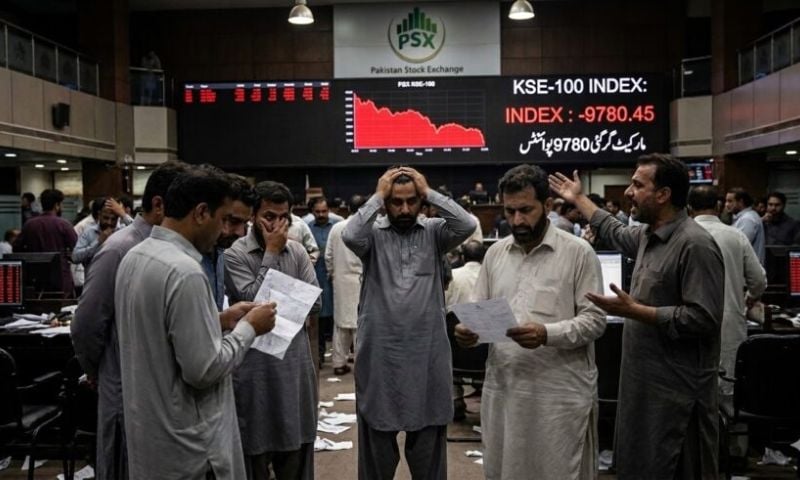
ISLAMABAD: Pakistan’s stock market suffered a sharp decline during the second week of the Iran war, with the benchmark KSE-100 Index plunging nearly seven per cent in a single trading session as investors reacted to rising geopolitical tensions and fears of energy supply disruptions.
The Pakistan Stock Exchange recorded one of its steepest recent falls, as the bourse’s benchmark KSE-100 Index shed about 11,015.96 points, representing a 6.99 per cent decline, after news of escalating military confrontation in the Middle East rattled investor confidence.
Analysts said the sudden sell-off reflected fears that a prolonged military conflict between Iran and an alliance of the US and Israel could drive global oil prices higher and create economic pressure for energy-importing countries such as Pakistan.
Sharp losses were recorded across major sectors, including banking, cement, oil and gas exploration, and fertiliser stocks.
Market participants said many investors opted to reduce exposure. Uncertainty surrounding regional stability and potential economic spillovers from the conflict was a major concern for them.
Strong rebound on bargain hunting
Following the steep drop, the market staged a powerful recovery as investors moved to pick up undervalued stocks.
During one of the week’s most dramatic sessions, the KSE-100 Index surged about 9,696.98 points, marking a recovery of roughly 6.62 percentage points from the previous close.
The upward rally was strong enough to trigger a temporary trading halt under Pakistan Stock Exchange rules after the benchmark index rose more than five percentage points during the session.
Analysts attributed the rebound to bargain hunting, improved sentiment in some global markets and speculation that diplomatic efforts could contain the conflict.
Regional and international markets
Regional stock markets also reflected investor caution. The Dubai Financial Market General Index fell by 3.5 per cent during the week, while Saudi Arabia’s Tadawul All Share Index dropped by 2.8 per cent amid heightened concerns over regional security.
Internationally, European markets ended the week slightly lower, with London’s FTSE 100 down 1.9 per cent and Paris’ CAC 40 falling 2.1 per cent.
US markets saw moderate declines, with the S&P 500 dropping 1.7 per cent over the same period, largely due to rising oil prices and investor uncertainty about potential escalation in the Middle East.
Commodity markets reacted sharply, with Brent crude climbing above $105 per barrel midweek before retreating slightly to $102 by the week’s close.
Market ends week in volatile range
Despite the rebound, trading remained highly volatile throughout the week as investors continued to assess the potential economic fallout of the war.
By the end of the week, the KSE-100 Index was trading around the 153,000–154,000 point range after multiple sessions of sharp gains and losses.
Comparison with last year
Despite the recent turbulence, Pakistan’s stock market remains significantly stronger than it was a year ago.
The KSE-100 Index is still more than 30 percentage points higher than the same period last year, reflecting the strong rally recorded through much of the past twelve months.
That earlier surge had been supported by improving macroeconomic stability, easing inflation expectations, and renewed investor interest following progress in Pakistan’s economic reform programme.
Outlook ahead
Market analysts warn that volatility is likely to persist in the coming weeks.
Key factors include developments in the Iran War, oil price fluctuations, and domestic economic indicators such as inflation, currency stability, and corporate earnings.
Investors are advised to monitor geopolitical developments closely, as any escalation could trigger further market swings.
Conversely, a de-escalation or diplomatic resolution could stabilise markets and provide renewed buying opportunities in undervalued sectors.