
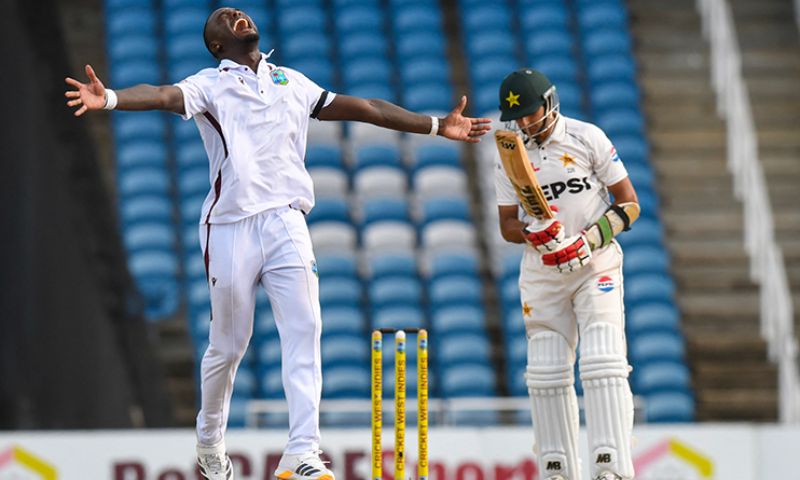



PORT OF SPAIN, Trinidad and Tobago: Pakistan will take on West Indies in the second Test of a two-match series starting August 2 at the Queen’s Park Oval, with the visitors desperate to break a grim streak of eight consecutive away defeats and keep their series hopes alive with a draw in the longest format.
As the Pakistan team took to the Queen’s Park Oval for an optional training session on Thursday, the weight of an unwanted record hung heavy over their shoulders: eight consecutive away Test defeats, the worst slump in the nation’s proud cricketing history.
Skipper Roston Chase eyes more glory for the West Indies as they brace for the #WTC27 series decider against Pakistan 🙌https://t.co/xLR39Vr0F6
— ICC (@ICC) August 1, 2026
Now, with the second Test against West Indies just a day away and their trump card Shan Masood sidelined with a broken finger, the visitors face a selection dilemma that could define not just this series but the direction of Pakistan’s red-ball future.
The 90-run defeat in Tarouba was Pakistan’s eighth straight loss on foreign soil, a statistic that has sent shockwaves through the cricketing world and raised urgent questions about the team’s composition, strategy, and mindset.
Despite the selectors’ pre-tour overhaul, reappointing Babar Azam as Test captain and revamping the bowling attack, the results have remained stubbornly unchanged. Now, with the series on the line at Port of Spain starting August 2, Pakistan must get their combination right or face an embarrassing series defeat.
🚨WEST INDIES PLAN TO TEST PAKISTAN🚨
– The hosts are expected to prepare a bowler-friendly surface aimed at making Pakistan’s task much tougher in the Second Test. pic.twitter.com/dwQevPEwmO
— Talha Nawaz (@TalhaDigital007) August 1, 2026
Shan Masood void: Experience vs. opportunity
The forced absence of Shan Masood, who suffered a broken index finger in the first Test, has opened a contentious debate over who should walk out at No. 3. Pakistan’s squad boasts two experienced candidates in Abdullah Shafique and Saud Shakeel, both of whom participated in Thursday’s training session after being called up as replacements.
The uncapped Awais Zafar also looms as a wildcard option, but with the series at stake, Pakistan are unlikely to hand a debut to the middle-order batter.
The catch, however, is that neither Shafique nor Shakeel has ever batted at No. 3 in Test cricket. Pakistan’s preference would be to keep Babar Azam at his favoured No. 4 position, where he averages a stellar 50.09, freeing up Shafique to occupy the vacant slot. Shafique’s experience as an opener could prove invaluable against the Dukes ball in challenging conditions.
Alternatively, Pakistan could push either Imam-ul-Haq or Azan Awais, the openers from the first Test, up to No. 3, with Shafique returning to open. But neither Imam nor Awais has batted at three before, making it a gamble.
A third option would see Babar remain at three, where he scored an unbeaten half-century in the second innings at Tarouba, potentially allowing Shakeel to return to the middle order or Zafar to make his debut.
Batting Depth or Bowling Firepower?
Pakistan’s surprising decision to field only six specialist batters in the first Test backfired spectacularly. Aamer Jamal, brought in as an all-rounder to provide balance at No. 7, managed just two wickets across both innings and contributed a duck and three runs with the bat. The experiment failed, and Pakistan may now retreat to their traditional formula of seven batters and four bowlers.
Pakistan Test squad held a full practice session at the Queen’s Park Cricket Club in Trinidad & Tobago ahead of the second Test against West Indies!
All players took part in the session, Under the supervision of the coaches, the squad completed batting and bowling drills in the… pic.twitter.com/xQXozYDYPN
— Muhammad Areeb Uddin Sheikh Areeb Cricket World (@areeb_7official) July 31, 2026
Such a move would accommodate both Shafique and Shakeel, with a top seven potentially reading: Awais, Imam, Shafique, Babar, Mohammad Rizwan, Shakeel, and Salman Ali Agha. This would provide the batting depth that was sorely missing in Tarouba and allow Pakistan’s fragile middle order to breathe easier.
Read Also: Past Glory, Present Uncertainty: Pakistan and West Indies Renew a Classic Test Rivalry
Ubaid Shah question: Pace as a point of difference
Perhaps the most tantalising selection dilemma revolves around young Ubaid Shah, the youngest brother of pace sensations Naseem and Hunain Shah. The 20-year-old earned his maiden call-up on the back of his express pace, consistently hitting the 140kph mark, a commodity Pakistan’s one-dimensional seam attack sorely lacks.
The average pace of Pakistan’s fast bowlers in the first Test was a modest 128.4kph, compared to West Indies’ 132.3kph. With the Queen’s Park Oval expected to offer similar seam-friendly conditions to Tarouba, Pakistan may be tempted to inject Ubaid’s raw speed into the attack. His inclusion would provide a point of difference alongside the line-and-length offerings of Mohammad Abbas, Khurram Shahzad, and Mohammad Ali.
What changes should Pakistan make ahead of tomorrow’s second Test against West Indies?
Let us know your thoughts in the comments below! 👇🇵🇰🏏#TOKSports #PAKvWI #PakistanCricket #WIvPAK #WTC27 #TestCricket pic.twitter.com/fAkBmqAXjj
— TOK Sports (@TOKSports021) August 1, 2026
However, bringing in Ubaid would likely mean dropping Jamal, leaving Pakistan with an all-pace attack and their batting extending only until No. 7. Babar would then have to rely on Salman Ali Agha’s part-time spin when needed, a risky proposition on a pitch that may offer turn as the match progresses.
Spin conundrum: Stick or twist?
Spin played a negligible role in the first Test, with Ali Usman and Jomel Warrican bowling just 11% of the total overs across four days. Remarkably, all 40 wickets fell to pacers, only the sixth such instance in Test cricket’s 150-year history. If conditions at Queen’s Park mirror those of the Brian Lara Cricket Academy, Pakistan may consider dropping Usman altogether.
But if Pakistan anticipate the pitch breaking up and offering turn, they could not only retain Usman but also strengthen their spin arsenal by including offspinner Sajid Khan, who is also a handy lower-order batter. Sajid’s inclusion could be particularly effective against West Indies’ right-handed-heavy batting line-up, especially if footmarks created by Pakistan’s left-arm pacers provide turn outside the off-stump channel.
Read Also: Pakistan Fold for 120 as West Indies Win Test Series Opener
The verdict: Pakistan’s moment of truth
Pakistan’s optional training session was just the beginning. One thing is certain: with the series hanging in the balance, Pakistan cannot afford another selection misstep.
The ghosts of eight consecutive away defeats haunt this team. But as Sarfaraz Ahmed controversially noted about the decision not to play a frontline spinner in the first Test, “We read the pitch correctly.” Whether that confidence translates into smarter selections for the second Test remains to be seen.
Come Sunday, when the first ball is bowled at Queen’s Park Oval, Pakistan’s XI will reveal not just their tactical approach but their resolve to halt a slide that has become Pakistan’s longest losing streak away from home. The question is no longer just about who replaces Masood, it is about whether this team can finally find the winning combination.