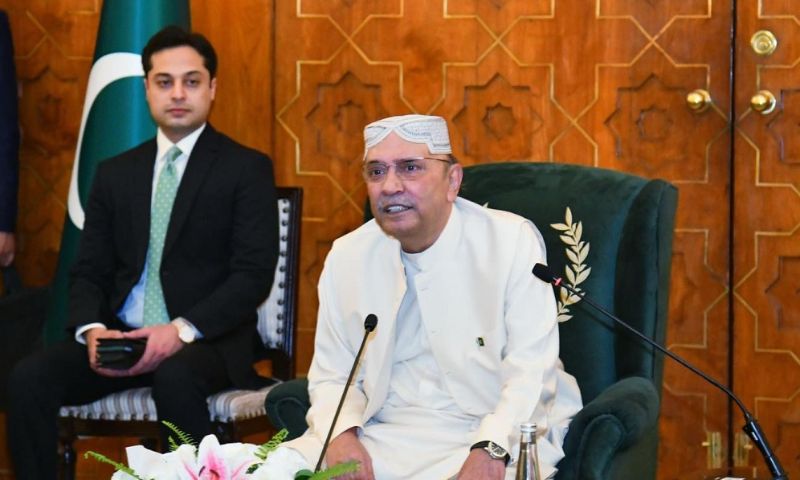



ISLAMABAD: Pakistan’s President Asif Ali Zardari has warned that Afghanistan under the Taliban has descended into conditions “similar to or worse than pre-9/11”, accusing neighbouring countries, including India, of enabling terrorist groups amid recent attacks in Islamabad’s imambargah and Balochistan.
The president expressed gratitude to world leaders and international organisations for their solidarity following Friday’s bombing at an imambargah in the federal capital, which martyred at least 31 people during Friday prayer, as well as coordinated assaults in several cities and towns across south-western Balochistan.
In a statement on Sunday, Zardari emphasized that terrorist organisations operating from Afghan soil posed serious threats to regional and global peace, urging collective international action to counter militancy and violent ideology.
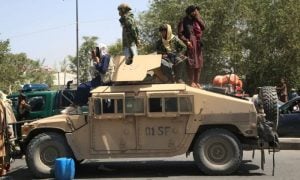
He said Pakistan takes strong exception to the situation in Afghanistan where the Taliban regime has created conditions similar to or worse than pre-9/11, when terror organisations posed threats to global peace, ending in the 9/11 tragedy.
The president underlined that terrorism cannot be tackled by any single country alone, stressing that when terrorist groups are given space, facilitation, or impunity beyond national borders, innocent civilians bear the consequences.
Within this context, Zardari accused certain neighbouring countries of “regrettably becoming partners in crime” by allowing terrorist elements to operate against Pakistan from their territory, while some provided direct financial, technical, and military support.
“This is a reality that has shaped regional developments in recent years,” he said. He specifically accused Pakistan’s eastern neighbour of assisting the Taliban regime and threatening not only Pakistan but also regional and global peace.
Zardari thanked world leaders, governments, and international organisations for standing with Pakistan during this moment of national grief. “Pakistan is humbled by the strong and sincere outpouring of support and solidarity,” he added.
He noted that messages of sympathy have provided comfort to the people of Pakistan and strength to families mourning their loved ones.
He said the international response reaffirmed that the fight against terrorism and its violent ideology is a shared global responsibility and a common struggle for all nations.
He reiterated Pakistan’s commitment to work with international partners to achieve peace and stability, aiming to decisively end terrorism in all its forms.
According to The Express Tribune, Zardari also reiterated Islamabad’s longstanding position that Afghan territory has repeatedly been used by terrorist groups to launch attacks inside Pakistan, targeting both civilians and security personnel.
The September 11, 2001, attacks carried out by Al Qaeda, which claimed nearly 3,000 lives, reshaped global security policies—a comparison Zardari invoked to highlight the growing dangers emanating from Afghanistan.
As investigations into the Islamabad bombing continue, authorities have tightened security across major cities, while intelligence agencies pursue leads linked to cross-border facilitation.
Zardari concluded by emphasizing that the international solidarity shown has strengthened Pakistan’s determination to confront terrorism, expressing deep gratitude for the compassion extended during this difficult hour.
Political experts say Zardari’s warning underscores the persistent cross-border nature of terrorism in the region, highlighting the urgent need for coordinated international strategies.
Analysts warn that Afghanistan’s instability threatens not only Pakistan’s security but also regional and global peace.
They emphasize that tackling militancy effectively requires enhanced intelligence-sharing, strict financial oversight, and coordinated diplomatic pressure on countries that may provide support to extremist groups.