
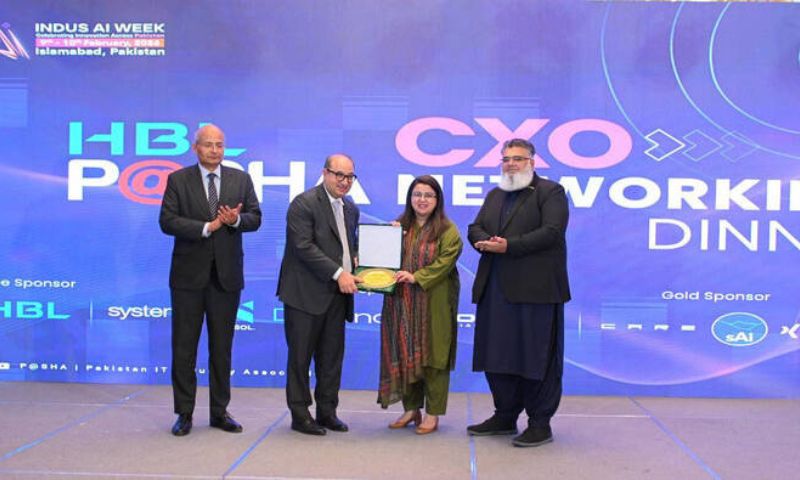



ISLAMABAD: As the region’s two major artificial intelligence events unfolded, a stark contrast was witnessed. Organisational setbacks and public apologies marred India’s AI Summit, while Pakistan’s Indus AI Week distinguished itself through seamless execution and strong operational discipline.
One struggled with crowd control and logistics; the other demonstrated command, coordination, and strategic clarity.
The comparison highlights not just two events, but two very different approaches to planning, management, and delivery.
Indus AI Week 2026 was a complete success, reflecting the Pakistan government’s commitment to integrating advanced technology into the national framework.
During the event, there were no evacuation headlines, no reports of stranded students, and no technical breakdowns overshadowing the agenda.
Also, there were no public apologies, and no viral complaints diverted attention. Instead of founders tweeting about missing hardware, they were engaging in meaningful dialogue.
Sessions began on time, delegates moved in smoothly, and speakers delivered their insights without interruption.
Conversations focused on innovation, collaboration, and policy. In the end, the spotlight never shifted from what truly mattered — AI.
While the India AI Summit was widely viewed as a failure, the disruptions and public apologies exposed serious gaps in planning, coordination, and crisis management — raising questions about the organisers’ ability to manage a large-scale international technology event.
Students with valid registrations were denied entry at the event and despite people queued from 7 AM, the gates were suddenly shut, and booths were evacuated mid-day.
Another major setback at the summit was the reported failure of internet services, a critical infrastructure component for any technology-focused event, particularly one centered on artificial intelligence.
The disruption not only affected live demonstrations and presentations but also undermined the event’s credibility as a platform for digital innovation.
Compounding the situation were allegations that startup equipment went missing inside what was described as a high-security venue.
These incidents raised serious concerns about logistical preparedness, oversight, and security management, further intensifying criticism of the summit’s overall organisation.
The situation escalated to the point that India’s IT Minister issued a public apology on the second day of the summit, acknowledging the disruptions and organisational shortcomings.
An embarrassing moment came at the event when an Indian professor claimed that a robot dog displayed at the summit was developed by her university, while the silver mechanical dog is manufactured by Chinese robotics startup Unitree Robotics.
The robot was exhibited at a booth run by Galgotias University during the Summit, bringing shame for New Delhi.
Later, in a statement posted on the social media platform X, Galgotias University clarified that it had not built the robot.
The opposition Indian National Congress criticised the government over the incident, linking it to Prime Minister Narendra Modi, who is hosting nearly 20 world leaders and numerous national delegations at the five-day summit.
In a post on X, the party alleged that “Chinese robots are being displayed as our own,” calling the situation “truly embarrassing for India” and describing it as “brazenly shameless.”
As frustrations mounted, social media platforms quickly filled with criticism from attendees, startups, and observers, amplifying the negative attention. Instead of highlighting innovation, research, and policy discussions, the narrative shifted toward logistical failures and crisis management at the India AI summit.
The focus moved away from artificial intelligence itself, as operational missteps became the dominant story.
In contrast, Pakistan’s Indus AI Week projected a different narrative — one defined by preparation, precision, and performance. While India struggled with crowd control, Pakistan demonstrated control of complexity.
While others focused on optics, Pakistan focused on operations. And while apologies dominated headlines elsewhere, execution defined the outcome in Pakistan.
The comparison ultimately underscored a broader point: successful technology leadership is not just about ambition or scale, but about disciplined planning, coordinated delivery, and the ability to let innovation — not logistics — take center stage.