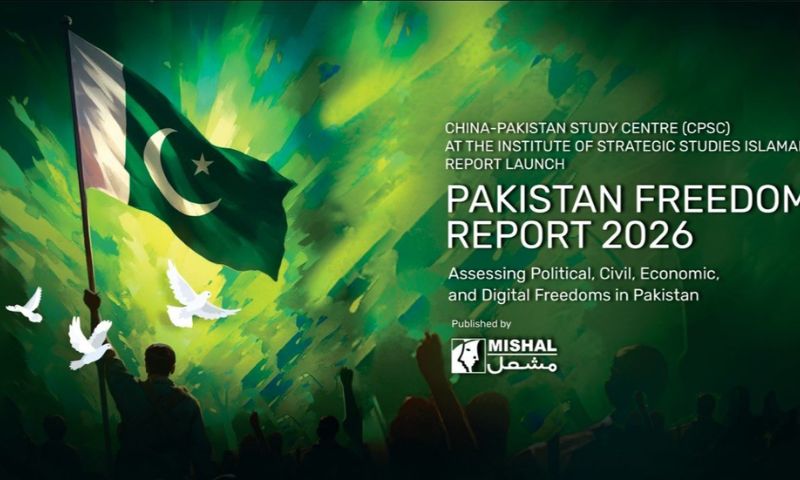
ISLAMABAD: Pakistan on Monday unveiled its first-ever State of Freedom Report – Pakistan 2026, a landmark study aimed at providing an evidence-based assessment of freedoms, governance and public trust across the country.
The report, prepared by Mishal Pakistan, the World Economic Forum’s country partner institute in Pakistan, seeks to establish a national benchmark for evaluating political, civil, economic, digital and social freedoms, as well as institutional performance and citizen empowerment.
The report was launched at the Institute of Strategic Studies Islamabad (ISSI) in collaboration with the China-Pakistan Study Centre (CPSC). The event was attended by senior government officials, parliamentarians, diplomats, academics, media professionals, civil society representatives and policy experts. Minister of State for Law and Justice Barrister Aqeel Malik attended as the chief guest.
Addressing the gathering, Dr Talat Shabbir, Director of the China-Pakistan Study Centre at ISSI, underscored the importance of evidence-based research in shaping public policy and promoting national dialogue on governance and citizens’ rights.
Ambassador Khalid Mahmood, Chairman of the Board of Governors at ISSI, said understanding public perceptions was essential for strengthening institutions and improving governance outcomes.
According to the report, this is the country’s first comprehensive effort to assess freedom across six key areas: political freedom, civil liberties, rule of law and access to justice, economic freedom, digital freedom and access to information, and social inclusion, gender and public trust.
The findings are based on constitutional and legal analysis, institutional indicators, international comparisons, expert consultations and a nationwide Freedom Perception and TRUST Survey involving around 2,000 respondents.
Public perceptions
The report presents a mixed picture of Pakistan’s freedom landscape, pointing to progress in several sectors while highlighting challenges that require policy attention.
Among its findings, 77 per cent of respondents said citizens were free to choose their profession and occupation, while 75 per cent believed businesses could function without excessive government interference.
Three-quarters of respondents also expressed positive views regarding women’s opportunities and empowerment, and 65 per cent reported favourable perceptions of religious freedom and constitutional protections.
At the same time, 62 per cent of participants believed ordinary citizens had limited influence over government decision-making, while 58 per cent expressed concerns regarding their economic security and financial well-being.
More than half, or 55 per cent, raised concerns over access to impartial and unbiased information. The survey further found that 69 per cent of respondents favoured long-term national planning extending beyond five years.
Growing digital landscape
The report highlighted Pakistan’s expanding digital ecosystem, noting that the country has more than 190 million cellular subscriptions, between 140 and 150 million broadband users and around 70 million active social media users.
It said Pakistan’s information technology and freelance exports now exceed $3 billion annually, creating new opportunities for economic participation and digital empowerment.
Social media and digital platforms have increasingly become the primary sources of information. According to the survey, Facebook was identified as the main source of information by 24.8 per cent of respondents, followed by WhatsApp at 19.9 per cent. Websites and online news portals accounted for 18 per cent, while X and television each stood at 15 per cent.
The report also drew attention to digital governance issues, noting that Pakistan submitted more than 15,000 requests to major global platforms concerning cybercrime, hate speech, misinformation, extremist content and unlawful online activity. Public transparency reports showed that nearly 46 per cent of these requests resulted in enforcement actions, including restrictions or removal of content.
It further noted that Pakistan possesses one of the region’s most diverse media environments, with more than 120 licensed television channels, hundreds of newspapers and a rapidly expanding digital media sector.
Social inclusion and justice challenges
On social inclusion, the report noted that women currently account for approximately 20 to 25 per cent of the labour force, compared with 65 to 68 per cent participation among men. Nevertheless, survey findings indicated strong public support for expanding opportunities for women, young people and marginalised communities.
The report also highlighted structural issues within the justice system. It stated that Pakistani courts are dealing with more than 2.2 million pending cases, while prison populations exceed 102,000 inmates, underscoring the need for reforms aimed at improving access to justice and strengthening confidence in legal institutions.
The study identified climate change, water scarcity, cyber threats, misinformation, rapid urbanisation, youth unemployment and widening economic inequality among the challenges likely to influence Pakistan’s future freedom landscape.
Speaking at the launch ceremony, Barrister Aqeel Malik welcomed the publication and stressed the importance of evidence-based policymaking and institutional accountability.
“Freedom is strengthened when citizens feel heard, institutions remain accountable, and policymaking is informed by evidence. This report is an important contribution toward that national objective,” he said.
The minister said Pakistan’s constitutional framework provided extensive protections for fundamental rights and that ongoing reforms aimed to improve access to justice, transparency and citizen participation.
Amir Jahangir, chief executive officer of Mishal Pakistan and co-author of the report, described the publication as a historic milestone. “For decades, Pakistan has largely been assessed through external indices and international reports. The State of Freedom Report represents Pakistan’s first indigenous, evidence-based effort to understand freedoms through our own constitutional, institutional, economic and societal realities,” he said.
Co-author Puruesh Chaudhary, President of AGAHI, said freedom should be viewed in terms of dignity, opportunity, inclusion and trust. “Citizens increasingly associate freedom with political empowerment, economic opportunity, digital access, institutional fairness, security and social inclusion,” she said.
Meanwhile, Shafique Chaudhry, Executive Director of the Parliamentarians Commission for Human Rights, said freedoms should be assessed not only through constitutional guarantees but also through citizens’ everyday experiences and institutional effectiveness.